Friday, March 4, 2011

More Squirrels Playing Cards

9 out of 10 squirrels prefer cribbage. It's just a fact.
You can keep your "Dogs Playing Poker" paintings. I have something much better: taxidermy squirrels playing cards. I posted one with the site update earlier today, but I thought I'd roll out the rest of them here.

I'm not sure where they all come from. In my journeys around the internet I just save any weird gaming photos I happen to stumble upon. Some of them (such as the one at the top) are the work of Walter Potter, Victorian taxidermy's mad genius. And some are just the work of people with too damn much time on their hands.

Interesting fact: every tableaux includes a smoking squirrel. And most of them also have at least one kibitzer. See if you can find the tableaux where it appears as though one squirrel has bet his own tail. That's just hardcore.

from the National Museum of Play

Peaceable Kingdom: Stoat (?), Fox, Rabbit, and Cat. (The fox is cheating.)

"You gotta know when to hold 'em, know when to fold 'em..."


Site Changes (Plus Squirrels)

I've been fiddling with the site for the past week or so, with a new header and some added boxes & such.

For those of you who find this kind of post boring, here's a picture of squirrels playing cards.


For the rest of you, here's the rundown:

  • Game Blog Feeds. This display the top posts from gaming blogs that I think are worth a regular visit, like Dice Hate Me or Purple Pawn. You'll find Seize Your Turn's weekly linkapalooza there, as well as other regular updates.
  • Other Links. I'm not planning to create an encyclopedic set of links to gaming resources, but these are places I think are worthwhile.
  • My Twitter Feed. I'm still not all that great with the Twitter thing, but I'm getting used to it. It's best just to Follow me on Twitter, but I've also included a feed update in the sidebar.
  • Gaming Twitter Feed. This one is for my gaming Twitter list, and includes Twits that I follow. If you'd like to be a Twit, send me a message.
  • Donation Button. Yes, I've become shameless enough to start requesting donations. It's all nice and secure via Paypal, and helps keep me from standing on the grassy median holding a cardboard sign that says "Will Game For Food." The recession has bit deep into our household, so anything helps.
  • Facebook Button. Do you like me? Do you really like me? Then hit the brand new Facebook button on the sidebar.


Wednesday, March 2, 2011

iPad 2

You knew it was coming. Here's the news from today's Apple press event:

The iPad 2 will ship March 11 in the US.

It's lighter and 33% thinner.

It has a new dual-core processor that runs twice as fast as the old one, and a new graphics processor that's 9-times as fast.

It also finally has cameras front and back, a nifty flexible magnetic cover, and HDMI video output. They're calling it a complete redesign.

The prices will all remain the same: $500 to $850.

There will certainly be more information available as the day goes on.

Scrabble Ascendant

According to the New York Times, the proliferation of word games on Facebook and mobile platforms is driving a new renaissance for Scrabble-style gaming. The prime movers are Words With Friends (now owned by the demonstrably evil Zynga) and various adaptations of Scrabble itself.

More interesting is the information that digital sales are driving conventional sales, with 4 million Scrabble sets sold in 2010 alone. According to Hasbro, this represents a 100% increase over a five-year period. And, yes, it's because of apps.

h/t: Erik Arneson

A Closer Look: French Tarot: Trumps 7 & 8

Many people are familiar with the standard Tarot suits (the "Major Arcana") used for "divination" purposes, but they're less aware that Tarot cards were created for playing trick-taking games and have a rich and diverse design history. These images are part of an ongoing series highlighting the art of a single deck used in France, which contains scenes of rural and domestic life in the 19th century.

Click to enlarge

Trump No. 7 (Detail)

Click to enlarge


Trump No. 8 (Detail)

U.S. Representative Rush Holt (NJ) Defeats Watson

Apparently IBM's Jeopardy-playing computer can indeed be defeated, and by a congressman no less.

Rep. Rush Holt of New Jersey, former Assistant Director of the Princeton Plasma Physics Laboratory, was a Jeopardy winner 35 years ago when the show was in its initial run. Watson was pitted against several congressmen in promotional match in a Washington hotel, but Holt, who holds a PhD in Physics, was the only winner. The exhibition was a chance for IBM to promote potential government applications of their technology, and for politicians to promote the value of science education.

Holt was my Representative when I lived in his district. No, I didn't vote for him, but he always seemed like a decent guy, and we used to live in the same town. He's also the answer the Jeopardy question: "Who is the only Quaker currently serving in Congress?" (Quick: Which U.S. Presidents were Quakers?)

I promise this is my last Watson post. Until the next one.

Tuesday, March 1, 2011

Be a Mathlete: World Math(s) Day

March 1st is World Maths Day according to The International Committee for Proclaiming Days for Things.

Actually, this one is proclaimed and run by an Australian e-learning company, but it seems to have caught on and the competition raises money for schools (which is good) and UNICEF (meh). You can tell it's not American because they call it "maths" rather than "math."

(Why do the Brits say "maths"? Because  the word is a contraction of "mathematics," which is a plural. Thus, technically, the contraction should also be plural. That may appear to make perfect sense, but since we won the Battle of Yorktown and they didn't, we're right.)

Anyway, back to World Math Day. Over 5 million kids from 218 countries are taking part in a 60-second math challenge by logging in to worldmathsday.com and answering a series of addition, subtraction, multiplication, and division problems. That makes it the biggest multiplayer session of the day.

Monday, February 28, 2011

Godzilla: Kaiju World Wars (Toy Vault)


Toy Vault has released some more shots from their upcoming Godzilla game, designed by the great wargamer designer Richard Berg. (Not to be confused with Richard Borg, creator of Memoir '44, Battle Cry, and others). It should be out some time this spring.

Players pick a monster and defend against military attacks and other monsters while stomping buildings and terrain. It comes with 4 painted 2 3/8 inch plastic monster figures, 90 stackable plastic tiles for building skyscrapers, four individual monster playmats, 86 terrain and power tokens, and much more.


REVIEW: Dead Space 2

Electronic Arts
Platforms: Xbox 360, PC, PlayStation 3
Price: $60
Rated: Mature


Content descriptors: Blood and Gore, Intense Violence, Strong Language


ESRB Rating Summary: This is a third-person action game in which players assume the role of an engineer (Isaac Clarke) who must fight his way through hordes of aliens aboard a space station. Players use futuristic weapons (e.g., plasma guns, flamethrowers, electrified spikes) to kill a variety of mutated creatures—attacks generally result in cries of pain, dismemberment, and large spurts of blood. Some cutscenes depict close-up views of characters getting stabbed in the face by blades and needle instruments. Several environments depict mutilated bodies, as well as blood-splattered floors, walls, and ceilings. The words 'f**k' and 'sh*t' can be heard in the dialogue.

I've already smacked around EA for their childish "Your Mom Hates This" Dead Space 2 ad campaign. I guess they assumed there was some need to gin up a fake controversy to get this one on people's radar. Frankly, though, the first game was pretty popular, the sequel was generating good buzz, and there was already a lot of anticipation. 

And really, the game stands on its own merits, even if those merits are completely, undeniably, and inescapably gross. The core combat mechanic is based on dismembering mutants and killing them with their own limbs. Blood sprays, flesh flies, bones crunch, and icky-gooey sounds crowd the soundtrack. At some point, not too far into the game, the sheer excess of it all tips over into high camp, like the Black Knight in Monty Python and the Holy Grail spouting streams of blood from his severed arm sockets.

There is a point at which gore ceases to scare or even horrify and simply creates a kind of giddy-nervous reaction. Think of the fire hose of blood in Evil Dead 2. Dead Space 2 manages to work both sides of the line, mixing bursts of absurdly over-the-top-violence with some genuine scares, a bit of psychological terror, and sustained tension. It is not a mix that will appeal to everyone, and it is most certainly not for children or even teens, but it is a well-crafted horror/sci-fi romp.

The Return of Isaac Clarke
You play as Isaac Clarke, an engineer who finds himself on a disabled mining ship populated by “necromorphs.” The result of some kind of alien virus, these necromorphs are a kind mutant alien/human hybrid, and the mutations move at a rapid pace. Since their physical structure is stretched out of place, it’s hard to know just where to shoot them. In fact, conventional weapons don’t work all that well, since many of the mutants can function just fine without a head. If one part of a creature is damaged, it may just attack with another, or it may sprout a new limb, or simply dissolve into a swarm of smaller, nastier creatures.

Thus, the Dead Space games are based on the idea of “strategic dismemberment.” You have to take the necromorphs apart piece by piece, and different critters require different kinds of dismemberment strategies. Since Isaac is an engineer, his weapons are almost all some kind of practical tool, like a plasma cutter or a rotating saw. New weapons can be purchased along the way, and upgraded at various work benches. The result is a heavily-customized set of weapons/tools specially crafted for an individual gamer’s fighting style.

Isaac also has the ability to pull objects and then fling them back. This creates one of the signature attacks of the series: cutting off a creature’s limb, pulling it towards you, and then shooting it back. Successfully executed, it’s an oddly satisfying move.

The original Dead Space was a tense, claustrophobic third-person action game. Dead Space 2 ramps up just about everything, largely dispensing with the quieter moments and tension in favor of an all-out action assault. The first game centered on a strange alien artifact called “The Marker,” which is a sacred relic to a religious cult called the Church of Unitology. The Marker is connected to the alien hive mind that controls the necromorphs, and the first game ends with Clarke returning the Marker in an attempt to stop the attacks.

Dead Space 2 picks up three years after the events of the first game. Clarke awakens in a hospital on the Sprawl, a huge urban development on one of Saturn’s moons. He has spent the last 3 years in an induced coma, and wakes to find the Sprawl overrun by necromorphs. The fight begins all over again, but this time on a much grander scale. The more spacious location, persistent hints of the horrors that caused the present problems, various narrative threads, and the use of recordings and journals to fill in the story are all techniques reminiscent of Bioshock, although without the extra layer of intellectual depth.

There’s certainly more heft to Dead Space this time around. The character of Isaac Clarke—who was silent in the original game—is significantly fleshed out in the sequel. The game spends a good amount of time with Isaac struggling to retain his equilibrium in the face of betrayal, guilt, emotional scars, and terrifying hallucinations. The narrative itself manages a few interesting turns, but none of them is particularly surprising. Instead, we have a game that plays like a funhouse ride, with periods of mounting tension punctuation by incredible (and fairly challenging) acting sequences.

Mutliplayer
DS2 also expands the world with a bit of multiplayer, and although the offerings are slim they’re satisfying. First, the negative: you’ll need an account and online pass for multiplayer. The pass is free if you bought the game new, but the process is a bit annoying. If you’ve bought the game used or merely borrowed it, there’s a one-time, $15 fee for playing online. Let’s hope it’s not a sign of things to come.

The multiplayer comes with 5 maps for teams of 4 humans against 4 necromorphs. Maps are objective-oriented, with the humans tasked with running to various waypoints to accomplish specific tasks while necromorphs try to the prevent them. Humans play as a character similar to Isaac Clarke, which means the real treat is the addition of player-controlled necromorphs.

There are 4 different types of playable alien. The Pack is small and fast, the Puker has a flailing attack and vomits a substance that slows you down, the Lurker can walk on walls and fire projectiles, and the Spitter is your basic melee fighter. Their sole goal in multiplayer games it to slow humans down long enough so they can’t accomplish their objectives. Players trade off roles: one attacked (humans) and one defender (alien). It’s a nice mix similar to that found in a semi-obscure action game called The Singularity.

Verdict
This is an adult game and is rated as such. Children not only shouldn't be playing it, they probably shouldn't even be within a 100 yards of anyone else who is playing it. It's pure survival-horror, and it works on a number of levels, delivering funhouse shocks, straight gore, intense action, moments of suspense, and even a touch of psychological horror. And blood. Oh yes indeed: plenty of blood.


Friday, February 25, 2011

REVIEW: Stone Age (Rio Grande Games)

Rio Grande Games
2-4 players
ages 10+
60-90 minutes
$45
Originally released: 2008
Designed by Michael Tummelhofer

The conversation went something like this:

ME: I got a new game and we're going to try it out tonight. It's called Stone Age.
FAMILY: Yippee! Sounds good! Battling cavemen! Wooly mammoths!
ME: Well, no, not really. Actually, it's what's called a worker placement game.
FAMILY: [blank stares]
ME: No, really, it's a great kind of game. You have little guys and they're, um, your workers, and you place them on the board and collect stuff, and then, well ... you place them again, but maybe in different locations on the board to get different kinds of stuff.
FAMILY: [uncomfortable glances at each other]
CHILD A: Placing workers is not fun. It's not even a game.
ME: Oh, yes! It's a very rich class of game! There's Agricola, and-
CHILD B: Can't we just play Dominion again?

Needless to say, we played Stone Age, much fun was had by all, and I learned a valuable lesson: never, ever use the phrase worker placement game among children or people who are not familiar with Eurogames. Seriously: kiss - of - death. Maybe call it something else, like a "Resource Acquisition Simulation".

In Brief
In Stone Age, players try to sustain and improve their tribe by gathering food and resources, adding new members, making tools, increasing their agricultural output, constructing buildings, and enhancing their civilization. This is done through a very simple mechanic that involves placing workers on certain spaces on the board and then resolving the actions for each of those spaces. Victory points are earned in several different ways, and the person with the highest number of victory points wins.

Components
This is the usual sturdy, well-crafted product from Rio Grande. The board condenses an immense amount of information into a limited space without making it seem crowded. There are 40 wooden people and 68 wooden resources (brick, wood, gold, and stone), as well as tiles for huts, food, and tools. The art is good and does a lot to extend the theme.

There's a lot of dice rolling in this game, so something really needs to be said about the Stone Age dice cup, a "leather" cup which is designed to look primitive. It is, without question, the worst-smelling game component in history. There may have been that one time when Sid Sackson dropped a copy of Acquire in his septic tank, but ... no, the Stone Age dice cup is worse. It smells like someone left a skinned polecat in a car on a 100-degree day with the windows up.

Gameplay
Stone Age is a hard game to summarize. Although it's fairly easy once your grasp the essentials, there are a lot of choices and resolutions for each turn. I'm just going to run through the basics.

You begin the game with a tribe of 5 workers, a bit of food, and a player board representing your village. People take turns placing these workers in specific locations on the main board. Each location yields some different result during the resolution phase. Some spaces have limited slots for workers, so people may be competing for a choice job during any given round. The locations break down like this:

The notorious Stone Age dice cup
  • Hunting grounds (any number of workers): Gather food, which is used to feed your tribe during the feeding phase.
  • Four different resource areas (up to 7 workers each): Gather wood, brick, stone, or gold, which is used to buy civilization cards and buildings.
  • Tool maker (1 worker): Make 1 tool. Tools are used to increase the total value of your dice rolls.
  • Hut (exactly 2 workers from a singe tribe): Add 1 worker to your tribe,
  • Field (1 worker): Move your marker 1 space up on the food track. This automatically gives you 1 extra food each turn.
  • Building tiles (1 worker per building tile): You pay for a building tile with resources, and then immediately add a certain amount of points to your total score. The building tile is moved to your player board. You can only buy 5 buildings in the course of the game, so plan wisely.
  • Civilization cards (4 cards are laid out on the board, and you can place 1 worker per card): Once a card is paid for, it is taken by the player and replaced from the stock. These cards provide two kinds of bonus during the final scoring phase. Cards with culture symbols (writing, healing, pottery, art, and music) are worth 5 points for each unique card, while cards depicting different kinds of workers will add multipliers. For instance, if you have civilization cards depicting a total of 5 tool makers, and you have 4 tools, you earn 20 victory points at the end of the game. 

Food and resources are calculated by rolling dice, with 1 die rolled for each one of your workers placed on that resource. For instance, if you have 4 workers on the hunting grounds, you roll 4 dice. The total value of these rolls is then divided by various numbers to determine the total yield. (Food rolls are divided by 2, wood by 3, brick by 4, stone by 5, and gold by 6.) Thus, a roll of 24 on a food space would give you 12 food, while a roll of 24 on a gold space would give you 4 gold.

Each turn is played in rounds. First, everyone takes turns placing workers, then everyone resolves their workers' actions, then everyone feeds their tribe from the store of food. Food is measured simply: 1 food for each member of your tribe. If you don't have enough good, then your start paying out resources or even losing victory points.

The game ends when 1 stack of building tiles is exhausted, or when you cannot fully replenish the civilization card layout. People calculate their final score, and the winner is the person with the most victory points.

Food tokens
Verdict
This is a great worker placement game. It's a bit easier than some, which makes it perfect for families, but there's still plenty of room for strategy and planning. There isn't a great deal of player interaction. Other players may take some spot you want, but other than that there is no trading or real competition, except for points.

There is a lot of dice rolling and simple math in the game, so if you fear the dice, you might want to give this one a pass.  (Seriously, though: don't fear the dice, people!)

Strategy comes from finding the right balance between sustaining and growing your tribe, and earning enough for the point-generating cards and tiles. It's very hard to judge who's winning at any given point, since cards can remain hidden until the final scoring phases. Someone lurking at a 100-point deficit can suddenly lap the track once they calculate all their multipliers.

This points up one weakness in the game: the score can go very high, but the track only goes up to 100 points. That means you will almost always lap the scoring track, sometimes more than once. There's no simple way to mark which pieces have lapped the track, unless you put a coin or chit under their markers. It's not a big issue, but it's something we had to account for.

The theme works well with the mechanics, but I imagine you could place this in any number of settings with few changes. It could just as easily be themed to Colonial America or Ancient China. The stone age setting adds some flavor, but it's not integral to the design.

The design, however, is quite strong, with everything coming together nicely. It's a colorful, entertaining take on worker placement.



Kasparov on Watson

In my post about the Jeopardy-winning supercomputer Watson, I remarked that Chess Grandmaster Garry Kasparov "wouldn't last five minutes against Ken Jennings." That was no slight against Kasparov, who may well be the finest player in the entire history of Chess, and is proving to be a charismatic political figure in post-Communist Russia. It's just that the skill set and knowledge base needed to succeed at Jeopardy is far more diverse and complex than that required to succeed at Chess.

Although Kasparov won his first match against IBM's Chess-playing computer Deep Blue, he lost the rematch, and didn't handle the loss very well. Obviously, he's thought quite a lot about the man-versus-machine contest in the ensuing years, and he offers some interesting comments about Watson in The Atlantic:
My concern about its utility, and I read they would like it to answer medical questions, is that Watson's performance reminded me of chess computers. They play fantastically well in maybe 90% of positions, but there is a selection of positions they do not understand at all. Worse, by definition they do not understand what they do not understand and so cannot avoid them. A strong human Jeopardy! player, or a human doctor, may get the answer wrong, but he is unlikely to make a huge blunder or category error—at least not without being aware of his own doubts. We are also good at judging our own level of certainty. A computer can simulate this by an artificial confidence measurement, but I would not like to be the patient who discovers the medical equivalent of answering "Toronto" in the "US Cities" category, as Watson did.
Read the whole thing.

h/t: My wife (again).

Playing With Your Food

I'm not really that big a fan of Angry Birds, but I love how it's creeping into so many corners of society. Here's a guy who made a playable--yet wholly edible--Angry Birds birthday cake.


And here are the instructions for how to make your own.

h/t: My wife.

Thursday, February 24, 2011

PUZZLE: Musical Letters

It's been a while since I posted a puzzle, so let's try some word playing.

Using just the musical notes--C D E F G A B--what is the longest word you can "play" on the piano? You can play the notes as many times as you like, but they have to a) make a single word and b) not require any letters but these seven.

There are multiple solutions.

Guitar Hero's Death Spiral

Joystiq charts the grisly toll following the death of the Guitar Hero franchise, and it's not a pretty picture. By the time the music game genre is finally laid to rest, the jobs lost actually may be in the thousands, once you add up development, marketing, and manufacturing.

In game development, it's not at all unusual to see cycles of hiring and firing. Companies swell with employees when they need to get a product out the door, and then sometimes shrink in the lull between its completion and the start of the next project.

Due to the size and rapid growth of the series, however, this is a bloodbath. The only Guitar Hero company with a real track-record is Neversoft (creators of the Spider-Man and Tony Hawk series), and they seem to have survived in some reduced form. Vicarious Visions also has some history, mostly working with Neversoft on ports and sequels, and it looks like they're going to survive as well.

On the positive side, a lot of people (including store owners, software developers, and factory workers) made a lot of money in a very short time. On the downside, it's left behind a sobering scene of wreckage that impacts real lives. These boom and bust cycles are the Gold Rush of the digital age.

Wednesday, February 23, 2011

Wrath of Ashardalon (Wizards of the Coast)

The new Dungeons & Dragons board game, Wrath of Ashardalon, is now available. This one slipped under my radar. Unlike its predecessor, Castle Ravenloft, it didn't seem to generate a lot of buzz, perhaps because it leans more towards fantasy than horror.

Like Castle Ravenloft, this looks like a chunky box full o' stuff for cooperative, boardgame-style adventuring. D&D purists seem to be turning up their noses at these, but my few sessions with Castle Ravenloft have provided a bit of that RPG flavor without the lengthy play, prep time, or need for a dungeon master. In other words: it's a way to play an RPG without it becoming an entire lifestyle.

This time, the Big Bad is a dragon rather than a vampire, and there seems to be a bit more complexity to the experience. The box is stuffed with plenty of dungeon tiles, hero and villain figures, cards, tokens, markers, and everything else a body needs to the D&D thing without a DM. It's listing for $65, and if I get a chance to look at it, I'll do a full review.


REVIEW: Funglish

Hasbro
$23
2+ players (the more the better)

I assume that Hasbro spends millions of dollars on R&D each year, and millions more on market research. Thus, it seems odd that they released a decent little party word game with that title that sounds like the word "fungus."

Despite the mushroomy name, it's still a lot of fun. Here's the gist: Funglish is charades with words. Not words you speak, mind you. Absolute silence on the part of the clue-giver is still required. The words are on little tiles, and you must assemble them on a frame in such a way that they describe a certain object, place, person, or phrase.

The game comes with 120 descriptive tiles, each bearing a single word. The tiles are divided into various types by color: black tiles are colors and patterns (green, striped, colorful), puke-green tiles are negative traits (evil, sour, ugly), gray are materials (wood, fabric, glass, etc), yellow are shapes (thin, wavy, round), blue are related to origin (such as African, fiction, British), red are states of being (manmade, living, dead), beige are general adjectives (scented, moving, liquid), orange are sets of antonyms (hot/cold, old/new, smooth/rough), and green are positive attributes (lovable, happy, glamorous).

The other components are fairly simple. There's a frame that allows you to set the tiles in place in one of three rows: "Definitely," "Kind of ," and "Not," as well as a set of cards with words, people, places, phrases, and various object to describe. These can range from "toast" and "silk" to "Led Zeppelin" and "Al Capone."

One person chooses a clue from the card, and then selects words that best describe it. The tiles are all laid out on a table, grouped by color to make it easier to assemble a description. Thus, if you pulled "honey," you might put "sticky" and "yummy" and "sweet" under "Definitely," "yellow" under "Sort of" (since honey is more gold than yellow, but there's no gold among the color choices), and "furry" under "Not." (If your honey is furry, it's probably time you cleaned out your pantry.) People then have to guess what the words describe, without any acting or verbal input from the clue-giver.

There's a timing element and a way to score points and determine a winner, but frankly the gameplay, win/lose aspect is a lot of hooey. This is less of a game and more of a social lubricant to get people thinking, talking, and laughing. As such, it's actually a lot of fun. The cards have some insane clues (How the heck do I describe Led Zeppelin with a random clutch of adjectives?), and always seems to lack just the word you need. I have a feeling that's on purpose, since a wider range of words might make it too easy to create very precise descriptions.

$23 seems a tad on the high side given what's in the box, and the components won't win any prizes. The tiles are thick and sturdy, but the frame likes to fall apart at random intervals. That said, it's a nice little word game that is quite a bit of fun with the right crowd. It gets people thinking in words, and helps them make interesting connections between words and the meaning they convey. I could also see it being an excellent addition to some classrooms.

Recession Buster Version!
In these troubling economic times, shelling out $23 for a party game just may not be in your budget. It is, however, relatively easy to make your own version of Funglish by printing words on card stock, or writing them on index cards. That way, you can also choose your own words and use different colors of paper for different classes of word. You won't get the frame, but since we've already determined that the frame is about as useful as a screen door on a submarine, I don't think you'll miss it much.

PS: The writer of this review wishes to confess that he tried to work the phrase "Fun Guy" into this piece. He is currently hanging his head in shame.

Tuesday, February 22, 2011

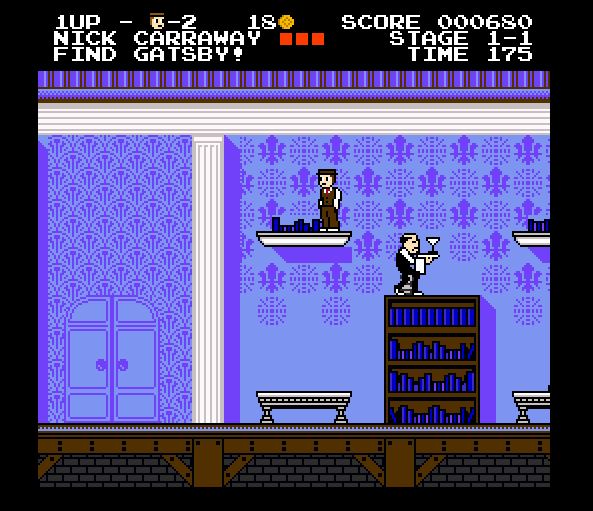
The Great Gatsby: The Long-Lost NES Game

Kotaku pointed me at a "lost" gem of the classic Nintendo Entertainment System days: the 8-bit adaptation of F. Scott Fitzgerald's The Great Gatsby.

Writer Michael McWhertor fills in the details of just how lead developer Charlie Hoey created a spoof of the iconic Great Gatsby cover art done in an 8-bit visual style. It was such a good idea they decided to turn the whole thing into a flash videogame done in the classic NES style, complete with a period advertisement and scans of the "real" insert for the original cartridge.

There's a certain mad genius in the game, a classic platformer in which Nick Carraway hops around Gatsby's mansion and other locations, collecting money and martinis while dodging flappers, Wilfred the butler, and other foes.


You can play the game online at GreatGatsbyGame.com. Can a version of Thomas Wolfe's Look Homeward, Angel, complete with avenging ghost of Ben Gant, be far behind?

A Closer Look: French Tarot: Trumps 5 & 6

Many people are familiar with the standard Tarot suits (the "Major Arcana") used for "divination" purposes, but they're less aware that Tarot cards were created for playing trick-taking games and have a rich and diverse design history. These images are part of an ongoing series highlighting the art of a single deck used in France.
Click to enlarge

Trump No. 5: Detail

Click to enlarge


Trump No. 6: Detail

Minecraft Documentary in the Works

2 Player Productions has created a 20 minute proof-of-concept video for a feature-length documentary on Minecraft and its creator, Markus Persson. It's a remarkable story--one man creates a genuine PC gaming phenomena--so it should make for a good show.

The filmmakers are trying to raise funds to finish Minecraft: The Story of Mojang, and they've created a Kickstarter page to get the ball rolling.

Here's how they describe it:

For the first time, viewers will be given an in-depth look at both the triumphs and the challenges faced by a studio during their first year in existence. We will analyze the unprecedented success of Minecraft, gain insight into its impact from journalists and industry professionals, and meet the fans whose lives have been changed by the game.

The video embed was cluttering up my site with a lot of autorunning ads, so just click on the widget or link to see the full excerpt.

Friday, February 18, 2011

Watson's Amazing Victory


Ken Jennings has written a wonderful piece for Slate about his experience playing against (and losing to) IBM's Jeopardy-playing supercomputer Watson.
But there's no shame in losing to silicon, I thought to myself as I greeted the (suddenly friendlier) team of IBM engineers after the match. After all, I don't have 2,880 processor cores and 15 terabytes of reference works at my disposal—nor can I buzz in with perfect timing whenever I know an answer. My puny human brain, just a few bucks worth of water, salts, and proteins, hung in there just fine against a jillion-dollar supercomputer.
I remember writing about Deep Blue and what its victory against Chess Grand Master Garry Kasparov meant for AI, and Watson is exponentially more impressive than Deep Blue. Kasparov wouldn't last five minutes against Ken Jennings. The skill set and programming necessary to master Jeopardy is far more subtle and complex and that required to master Chess, at least from a pure computer AI perspective.

The Singularity is Not Near
Impressive as it is, I still balk at the notion that this is the first step towards The Singularity, for the simple reason that I believe The Singularity is the greatest farrago of nonsense since the Population Bomb. Time Magazine recently ran a long, hilarious piece on The Singularity. I laughed all the way until the end, and then I realized that it wasn't satire, thus reminding me yet again that Time isn't so much a news magazine as it is a source of absurd trend-chasing and juvenile credulity wrapped in a squishy coating of bias.

Let me state this as clearly as possible: The Singularity--the moment at which computers essentially become sentient--is the greatest load of BS to come down the pike in many generations. That intelligent people believe it's All Really True! doesn't make it so. Aristotle, the most intelligent man of his age or almost any other, was certain that the blood cooled the brain and the liver was the true seat of human life. At one point, all the brightest minds in the world were utterly convinced in the truth of geocentricism. In our own day, powerful interests continue to flog the big lie of anthropogenic global warming. 

So, I don't care one bit that some of "the best and brightest" have signed on to Ray Kurzweil's loony idea that one day (in the next 40 years!) we will reverse engineer the human brain, dump our entire consciousness into a computer, and live forever. It is more likely that I could swallow my own torso than it is for a machine to replicate the human brain. I am not saying "maybe," or "perhaps eventually," or "given the right scientific developments": I am saying never, ever, ever: not in 40 years, not in a 1000.

This is all just part of the progressive's favorite delusion: that of the continued upward development of humanity, hand in hand with glorious technical achievement. This is utilitarian nonsense. First off, it's a failure to understand the practical reality of Moore's Law. The number of transistors on an integrated circuit may in fact keep doubling every two years until infinity (although I highly doubt it, and there is already some evidence that this will eventually peak and then decline), but that does not correlate to a matched increase in processing speeds. 

Second, it ignores the immense complexity of the human brain, and just how much of its function remains poorly understood if not downright inexplicable. Even the common process of medicating for mental illness remains a matter of trial and error because we simply don't know how the brain does much of what it does. The notion that the myriad complexities of the human psyche can be wholly reproduced if we just have enough processing power is madness.

Finally, there is the part many scientists leave out due to their own personal bias. I hate to break it to the atheists out there, but the human soul exists. We are not merely clever meat. We are simultaneously physical and metaphysical beings. The notion that we are the product of random chance, originating from nothing and returning to nothing, isn't even good nonsense. Ex nihilo nihil fit. The rational soul is transcendent, and will forever remain a mystery beyond the ability of science to grasp.
The Simulated Brain
Without question, we will see continued progress in artificial intelligence. Watson impresses not because of its 15 terabyte store of knowledge, but because of its ability to parse the English language, including puns, word play, allusions, and other very human subtleties of speech. Its knowledge set did not impress me: that's simply raw processing muscle. It's language ability, however, is frankly amazing. 

Yet with all that, IBM couldn't create a truly human voice. Watson won Jeopardy, but he still would have failed the Turing test. No one listening to its answers would be in doubt that they were hearing a computer. Watson is the Deep Blue of this generation, and as such is a fascinating and important milestone in the development of artificial intelligence. Where it will lead, I have no idea. Deep Blue was dismembered and mothballed, with a chunk of it ultimately winding up in the Smithsonian. 

And it's important--vitally important--to remember one thing. Watson did not create itself. It was created by a team of brilliant and dedicated people, pouring human knowledge into its brain and teaching it to think and learn in human ways. A machine can only be a simulation of the human brain, and no machine will ever be anything more than that. It will forever remain a mere shadow of the real thing.