Friday, April 8, 2011

More Religion Games

We can't let the Jews and the Catholics have all the fun this week, so I did a bit of digging around to see if other religions were doing the gaming thing.

Of course, I realize just saying "other" kind of makes it sound like I'm channeling Rev. Lovejoy from The Simpsons:
Rev. Lovejoy: No Homer, God didn't burn your house down, but he was working in the hearts of your friends be they Christian, Jew, or miscellaneous.
Apu: Hindu! There are seven hundred million of us!
Rev. Lovejoy: Aww, that's super.
Be that as it may, it's pretty easy to find games that are used as religious teaching tools, primarily for kids. These are your basic "scripture quote" and "heroes of the Bible" trivia games that Christian kids play at Summer Bible Camp. (Oddly enough, I went to a Jewish summer camp as the Token Catholic. It's a long story.) As games, they're fairly uninteresting, based on the bog-standard trivia two-step of 1) answer questions in order to 2) win the race to the finish. I got bored just typing that sentence.

For instance, there are a number of Islamic board games made by Goodword Books to teach Muslim children about various subjects. The Hadith Challenge Game and the Quran Challenge Game are designed to help with memorization of the religious texts. Pilgrimage is taught with the Hajj Fun Game, prayer with the Madinah Salat Fun Game, and mosque architecture with the Great Mosque Game. They all appear to be trivia games designed for use in religious education.

Mecca to Medina is another Muslim board game, and this one looks like it might have a little more substance. It doesn't require any specialized knowledge of Islam, and appears to be a trading and resource collection game with an Islamic theme, rather than a trivia game.

Buddhist board games follow a similar pattern. Buddhist Knowledge Quest, for example, is a straight-up Trivial Pursuit-style learning game.

I'd like to be able to tell you just what Karma Chakra is like, but I've read the instructions a couple of times and still not figured it out. The description makes it sound like a trivia game with perhaps a more complex racing mechanic. The goal is to "attain a rebirth as a Bodhisattva of the First Level (Great Joy) or at least a better rebirth than one’s current existence. There are no 'winners' or 'losers' in this game and whomever finishes first may not acquire the best rebirth. At the end of the game, players' Sonam points (merit) are totalled to see what kind of rebirth he/she managed to get."

By the way, Gautama Buddha didn't think much of games and toys, and left behind a list of games he would not play. This included "hitting a short stick with a long stick," "guessing at letters traced with the finger in the air or on a friend's back," and "imitating deformities"(?). Oh, and all board games.

Hindus seem to have a much wider range of game choices thanks to the efforts of Kreeda Games. Indian culture in general is remarkably rich and diverse, so this shouldn't come as a surprise. After all, they gave us chess, pachisi, and snakes and ladders.

"Kreeda" means "play" in Sanskrit, and the company evolved from a series of articles on traditional Indian games. People became interested in playing the games, but there were no pieces or boards available. So, the people who wrote the articles founded Kreeda to produce these classic games, as well as make some new ones based on traditional Hindu themes.

The results are fascinating historical recreations. Kalanay Belanay (Black Elephant White Elephant), for instance, appears to be a regional wari variant taught to the Kreeda staff by "a lady anxious to see the games she played as a child passed onto the next generation." That's the kind of cultural field work that we see all too rarely in gaming. (As I never get tired of saying, gaming is part of folklore and regional culture, just like music, storytelling, food, dress, and dance.)

Some of Kreeda's original games are more explicitly religious. They've created a trilogy of games based on the Hindu epic the Ramayana, and including Vanavaas (Adventures in the Forest), Search for Sita, and Battle of Lanka (The War Game). Kreeda describes Vanavaas this way:
In the Ramayana, Dasharatha, Rama.s father is forced by an old promise to send Rama, his eldest son away to the forest for fourteen years. Rama is accompanied by his wife Sita and brother, Lakshmana. In the forest they have many adventures and face many hardships. Vanavaas - The Adventures in the Forest lets you understand their experiences and brings you face to face with the demons they meet in the forest.
In the game, the footsteps are pictured as sandals - the old and traditional footwear worn by forest dwellers and rishis. The game is played with long dice which are the traditional dice in India.
This game begins with Rama and Lakshmana leaving Ayodhya and follows their adventures in the forest. The game takes you through the stay at Chitrakoot, Bharata.s encounter with Rama, the meeting with Shoorpanaka and the incident of the golden deer.
This blend of storytelling, traditional game techniques, history, and pedagogy sounds far more interesting than the usual "Who begat Abijah?"* trivia-race, and might serve as a good example to religious game designer who want to make more engaging games.  The full list of Kreeda games can be found here.

And thus ends the Unofficial Accidental Religion in Games Week here at State of Play. If you have any favorites that I missed, please feel free to add them in the comboxes. And I'll leave you off where I began: with The Simpsons:
Interviewer: Apu, there are rumors that you are a Hindu. Is this true?
Apu: By the many arms of Vishnu, I swear it is a lie!


*Rehoboam. 

Thursday, April 7, 2011

Clue + Passover = Chametz: The Search is On!


Designer: Jay Falk
Publisher: Hazahak Inc.
Players: 2-6
Ages: 7+
Time: 30 min.
Price: $30
Publication Date: available now


Colonel Moti is ready for Passover and has invited Rabbi Greenberg over for snacks (kosher, of course) and a Torah lesson. One of the guests, however, is wandering around the Colonel's house with some chametz: food that's not properly kosher for Passover. By searching the house (inspired by a Clue board) and answering trivia questions, the players narrow down the field of suspects and find the culprit

Chametz: The Search is On! is a rarity: a Jewish-themed boardgame. Featuring a blend of trivia and Clue-style mystery, it seems well-designed for players of various ages, with three levels of difficulty for each question. For instance, one of the sample cards reads:
  • True or False: The last step in the seder is prayer.
  • The last step in the seder is: A) Afikoman (dessert) B) Hallel (Psalms of praise) C) Nirtzah (pray G-d accepts the mitzvah)
  • [What is] the last step in the seder?
According to the story in JewishJournal.com, the game is "Shabbat-friendly — rather than keeping track of the culprits on a notepad, as in Clue, players slip markers into slots on cards. The Jewish characters and content are slightly unexpected — Rabbi Greenberg (“Clue” has Rev. Green) is clean-shaven, while Professor Slivovitz sports a long, gray beard and, according to the Web site, teaches endocrinology."

H/T: Purple Pawn


Wednesday, April 6, 2011

Who Is The Patron Saint of Gaming? UPDATED

St. Cajetan
Short answer: there is none.

However, searches for variations of that question bring a lot of people to this site, probably because of the sidebar picture of St. Balthasar, the Patron Saint of Playing Card Manufacturers.  Since I lecture on Church history and have a sizable collection of hagiographic reference material, I thought I'd sort it out so people don't go wandering all over the internet getting half-formed ideas about saints, patronage, gaming, and related subjects.

Since this is a long post about theological and historical subject matter, I'm going to place the text after the jump.

Funagain Games

State of Play is now part of the Funagain Games Affiliate program, which works the same way as the Amazon Affiliates program. If you shop at Funagain.com through one of my links, I get a small commission. There's a Funagain banner in the sidebar, and I'll start adding some Funagain.com links to the posts.

Funagain.com is the leading online retailer for boardgames and puzzles. They have a large selection and decent prices, and run good sales from time to time. The Spring 2011 sale is underway right now.

Funagain also has a game grant program for schools, libraries, community groups, and US military. Each month, they award $100 credit to a single group.

Tuesday, April 5, 2011

Find the Future at the NY Public Library

Jane McGonigal, game designer and author of Reality is Broken, has created a scavenger hunt/gaming event to kick off the centenary of the New York Public Library

On May 20th, 500 people will be locked into the library overnight for the "Write all Night" kickoff event. They will "explore the building’s 70 miles of stacks, and, using laptops and smartphones, follow clues to such treasures as the Library’s copy of the Declaration of Independence in Thomas Jefferson’s hand. After finding each object, players will write short, personal essays inspired by their quest—for example, how would they write the Declaration? Winning the game means writing a collaborative book based on these personal stories about the future, and this volume will be added to the Library’s collections."

On May 21st, other people will be able to participate online.

H/T: Scott Nicholson via Twitter

Troyes from Z-Man Games

Designers: Sebastien Dujardin, Xavier Georges, Alain Orban
Publisher: Z-Man
Players: 2-4
Ages: 12+
Time: 90 min.
Price: $55
Publication Date: April 2011


Z-Man will be publishing the US version of Troyes (published in Europe by Pearl Games) this month.

Medieval games always get my attention, but I'm looking forward to this one because of Troyes (pronounced "Trwah") and its important place in history. The Cathedral of St. Peter and St. Paul, which forms the major theme of this game, is one of the masterpieces of Gothic design. Begun in 1200 (which is the starting point for the game) it remains incomplete to this day. The city also has links to the founding of the Knights of the Temple of King Solomon, better known as the Knights Templar. Their founder, Hughes de Payens, was born nearby in the 11th century, and St. Bernard of Clairvaux created their rule and officially organized the group at the Council of Troyes in 1128-29.

Troyes is also important because of its connection Chrétien de Troyes, one of the greatest poets of the Middle Ages and the man responsible for a large chunk of the Arthurian legend, particularly the grail lore. The story of Sir Percival, the Fisher King, the bleeding lance (identified with the Spear of Longinus), and the holy grail (actually a serving dish, not a cup) all spring from Chrétien's Perceval, le Conte du Graal. (There's no reference to the grail prior this story, not even in the form of a grail-shaped beacon from Castle Anthrax.)

Chrétien, Pope Urban IV, Hughes de Payens, Henry I, and other historical figures all feature in the game, which spans 400 years. Here's the official description:
Troyes is a strategy game in which you represent a rich family from the Champagne region of France, using your influence to recruit and supervise individuals from the three prominent domains: military (associated with the color red in every aspect of the game), religious (white), and civil (yellow).
Each domain offers different benefi ts: The military permits you to fight with greater effi cacy against invasions. The clergy focuses on completion of the cathedral, and education of the peasants and the military. The peasants toil to fill your coffers. The citizens of the city provide a work force, represented by dice. You use the work force in different ways: to perform various activities supervised by your tradesmen, to build the cathedral, to grapple with unfortunate events, or even to recruit new citizens. 
Each of these actions requires utilization of one group of 1 to 3 dice. In your actions, always regard the goals of the famous character that inspires your family. This individual is one of several very influential people whose principles have helped make the city what it is today! In fact, if you can figure out whose principles the other families follow, you can maximize your own fame, because each family will be scrutinized by all of these famous figures. The player who has garnered the most fame, in the form of victory points, will win the game!

Alan Moon on Airlines Europe

W. Eric Martin has done a terrific piece on Alan Moon and Airlines Europe, the upcoming redesign of Moon's first game, Airlines.
"It's sort of fun to work on an existing game and try to improve it," says Moon, who started work on what became Airlines Europe in 2007. "The design has been around so long and been through so many different versions. I'd do something, then change something else. The prototype went back and forth between a railroad and airline game a number of times."
It will be fascinating to see how Moon redesigns one of his earliest efforts after 20 years of experience, including certified hits like Ticket to Ride and Union Pacific (particularly since Union Pacific and Airlines are based on the same fundamental design). These are primarily stock trading games, with players scoring points for any stock they have in play.

Airlines Europe is due this year from Rio Grande Games.

Monday, April 4, 2011

Mo Rocca Does Gen-Con

With appearances by Scott Nicholson! Bob Carty! And more! It's actually a really good segment on Eurogaming, from Sunday Morning on CBS. (Let it preload or it may stop and start.)

D&D Insider: Three Years Later


When Wizards of the Coast began gearing up for publication of Dungeons & Dragons 4th Edition in 2008, they rolled out a series of videos that seemed to show the future of table-top role-playing. In this tantalizing glimpse, computer and conventional gaming converged, with the laptop taking the role of the DM Screen and doing all the heavy-lifting for character creation, number generation, and adventure building. The most impressive part of the system was the D&D Game Table, which allowed people to link up online for conventional, pen-and-paper-style games using a 3D map and set of chat tools as a virtual gaming arena.

Here's what was being planned in 2007 as part of the 4th edition rollout:

I thought it looked a little good to be true, and it was. As of 2011, the whole "Game Table" concept has yet to materialize, but a number of individual tools have made their way to the internet and are available as D&D Insider, a premium site for serious D&D gamers.

D&D Insider does a good job of supplementing the D&D experience in ways both small and large. The core features are a Character Builder, Monster Builder, Compendium, and online editions of Dungeon and Dragon magazines.

The heart of the experience is the D&D Compendium, a searchable online reference work that lists all the races, classes, items, skills, creatures, powers, traps, deities, and epic destinies found in every 4th edition book, supplement, and magazine published to date. These are complete, printable entries, which can be searched by any number of parameters or merely browsed. For instance, select “Creatures” and “Search,” and you get a list of 4315 critters, searchable or sortable by name, level, main role, group role, or source. The other tools refer back to the Compendium and integrate its data, making D&D Insider a fairly essential tool for Dungeon Masters.

The Character Builder draws on this data as it walks players through every part of character generation, from choosing a race to re-training skills. It even offers gamers things they may not have seen before by integrating races and classes not just from the Players Guide, but from the Compendium, drawing upon all 4th edition materials. This means you can create a character from of the more exotic races or classes that have thus far only appeared in the pages of Dragon Magazine, such as a Shadar-kai Swordmage. When you’re done, you can print out a standard character sheet and a set of cards with the details for every power and item associated with the character. 

Making characters on the computer is much more flexible and fun than the old way. By placing all the information right on the screen, the Character Builder makes it easier to find the proper balance among all the different elements without a lot of flipping pages and consulting multiple reference sources. It even includes a shop where your character can buy any item that has appeared in any 4th edition source, which is nice, because otherwise I’d never be able to pine for a Rod of Flaying +6, which only appeared in issue #367 of Dragon magazine.

And speaking of Dragon, you also get a full subscription to both it and Dungeon magazines, plus access to the archives. Dungeon is a magazine specifically for complete adventures, and publishes several new playable modules each month. Dragon is a more general interest magazine, offering columns, articles, and supplements. Together, they add up to about 150 pages of new content per month. Right now, one of the more intriguing Dragon projects is a complete “Adventure Path,” which takes players on a single campaign from level 1 all the way up to level 30. About a dozen of the individual modules have been published so far, and each can be viewed and downloaded at the site. All of this content is viewable in PDF format and can be printed. 

Most recently, Wizards has added a completely revamped the Monster Builder, which allows users to access any monster in the database, perform some customization, save it, and print it out. Thus far, this tool remains in beta, and the functionality seems limited. Although you can use a slider to adjust the monster's level (which automatically adjusts its other stats), you can't really dig into the monster profile and change things around on your own. You can rename Powers and Traits, but you can't modify them or rewrite their text boxes. 

For instance, one standard trait for an Abhorrent Reaper is "Bloodthirst." If I want to, I can change that trait name to "Bunnydeth," but I can't alter the base trait to say, "When the Abhorrent Reaper attacks an enemy carrying a stuffed bunny, the Reaper is immediately reduced to a puddle of tasty pudding." In other words, the Monster Builder remains limited to level changes and purely cosmetic name changes. 

I may in fact be missing some hidden feature, but I can't find it because the help window doesn't work. It's still in beta, so a few kinks are expected.

A pair of browser-based tools for DMs round out the Insider offerings. The Encounter Builder allows you to create balanced custom encounters tailored for a specific group of adventurers, while the Ability Generator automates the point system,

Look, there is a lot of content here for the serious 4th edition gamers. The compendium and character builder are very powerful tools, and the well of content provided by Dungeon and Dragon magazines is quite deep. Naturally, it comes at a price: subscriptions for D&D Insider are $9.95 per month, $7.95 per month for 3 months, and $5.95 per for a year. Still, if you’re into D&D, having all that extra material at your fingertips may be well worth the cost. 

Thursday, March 31, 2011

And Now For Some Chess Claymation


I'm not sure who did this, but it's from Italy. ("Scacchi" is not the animator's name: it's the Italian word for chess.)

REVIEW: Bendomino

Designer: Thierry Denoual
Publisher: Blue Orange
Players: 2-4
Ages: 6+
Time: 10-20 minutes
Price: $15


Bendominoes are dominoes.... that bend!

You probably already figured out that much, but what does it mean? Isn't reinventing dominoes kind of like reinventing the wheel? Isn't a domino just fine the way it is?

Why, yes--yes it is. But Bendomino takes a familiar favorite and adds a twist. (I'm so sorry I just wrote that.)

Dominoes have been around for at least 3500 years, and have spawned countless games based on their simple design. They replicate the roll of two dice in a single rectangular playing piece, but with the addition of a null (blank) face. Most commonly, you play by matching the number of pips (valued 0 to 6) on a domino in your hand to one in play on the table. It's a simple construct that allows for many drawing, placement, and scoring variations.

Bendomino adds a unique new element by giving each domino a 90-degree bend. Thus, four dominoes placed end-to-end form not a single line, but a circle.

This adds a new aspect to the game by altering not only the placement possibilities, but the strategic play. A bendomino may be placed in such a way that the game layout is either open or closed. An open placement means that the next player can place a domino facing in either direction. A closed placement means that a player is limited to placing his domino only in one direction.

The result is a more tactical and potentially aggressive game, with each player making decisions that can thwart an opponent while leaving an opening for himself. The resulting domino layout (known as the "line of play") becomes a single snaking track with openings limited to one of two ends. You can't use spinners (doubles placed crosswise) to alter the direction of the layout and open up new lines. You have to rely on strategic placement of the curves to change the direction. It's even possible to close off one end of a board entirely, potentially shutting down an opponent so you can play out your hand at the other end.

The game come in large curved tin. (A little too large and a little too curved for my tastes, but it's nicely made.) The pieces are solid and heavy, with colored pips for faster identification. It's a sturdy, well-made game that will hold up to years of play.

The instructions contain a few drawing and scoring variants, but this is a fairly simple game to understand and play. It can be learned in about 30 seconds, but provides an interesting and fun new way to play dominoes. If you don't like dominoes, this isn't going to change your mind. But if you enjoy tile placement and are looking for an fresh variant on a familiar family game, then Bendomino is a great pick.


Sunday, March 27, 2011

Nintendo 3DS on Jimmy Fallon


This is a pretty slick demo of the 3DS, and shows just how mainstream electronic entertainment has become. I mean, really: Reggie Fils-Amie on Late Night television? That's just weird.

Never Be Without a Dungeon Map

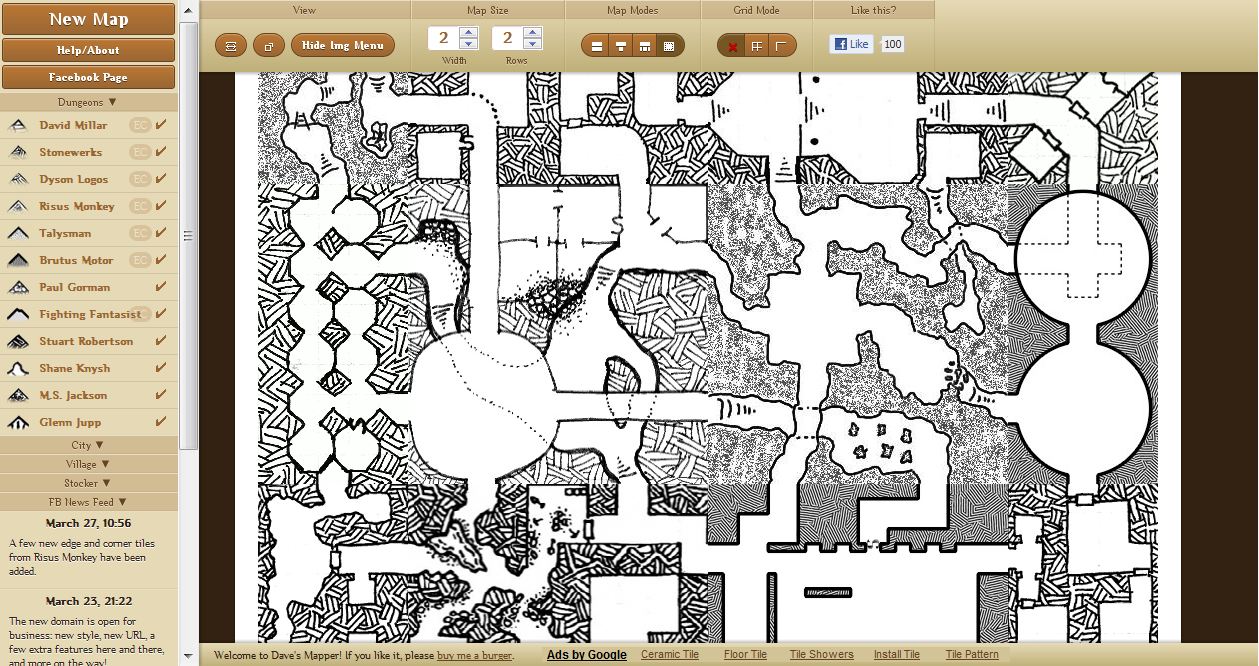
Ever find yourself needing a quick map for that quest or battle you’re about to play? Look no further than Dave’s Mapper, a quick browser applet that creates instant maps for adventuring. The maps can be customized a bit by swapping and rotating tiles, but it’s not a full featured map editor. Its appeal lies mainly in its ability to quickly create a random location. It accomplishes this with tiles that that will almost always fit together no matter how you spin or place them. Find it at davesmapper.com

Friday, March 25, 2011

Cheese ... or Font?

Your five-minute time-waster for the afternoon: Cheese or Font? Can you tell whether the name is a cheese or a font? I know my cheese, Gromit, but fonts? A little less so.

We actually did pretty poorly on our practice run. Give it a try. Bring your own Wensleydale.

Thursday, March 24, 2011

Chess World Hit By Cheating Scandal

Sebastien Feller
Two Chess Grandmasters and an International Master have been suspended by the French Chess Federation for cheating. IM Cyril Marzolo and GMs Sebastien Feller and Arnaud Hauchard were found “guilty of a violation of sporting ethics."

The cheating involved heavy usage of text-messaging during the 2010 Chess Olympiad in Khanty-Mansiys. An investigation showed that Marzolo sent almost 200 messages to Feller and Hauchard during the tournament, with the majority of them during times when Feller was playing.

ChessBase.com has a thorough story on the investigation, reveling how the scandal unfolded:
Joanna Pomian, Vice-President of the French Chess Federation, told the committee that she had uncovered the matter on September 27, 2010. Cyril Marzolo, who was beset by financial difficulties, had worked for her company. Since he was blacklisted by mobile operators she had paid for his mobile phone account. On September 27, Cyril Marzolo was in the Pomian’s home to give back some papers, and while he left the room a few minutes and left his phone on the table. She saw a sms message arriving, from Arnaud Hauchard, mentioning “Hurry up, send moves…”. Subsequently, when checking the dues, she discovered that she had access to the records of the SMS text messages sent during the Olympiad. Pomian said she knew that Feller and Marzolo were very close, and that she has also heard rumors of cheating during the 2010 Paris Championship (which Feller won with 8.0/9 and a 2859 performance).
Arnaud Hauchard
The report cited by ChessBase explains how they did it:
  • Cyril Marzolo, who was in Nancy at the time of the Olympiad, sent SMS texts with phone numbers
  • The first two digits of the numbers were always 06
  • The next two were the move number
  • The fifth and sixth were the "from" square
  • The seventh and eighth were the destination square
  • The final two digits were random and of no importance
  • For example: 06-01-52-54-37, 06-01-57-55-99, 06-02-71-63-84, 06-02-67-65-43 are the first moves of the Latvian Gambit (1.e4 e5 2.Nf3 f5).
Cyril Marzolo
Hauchard, the captain of the French team, had his phone and Feller's. He would go to the bar, check the messages, and then return to the hall during play in order to give Feller a signal for the proper move. There is some evidence that Marzolo was consulting a computer chess engine.

Marzolo is suspended for five years. Feller is suspended for three years, and has to do two years of community service with the French Chess Federation or he gets an additional two-year suspension. Hauchard was reprimanded and banned for life from being a captain or coach.

h/t: R. Wayne Schmittberger

Wednesday, March 23, 2011

The Big Game Hunter

Bruce Whitehill has redesigned and relaunched The Big Game Hunter, a gigantic resource drawing on Whitehill's 30 years of game writing and collecting. Whitehill has the largest collection of antique American games in the world, with items from over 400 companies from 1843 to the present. Game fans can get lost in his site--filled with history, collecting tips, design articles, and much more--for hours.

A Closer Look: French Tarot: Trumps 11 & 12

Many people are familiar with the standard Tarot suits (the "Major Arcana") used for "divination" purposes, but they're less aware that Tarot cards were created for playing trick-taking games and have a rich and diverse design history. These images are part of an ongoing series highlighting the art of a single deck used in France, which contains scenes of rural and domestic life in the 19th century.


Click to enlarge

Tarot Trump No. 11 Detail
Click to enlarge

Tarot Trump No. 12 Detail

The Amazon App Store

The Amazon App Store for Android is open for business, at least for now. Apple is objecting to Amazon's use of the name "App Store," and is suing to make them stop.

The suit claims that “Amazon has begun improperly using Apple’s App Store mark in connection with Amazon’s mobile software developer program.... Customers of mobile software downloads are likely to be confused as to whether Amazon’s mobile software download service is sponsored or approved by Apple.”

On the other hand, Angry Birds Rio for Android is free for a limited time! (Perhaps more limited than Amazon realizes.)


Tuesday, March 22, 2011

The Road to Canterbury

Designer: Alf Seegert
Publisher: FRED/Gryphon
Players: 2-3
Ages: 10+
Time: 45-60 minutes
Due: Summer 2011

One of my useless skills is the ability to read and recite Middle English, the language of Chaucer (The Canterbury Tales) and Langland (Piers Plowman). It's an ability that serves absolutely no purpose whatsoever other than giving me pleasure, and those are the things that tend to make life worthwhile.

I am an unapologetic medievalist. Civilization started to go pear-shaped with the Renaissance and really went to Hell in a handbasket (or perhaps Sheol in a sackbut?) with the Enlightenment. Medieval literature, art, history, and theology are fascinating to me. So, naturally, I was thrilled to see all of them converging with my love of gaming in Alf Seegert's upcoming game The Road to Canterbury.

Seegert is the designer of Trollhalla and Bridge Troll (both from Z-Man Games) as well as an English professor at the University of Utah. When I read Seegert's discussion of the game in his interview with Dice Hate Me, I wrote to him asking for details. 

"It might sound weird considering that it's based on Chaucer and I'm a literature professor," he replied, "but it's not too heavy on narrative--it's a more Euro-style design with different cards (Pilgrim, Sin, Pardon, and Relic cards--with art largely drawn from the Ellesmere Manuscript of the Canterbury Tales) that all interact together with a main gameboard that tracks the progress of the journey to Canterbury and shows which sin is currently denounced by the Parson, and which Pilgrims are currently available to tempt with sins and then pardon for ready cash. The board is itself based on Hieronymus Bosch's 16th c. tabletop of the Seven Deadly Sins."
Bosch: The Seven Deadly Sins and the Last Four Things
Here's the official description of The Road to Canterbury.
Greed, Pride, Gluttony, Wrath, Luxury, Idleness, and Envy—the infamous “Seven Deadly Sins.” For the faithful, they instill horror. For you, on the other hand, they present a wonderful business opportunity! In The Road to Canterbury, you play a medieval pardoner who sells certificates delivering sinners from the eternal penalties brought on by these Seven Deadly Sins. You make your money by peddling these counterfeit pardons to Pilgrims traveling the road to Canterbury. Perhaps you can persuade the Knight that his pride must be forgiven? Surely the Friar’s greed will net you a few coins? The Miller’s wrath and the Monk’s gluttony are on full public display and demand pardoning! The Wife of Bath regales herself in luxury, the Man-of-Law languishes in idleness, and that Prioress has envy written all over her broad forehead. And the naughty stories these Pilgrims tell each other are so full of iniquity they would make a barkeep blush! Pardoning such wickedness should be easy money, right?

Not quite. For you to succeed as a pardoner, you’ll need to do more than just sell forged pardons for quick cash. To keep your services in demand, you will actually need to lead these Pilgrims into temptation yourself! Perhaps some phony relics might help? There is also one big catch. The Seven Deadly Sins live up to their name: each sin that a Pilgrim commits brings Death one step nearer, and a dead Pilgrim pays no pardoners!

So much to forgive, so little time. Will you be able to outwit your opponents by pardoning more of these Pilgrims’ sins before they die or finish their pilgrimage to Canterbury?
Chaucer in the Ellesmere Manuscript
The game is due from FRED/Gryphon this summer, and Seegert is working with the publisher to finalize the art for the board and cards. I'm guessing the "Last Four Things" part of the painting, with Bosch's typically vivid depiction of the torments of Hell, will probably not appear in a game intended for family play. The Ellesmere Manuscript, which is the other artistic inspiration for the game, is the most famous and elaborate illuminated manuscript of The Canterbury Tales, with illustrations of the pilgrims and Chaucer himself. 

(Pointless Digression: As an added bonus for conspiracy theorists, the Ellesmere Manuscript was owned by John de Vere, the 12th Earl of Oxford, who wound up at the wrong end of the headsman's ax for his loyalty to the House of Lancaster in the Wars of the Roses. He was the ancestor of Edward de Vere, the 17th Earl of Oxford and the man some people believe wrote the works of William Shakespeare, despite the inconvenient fact of his being dead when Macbeth, The Tempest, and Henry VIII were actually written. However, I think these connections prove incontrovertibly that Geoffrey Chaucer actually wrote the complete works of William Shakespeare! Alas. the whole Oxford/Shakespeare debate is about to go massively mainstream thanks to a big-budget movie from crap-auteur Roland Emmerich.) (These rambling asides are bonus content, and are added free of charge.)

I'll write some more about The Road to Canterbury as it gets closer to completion.

Other games by Alf Seegert:


Monday, March 21, 2011

The Walled City of Carcassonne

Atlas Obscura did a brief entry today on "La Cite Mediavale de Carcassonne", the restored medieval walled city that inspired the popular game series. It's a concise overview of the famous French city, so for those who want some more information on the real thing, point your browser at a couple of official French cultural & tourism sites for maps, history, interactive tours, and more. (English versions are available for both of these sites.) Its famous concentric walls and blue roofs will be familiar to fans of the game.