Wednesday, August 25, 2010

Colonial Gaming: "Put" and the Lower Classes

"If you want to be robbed, my son, play Put in a tavern."
   Captain Crawley, The Card Players Manual (1876)
   [via David Parlett]

Put was the Poker of Colonial Virginia: a disreputable game of luck, bluffing, and wagering played in taverns by members of the lower classes. (The middle and upper classes preferred Whist and Loo). It followed the English colonists to Virginia, where it became very popular.

At first glance, the rules seem positively primitive. Three cards each are dealt to 2-4 players. Players take turns putting down cards to win tricks, with the rankings 32AKGJT987654.  I've seen no explanation why 3s and 2s are high, and have to assume it was simply some quirk of the rules dating from the game's origin in the 1600s.

High card wins each trick, regardless of suit, and there are no trumps. Each trick is worth 1 point, and game is 5 points.

This seems to make the game merely a mindless bit of trick-taking for money, but the "Put" rule is where it turns into a bluffing game. At any point, a player may say "Put" before playing the first card in a new trick. This is a shorthand version of the phrase "I put it to you that my card can beat your card." Maybe it can, maybe it can't. If the non-putter refuses the put, the putter gains a point. If the put is accepted, then the winner of the trick jumps to 5 points and wins the whole pot.

I tried a few hands of this with my son. It sounded boring and pointless, but after a couple of rounds, we started to find some definite strategies and a very interesting element of bluffing. By the end of several hands, we were finding it quite enjoyable.

It's a great game to introduce to kids to give them a taste of the taverns where the Revolutionary War was incubated. (Beer is optional.) They might also find it interesting how a game that was probably played in the time of Shakespeare migrated to the New World.

A couple of descriptions of Put can be found at Pagat. The authors of Pagat note that Charles Cotton (author of The Compleat Gamester in 1674) calls it "'the ordinary rooking [fleecing] game' of every place, and devotes much of his chapter on it to describing various common methods of cheating by marking the cards, introducing cards from another pack, and so on. He also explains 'The High Game,' in which the cards were stacked so as to deal the victim a three and two twos while the dealer dealt himself a two and two threes. The non-dealer would put, and perhaps agree some extra wager on the game, which the dealer would then see and win. Cotton remarks that you cannot get away with this more than once against the same player"


The Electronic Games 100: Done

The annual Games 100, our guide to the best games of the year, is finally locked down. The awards are picked for Electronic Game of the Year and Runners Up, and category winners for Action, RPG/Adventure, Sports/Driving, Strategy, and Apps are selected.

This is my biggest job of the year. The final text comes in at 11,000 words, which is about 15 pages in the December issue. The Traditional Games 100 list will fill the same amount of space. I believe this is the 30th Games 100. I've done the last 10 or so, and worked on it with the late Burt Hochberg for 5 years before that.

As we get closer to street date (late October), I'll talk a little bit more about what's in it and why we made the decisions we made. Last year was a bit of an upset, with the top electronic award going to Batman: Arkham Asylum, while the traditional game award went to Small World. If you haven't checked them out yet, you really should: both are excellent games.


App O' The Mornin': Reiner Knizia’s Samurai Review

Samurai is one of Knizia’s more popular designs. Along with Tigris and Euphrates and Through the Desert, it’s part of his “tile-laying trilogy,” all published in 1997 and 1998. Although some of his other games featured similar tile-laying mechanics (most notably Ingenious), these three had a different feel to them, if only because they replace abstract design with historical themes.

In fact, theme doesn’t matter all that much in Samurai, except to lend the game some flavor. This is a pure area control game, with up to four players taking turns laying hexagonal tiles on a map of medieval Japan. The goal is to exert the most influence on map areas bearing figures representing religion (a Buddha), the military (a helmet), and labor (a peasant). It works this way:

Players get a selection of tiles, and draw more as they expend this selection. Each tile has an image and a number from 1 to 4. The image represents the kind of influence that tile exerts (religious, military, or labor), and the number represents the strength of that influence. Samurai tiles are wild cards that can influence all three types of figure.

There are also “fast play” tiles, depicting a ship for control of sea hexes, a ronin to act as another (albeit weaker) wild card, and a “figure-exchange” tile to move figures on the map. You can place one standard tile per turn, and any number of number of fast move tiles.

The goal is to place tiles to surround the figures. When the figure is totally surrounded, the person with the most influence captures that figure. Influence is measured by the total value of matching or wildcard tiles that are surrounding that figure.

For instance, you place a samurai worth 3 and a ronin worth 1 next to a helmet figure. Your enemy places a samurai worth 2 and a ship worth 1 next to the same figure. Since you have more influence on that figure, you capture it and add it to your final total.

The game is played until all of one type of figure are captured, or there are four ties for figure control.

If all of that sounds a little fussy and complicated, have no fear. The App comes with a terrific little three-part tutorial that explains everything, as well as complete rules. Since it sets everything up and helps direct you towards legal moves, it’s all very easy to learn.

The graphics are quite nice, and the interface manages to compress a lot of control and information into a limited space. Four players can compete, either a single player with 2-3 AI opponents, or humans. The app has a full range of multiplayer features, including pass-and-play and turn-based online with push notifications.

All-in-all, a great new addition to the Knizia library.

Tuesday, August 24, 2010

Games Magazine: Online Puzzle (Contest)

A new puzzle is up at the website. This is a tough one. I didn't create it, and I doubt very much that I can solve it.

If you can solve it, you might be among the five lucky winners who get a free one-year subscription to Games Magazine.

Please follow the instructions on the website when submitting entries. I'm turning off the comments on this one, since my sharp puzzle-solvers usually slice through challenges like this in mere minutes, and publicly posted answers would invalidate the contest.

Oregon Trail: It's What's For Dinner

If she does, then a black cake with green icing isn't going to help matters.

H/T Failblog.


EA's Medal of Honor Courts Controversy

As I've said in the past, I have serious problems with the nihilistic, excessively violent, and anti-American elements in Modern Warfare 2. From both a gameplay and content perspective, I prefer the Battlefield series made by DICE and released by EA.

I was glad to see that EA was resurrecting the Medal of Honor series and turning it over to the DICE team. I suspected that they might try to top the excesses of Modern Warfare, but I haven't seen enough of it to know either way.

Neither has Britain’s Defence Secretary Liam Fox, but that hasn't kept him from voicing an opinion based on minimal evidence. He told the Telegraph that he was "disgusted" that such an "un-British" game was being released, and called for retailers to refuse to sell it, adding "It's shocking that someone would think it acceptable to recreate the acts of the Taliban."

Secretary Fox is referring to unsubstantiated reports that the game, set in contemporary Afghanistan against the backdrop of the War on Terror, would allow people to play as the Taliban and kill British soldiers. Obviously, with soldiers still fighting and dying in that theater of war, this was going to be a sensitive subject. Although I haven't seen the finished game, the "play-the-Taliban" idea seems in poor taste.

EA says that "British troops do not feature in the game." They are not denying that you can play as the Taliban, however, pointing out that someone has to be the bad guy.

It's always a mistake to offer an opinion about something that does not, technically, exist yet. The game may be as awful as Secretary Fox says it is, and he will have been well with in his rights to urge customers and retailers to shun the game.

Nota bene, he did not (as of this writing) talk about using the force of law to ban the game, which is an important distinction often lost in these debates. He urged retailers to "ban" the game by not selling it. We call that "free speech," and even British Defence Secreataries are entitled to it, even when they say things you don't like. Especially then.

Even the military mother quoted in a widely circulated story said she didn't want the game banned, just perhaps shelved for a couple of years until our boys come home. That won't happen, but it's not an unreasonable request.

Some gamers have a habit of screaming "censorship" anytime someone expresses disapproval of their chosen form of entertainment. DEAR GAMERS: NO ONE HAS TO LIKE WHAT YOU DO. They don't even have to approve of it. When you have this kind of content, you need to expect criticism.

People may get on TV and say it's awful and it shouldn't be sold. They may organize boycotts to keep it out of local stores. Bill O'Reilly may even write a sharply worded Talking Points Memo.

Good. That's what they should be doing. Free and open debate is the sign of a healthy society. Unless the State is kicking in your door and heaping copies of Medal of Honor on a bonfire, you aren't being censored. America, at least, is not in danger of tipping over into Fahrenheit 451 anytime soon.

Obviously, I'm going to reserve judgment until I see it. I'm hoping that DICE (a team for whom I have immense respect) will handle this kind of challenging material with good taste. I have serious doubts that this is even possible.

Some inside EA are pointing to the horrible "No Russian" level of Activision's Modern Warfare 2 as some kind of precedent, which is entirely the wrong point to make. That level was rotten gaming, not to mention artistically juvenile and offensive merely for the sake of being offensive.  Supporters of the game are also pointing to war movies like Hurt Locker to justify what they're doing.

This comparison to games as an art form like movies has to end. It's not only stupid, but it fatally underestimates the power of the medium. I remember being offended that Black Hawk Down was made into a game. People said, "Well what's the difference between that and the movie?"

I always find it funny when gamers complain about how ignorant non-gamers are about their hobby, because the movie-game comparison is flat-out stupid, and gamers say it all the time.

How can a gamer not understand the difference between the objective, passive experience of a movie and the subjective, active experience of a game. It's the reason they play games! In a movie, you may see atrocities committed, and even be made to identify with the people committing them, but you are not actively committing those atrocities yourself in simulation.

In other words: games are too powerful a medium to work by the same creative rules as movies. There are things that I may watch in a movie that I would never want to simulate in a game environment. Something like "No Russian" crosses the line for me: it's no longer fun. My fantasies don't involve being a cold-blooded terrorist. That's not a feeling or a role that I need to experience.

I sympathize with DICE and EA. They are trying to use a young medium to create a new form of entertainment, and feel that it should be as responsive to contemporary issues and realities as a book or movie. (And they want to make a pile of money while doing it.) The medium of gaming simply isn't there yet. It may never be, because of the subjective/objective split described above.

Developers need to use some discretion, have some empathy for people that are touched by what they create, and most of all, understand the raw power of their chosen medium. Just because you can do something doesn't meant you should.


NOTE: Whenever I post something like this, I get a load of commentators who send me emails or post comments saying that I'm some kind of drooling Jack Thompson-like censor. I do not believe in the power of the State to use force or the threat of force to control the freedom of expression. I do believe in citizens doing everything they can to make their voices and opinions heard. Game makers have every right to make what they like, but they have no implicit right to access to the marketplace. Citizens have every right to raise the roof and try to persuade people to deny the game makers access to the public marketplace. In other words, you may have a right to make something, but that doesn't mean Walmart has to sell it.

App O' The Mornin': Theseus

Robert Abbott is one of the masters of logic mazes, which add layers of complexity to the standard linear point-to-point maze. (You can find his home on the web here.) He does a lot of work for us at Games Magazine, including some fine cover puzzles. We even made an interactive version of one of his cover puzzles, called Starry Night, which you can try online.

One of his most enduring designs is Theseus and the Minotaur, which has evolved over several iterations, including pen-and-pencil, computer, Java, and the game Mummy Maze (PopCap), which belatedly acknowledged its dept to Abbott’s original concept.

It now finds a welcome home in the App store with a very simple, clean visual style and control system. Developed by Jason Fieldman, the app offers 17 levels in the free Lite version and almost 90 in the full $4 version. The goal is to maneuver “Theseus” (a blue ball) to the exit by first trapping the “Minotaur” (a red ball with horns) in one of the niches on the map. Since the Minotaur is always closing on Theseus with two moves to Theseus’s one, the trick is to find ways to trap him with his own rules of movement, which favor horizontal motion over vertical.

Although the rules are easy to understand, the puzzles get larger and increasingly complex, and some a real mind-benders. There are many maze games in the App stores, including rolling ball games that use the device’s motion control to emulate tilting mazes, but Theseus is the most clever. It’s a classic design done with a solid implementation.

Monday, August 23, 2010

Colonial Gaming: I. Hardy Cards

Cards were far and way the most popular pastime for people of all classes and genders in the 18th century. Records show tavern keeps buying dozens of packs of cards at a time.

As far as we can tell, all of them were imported from England, with heavy tariffs on each pack. The English cards were printed by woodblock on heavy stock, and then hand painted. There were no card "backs" as we know them today: the opposite side of the card was simply left blank.

One deck that survived was the "Great Mogul" deck made by I. Hardy in England 1765. An original resides in a museum at Colonial Williamsburg, but just about every vendor in the town carries a handsome reproduction set.


In this deck, the suicide king has already lost the head of his axe. The court images are fairly rough, as you might expect of wood-block prints. The lower ranks have no numbers: only pips in suit. People must have held their cards differently in the 18th century, since you can't form a standard fan and still read the rank and suit.

Particularly of note is the wrapper, which had to seal each new deck of cards. (Some version of these wrappers were actually still used in Great Britain until 1960.) It bears an embossed Royal seal, and the words "£10 penalty selling any Playing Cards unlabel'd. £20 penalty selling or buying any Label or Wrapper used before. Seller or Buyer of Label or Wrapper used before informing will be indemnified." Each pack required payment of a duty.

The inner wrapper bears the more extreme warning "For exportation. 50 pounds penalty if relanded and 20 pounds if sold in Great Britain." 50 pounds was about 20 pounds more than the annual salary of a member of the American middle class at the time.

In other words, you'd be punished for not having properly labeled cards, for reusing the wrapper, or for trying to bring the cards back to Great Britain. And you had to pay a duty on each deck. Every wrapper was a reminder of the hated stamp act. It's easy to imagine card-loving Virginians getting irritated every time they opened a new deck.

Sometimes it's the little things that lead to Revolutions.  

Update: I understand that some people have found these offered on the internet as originals, sometimes even looking worn down and "aged." The likelihood of real sets of these cards popping up on eBay is almost nil. If someone is offering them as originals, you are being hoaxed. They have also been passed off as period reproductions of Civil War cards. Civil War era cards would have looked nothing like this.

App O' The Mornin': Spite and Malice (Two-Handed Solitaire)

I was surprised to find this game in the App store, since it's fairly obscure. Oddly enough, my wife had just asked if there was such a thing as "two-handed solitaire," so I was in the process of learning its rather unusual rules.

Spite and Malice, also known as Cat and Mouse, is indeed an oxymoron: solitaire for two. It's worth checking out if only for the unique play. A variant of the game is marketed under the title of Skip Bo, but why buy special cards for something you can play with a couple of standard decks?

The regular game is played with two 52-card decks. The goal is to be the first to deplete a "pay-off" pile of 20 cards. This is done by playing solitaire to the center of the table, where either player can unload cards by playing sequences from Ace to Queen, Kings wild. When a sequence is complete, it's removed from the table and another can take its place. Up to four of these sequences can be played simultaneously.

Players draw 5 cards each to form a hand from a common stock, building whatever sequences they can, and drawing on the pay-off pile whenever possible. Each turn ends by playing a card to a side stack, which is a holding area for cards that might be needed later.

The full rules can be found at the inimitable Pagat.

The App from Trivial Technology is a completely straightforward version of the game. You get a few options, but no real surprises. It does the job quite well, providing a decent challenge and usable controls.

For a buck, it should be an easy call for anyone who likes unusual card games.

Sunday, August 22, 2010

Gaming in Revolutionary America

As I mentioned last week, I spent part of my vacation in Colonial Williamsburg, Virginia. Although I always keep an eye out for games when I travel, I didn't have to look far in Williamsburg: the place was positively full of them.

If Colonial household inventories are any indication, then Colonial Virginians were positively mad for their games. They were played by families, as part of social gatherings, and in taverns and coffeehouses. Checkers, chess, dice, cards, Fox and Geese, Nine Men's Morris, Shut the Box, the Game of Goose, and others were common items in homes and public places. This was in marked contrast to some of the New England colonies, which still banned almost all such activities due to the lingering Puritan influence.

Over the next couple of weeks, I'm going to post photos and scans of some of the items I picked up, and talk a bit about the games being played in America as we headed towards Revolution.

Saturday, August 21, 2010

State of State of Play

Since today marks one month since I started this blog, I thought I’d take stock and give you some idea of what I’ll be doing going forward.

I didn’t know what to expect when I began a blog, and I wasn’t sure I’d be able to add a whole new layer of work to what I already did. So far, it’s working out pretty well, so I plan to stay with it and gradually increase some of my coverage. In the first month, I managed 93 posts and 5,000 page views, which seems like a good start. I hope to expand that audience, and I hope you’ll help by sharing links on Facebook, reTweeting, and perhaps even accessing Amazon through my links at the right.

So here’s the State of SOP:

App O’ The Mornin’
It’s been remarkably popular, so it will continue just as is: one App a day posted Monday through Friday at 5:00am. Some might be shorter, others longer. I’m not going to feel bound by my usual length restrictions (which can very particular in magazine publishing). I’ll just use as many words as I need to. That’s kind of liberating. Check out Apps here.

Puzzles
I began posting logic puzzles to provide steady content while I was away, but it has also become somewhat popular, so I’m going to continue it, twice a week a first, and more if I have the ideas. Check out Puzzles here.

Eurogames
I’ve done far less coverage than I had planned to, so expect that to change. I hope to post steadily on Eurogames from the perspective of a fan and player. I don’t plan to do heavy coverage, news, or reviews, but rather commentary pieces on the entire range of adult boardgames.

Cards
Cards are also a popular subject here, and I plan to do multiple posts throughout September. (Believe it or not, the phrase which has led to the most Google search hits is “Autobridge board.”) As my family discovers all the old card games, I’m beginning to realize how much this wonderful pastime has faded in popularity. I’d like to help turn that around. I’m not just going to talk about individual games, but also cards themselves: their design and quality. Part of this is linked to my next bit of news, which is…

Prizes
That pack of Bicycle cards in my header image isn't just there to fill space. I’ve made no secret that I *heart* the US Playing Card Company and their Bicycle and Bee cards, so I decided to drop them a line. They’ve agreed to sponsor a series of giveaways throughout September, and have generously provided various prizes for my readers. I’ll let you know the details as I begin the card posts next month.

Electronic games

Apps aside, I’ve done very little on the subject that’s kind of my area of expertise: video and computer games. I’m not sure how much that’s going to change. A great deal of my writing on this subject gets directed towards my various print publications, and there’s never a lot left over. The whole point of this blog was to fill in the gaps, covering things I knew about and loved but didn’t get to write about. If something interesting pops up, I’ll certainly post it, but I have no plans to really increase this side of the blog. (Also, as per my usual experience, critical coverage of electronic games draws the most … exuberant people out of the woodwork, and I’m just not that interested in feeding the trolls on my own little corner of the web.)

Vault
The next few weeks should also feature some items I collected during my trip to Virginia, including a series of posts on games that were popular in Colonial America.

Personal posts
I haven’t decided on how to handle the personal end of the whole blog thing. I tend to find more personal posts interesting when I read other blogs, so I might do one O/T post on weekends. I’ll see how it goes. Yesterday's post, Math and Me, was kind of a first step in this direction.

Facebook, Twitter and RSS feeds are a blogger’s best friends, and I’m always looking to grow my rolls. Please follow SOP on your medium of choice, and share links to help spread the love.

By all means, if anyone has any comments or suggestions, just fire away. I’m still trying to find a “blog voice,” and expect it to take some time.

Speaking of time, I want to thank you all for taking some of it to visit here. I have always written for a specific audience, but this blog is meant to be different. I’m kind of writing it for myself, and hoping there are enough people out there who find that interesting. Time is one of our most valuable commodities, so I appreciate that you use some of yours to stop here. Thanks for your continued patronage.

Friday, August 20, 2010

Weekend Post: Math and Me

I’m about as far from being a mathematician as one can get while still being able to add 20% to a restaurant check. Math was my bane all throughout school. I hated it and held it in contempt. I failed Algebra I … twice. That takes a special kind of stupid.

I know my subjects: literature, art, history, philosophy, and theology. But the math thing always bugged me. I didn’t like the fact that I’d let it defeat me, and suspected I had done so for bad reasons, such as arrogance and laziness.

About ten years ago, I decided to do something about it. I bought a couple of “teach yourself” books and began with straight mathematics and “pre-algebra” and then did a full course of algebra self-study. It was hard going, but eventually I began to listen to the numbers like I could listen to words or music or rhetoric. I realized that they were a language and I just needed to let the numbers speak.
And, finally, I understood it. I’m still no mathematician, but I get it now. I can follow problems and see the special beauty in numbers.
My faith had a lot to do with helping me clear that hurdle. I study a particular stream of Catholic philosophy known as Thomism, which is a rigorously logical approach to all the questions of Creation. St. Thomas Aquinas was my first big personal “discovery” since college, when I first dug deeply into Plato. He opened up a doorway to a vast storehouse of logic. It was not merely a belief system, but a way of approaching any question in an orderly way, giving equal time to contrary arguments, assuming nothing, and testing everything.
Logic is at the core of Creation, just as it is at the core of all good gaming. Games and puzzles are logic made manifest. They are concrete. They can be cracked open and understood. I was always good at pattern puzzles, conundrums, riddles, and lateral thinking. But with St. Thomas in one hand and a new respect for math in the other, I started tackling the kind of puzzles and problems I used to avoid.

I’m still not all that great at them, but I like to think I understand them and appreciate them better than I used to. I also think they are terribly important, particularly in the education and parenting of children. We live in a world where extravagant emotion always trumps logic and plain old common sense. We could do with a little more logic and a little less hysteria. We’ve spent several generations nurturing our inner child, when we should have been nurturing our inner Mr. Spock.

Games and puzzles are almost always intertwined with mathematics, and all of them taken together sharpen the mind. They help us understand ourselves and our world. They form a language with its own poetry. We have to make sure the next generation knows how to listen to that poetry.

Spreading the Joy About Cribbage

My online pal Julie D. at Happy Catholic got inspired by Cribbage Friday, and has rediscovered an old favorite, as she explains in this great post.

Thanks also to the awesome Anchoress (Elizabeth Scalia) for giving me a nice shout-out. I think Elizabeth is one of the best essayists on the internet, and I'm honored that she published one of my pieces at Patheos.

"Cards are war."

Cards are war, in disguise of a sport.
  Charles Lamb

Thursday Puzzle SOLUTION: Startling Subtraction

STARTLING
STARLING
STARING
STRING
STING
SING
SIN
IN
I

See the comments on the original post for some alternative solutions. 

About Puzzles

I had fun preparing the puzzles for the past two weeks. A lot of them are classics, since even the master puzzlers didn't invent most of their own puzzles: they just reformulated them. Some I did from memory, and some were drawn from my collection of puzzle and math books. I only botched one answer, which my astute readers quickly caught.

This was never meant to be a regular daily feature, but I will continue to post puzzles, maybe a couple of times a week. As I said in a previous post, I'm about to disappear into the thickets of a massive special supplement for Games Magazine, but will continue to post an App O' The Mornin' and whatever else I can until I complete it sometime in the next two weeks.

I also plan to post something about the future of the site. It's about to be one month old, and I've been steadily populating it with posts. It will continue, and begin to take shape as I explore this whole blogging thing.

Thanks to the regular puzzle solvers, especially Eye of the Frog, who answered every one correctly, which puts him one-up on me. I think I posted today's "1105" puzzle just to see if I could stump him. I hope to heck I can get it right.

Friday Puzzle (Bonus): A Riddle

And now for a riddle:

What can go up a chimney down, but can't come down a chimney up?

Friday Puzzle (Hard): 1105

Let's finish off two weeks of puzzles with some challenging math and a more gentle riddle.  First, the math:

The sum of the squares of two consecutive numbers is 1105.

What are the numbers?

App O' The Mornin': Solebon Solitaire

The unquestioned king of solitaire is Solebon. Card Sharks is a good general collection with a lot of solitaire variants, but as the menu screen itself says, Solebon is “for refined solitaire players.”

Developed by Smallware, Solebon has migrated through various systems since 1998, when it was first launched for the Palm OS. Thus, it has a long pedigree not only as software, but as software designed primarily for mobile use. The version for Mac, called Solavant, contains 242 different solitaire versions and variants. When you consider that the authoritative book on the subject, David Parlett's Solitaire, details 400 versions and variants worldwide, you'll get an idea just how thorough the Mac version is.

Solebon Solitaire manages top bring a hefty chunk of solitaire to iPhone and other Apple portable devices. It includes forty games, ranging from the familiar (Klondike, Free Cell) to the exotic (Honeybees, La Belle Lucie). The interface is quite effective, using a double-touch system rather than gestures. You touch one card, and then touch where it should go. Card Sharks uses drag-and-drop. It's a matter of preference, but the double-touch is a little more precise and easy to use.

The graphics are crisp and easy to read, and the entire look of the game is subdued and appealing. The only flaw is the lack of a landscape mode. The screens are certainly optimized to handle the vertical layout, but solitaire is a game that benefits from a horizontal spread.

That minor point aside, this remains the premium solitaire experience in the App store.

List of titles in the game:
Accordion, Aces Up, Agnew Sorel, Ambrose, Askew, Baker's Game, Baker's Game Easy, Beleaguered Castle, Blind Alleys, Bouquet, Colorado, Creepy Crawly, Demon, Doublets, Eight Off, Eight Off Easy, Fanny, Fortune's Favor, Four Seasons, Fourteen Out, Free Cell, Free Cell Easy, Golf, Honeybees, Klondike Deal 1, Klondike Deal 3, La Belle Lucie, Lady of the Manor, Monte Carlo, Penguin, Provisional, Pyramid, Pyramid Easy, Russian Revolver, Scorpion, Spiderette, Spiderling, Spiderling 2 Suits, Triple Mulligan, Yukon

Thursday, August 19, 2010

Back From Vacation

I've actually been on vacation for the last couple of weeks, and had only intermittent internet access. Part of the reason I introduced two weeks of logic puzzles was to provide structured content while I was gone. (Blogger allows you to create all of your content at once for posting at a later time.)

Although I'm back, I'm about to go straight into finishing the December issue of Games Magazine, which includes the Games 100. It's a pretty exhaustive (and exhausting) 15-page supplement detailing the 100 best conventional and electronic games of the year.

My trip included a lengthy stay at Colonial Williamsburg, where the Founding Fathers were avid gamers and gamblers. This is in contrast to the Founders from Massachusetts, for instance, where playing cards and other forms of gaming were banned due to the Puritan influence. Virginia was a royal colony, and thus officially under the Church of England, which had no problems with cards, draughts, or similar frivolous activity.

The picture at the right was taken at the recently reconstructed R. Charlton Coffeehouse, which is  across the street from the capitol where Patrick Henry urged the Virginia House of Burgesses to "Give me liberty or give me death". The Coffeehouse was a favorite gathering spot for legislators. They served strong coffee, even stronger unsweetened hot chocolate, and plenty of liquor, and games were a favorite past-time. It's strange to imagine the founders playing Whist, Shut-the-Box, or Checkers while slamming back hypercaffeinated cocoa and talking Revolution.

Thursday Puzzle: Startling Subtraction

Take a look at the 9-letter word below:


S T A R T L I N G


It is possible to remove a single letter at a time, forming a new word each time, until you have formed a total of 9 words (including the starting word). The letters cannot be rearranged. Each time one letter is removed, a new word must be formed.


What are the words?


[Adapted from Martin Gardner, though I don't think he originated it]

Wednesday Puzzle SOLUTION: The Bookworm

UPDATED:  I've often used this puzzle to stump people, and this time I fell into my own trap. I tried to create even numbers for easy mental calculations, but I kept changing the numbers of volumes. In typing up the solution, I got sloppy and forgot that the central trick of the puzzle is that there are TWO FEWER BOOKS  eaten than would appear to be the case. In my original solution, I only calculated one.  Thanks to readers Eye of the Frog and Ethan C. for catching the error. This post has been revised to correct the mistake. (I plead exhaustion: aside from the puzzles that are directly quoted, I wrote the last two weeks worth of material from memory in a single sitting. No, Martin Gardner would not have bought that excuse either, but it's my story and I'm sticking to it.)

58 inches

Remember, if a set of books is in order on a shelf, the first volume will be the furthest book on the left. This would place the first page of that book to the right of that volume. The front cover of each book (except for the last) touches the back cover of the next book in line. The back cover of the first volumes touches nothing.

Therefore, a worm starting on the first page of the first volume will not need to eat through the first volume. It only needs to eat through the cover.

Since it's only going to the last page of the last volume, it doesn't need to eat through the front cover or text of volume 26.

24 volumes at 2 inches each = 48 inches

50 covers (front and back for volumes 2 to 25, plus the front cover of volume 1 and the back cover of volume 26) at 1/5th of an inch each = 10 inches

Culbertson on Cards

A deck of cards is built like the purest of hierarchies, with every card a master to those below it, a lackey to those above it.
 Ely Culbertson

App O' The Mornin': Monumental

What the?! Knizia again? Is he trying to corner the App market?

Well, if he is, he's doing a bang-up job, because even the relatively flaccid Knizia Apps (Poison, Robot Master) are still pretty good.

Although the Mayan graphics and exploration theme of Monumental call to mind Lost Cities, the game is a completely new design by Knizia for the iPhone/Thouch. Yes, it’s another set making game, but Knizia always manages to do something fresh with the format.

Monumental uses a mechanic that would be difficult to recreate in a conventional card game. Two sets of 12 empty spaces (3 columns by 4 rows) are split by a column of 4 tiles. As you slide each tile into one of the empty rows, another falls. The goal is to make sets of tiles matched by rune design, number of ruins, color, or any combination of the three, with more points award for more complete matches.

Although it’s a simple design, maximizing points requires pre-planning and a steady pace, making it a thinking person’s alternative to Bejeweled.

Wednesday, August 18, 2010

Wednesday Puzzle: The Bookworm

If you've read many puzzle books, you've probably come across this one in some form. Everyone takes a stab at their own version sooner or later, so here's mine:

A 26-volume encyclopedia set is placed, in order, on a single shelf. Each volume is 2" thick. Each cover is 1/5" thick.

If a book worm starts on the first page of the first volume, how far will he have to travel to reach the last page of the last volume.

Franklin on Games

Games lubricate the body and the mind.
  Benjamin Franklin

Tuesday Puzzle SOLUTION: Matchstick Fieldgoal ... Intercepted

Push the horizontal matchstick over, and then move one upright to reform the goalpost.

App O' The Mornin': Scrabble

With the demise of the unofficial "Scrabulous," the official EA/
Hasbro version of Scrabble became the only online version of this classic game. It's already a huge hit on Facebook, and has also made a successful jump the the App store, featuring multiplayer support that is among the best for any turn-based game.

The support for play across multiple platforms is, in my experience, unique among Apps. (And, no, I am not counting Farmville and Mafia. If you consider those “games,” you’re probably at the wrong blog.) I can start a game with the App, invite players via Facebook, and then anyone playing can continue the game either via Facebook or the App. This is a fantastic feature that needs to be implemented in more games.

The software passes the new moves fairly quickly, and App connection failures are rare. (The Facebook side of the equation is a little more fussy, often requiring repeated screen reloads.) This kind of offline multiplayer is ideal for mobile devices, since it allows people to make moves at their own pace. Because of this App, I now play Scrabble every day, and it’s so easy to use that a move never takes more than a minute or two.

On the downside, it could use a more diverse set of customization options and faster load times. Although the app will send push notifications when a new move from an online opponent is received, you have to restart the app, sit through the logos, and wait while it finds your games. Updates seem to have improved this since the initial release, so we can hope that it will get even better.

Those reservations aside, it’s still a fine implementation of Scrabble for $5.

Tuesday, August 17, 2010

Virtual Museum of Games

Another great collection of game art and information can be found in the Elliott Avedon Virtual Museum and Archive. This site reproduces the collection that was once housed in a museum at University of Waterloo, Ontario. The museum has closed and the collection was moved to the Canadian Museum of Civilization, but the site documenting the collection's treasures has been left up. It has some terrific images and text.

Life, or Chess?


Chess is like life.
 Boris Spassky


Chess is not like life. It has rules!
  Mark Pasternak


Chess is life.
  Bobby Fischer


If Chess is a science, it's a most inexact one. If Chess is an art, it is too exacting to be seen as one. If Chess is a sport, it's too esoteric. If Chess is a game, it's too demanding to be just a game. If Chess is a mistress, she's a demanding one. If Chess is a passion, it's a rewarding one. If Chess is life, it's a sad one.
 Anonymous


Life is a kind of Chess, with struggle, competition, good and ill events
.
  Benjamin Franklin

Tuesday Puzzle: Matchstick Fieldgoal ... Intercepted

The opposing team made the mistake of building their goalposts out of matchsticks. (They're really tiny football players).

A ball (the match head) is about to pass through the uprights.

See if you can make this fieldgoal an incomplete by only moving two matchsticks. You must still have an intact fieldgoal at the end. The ball must be completely outside of the goalposts.

SOLUTION

Monday Puzzle SOLUTION: A Lady Never Tells...

Mrs. Perkins is 45. Her husband is 54.

UPDATE: Reader "Eye of the Frog" posted an excellent solution to this in the comments of the original puzzle.

App O' The Mornin': Ingenious

I could write about only Reiner Knizia Apps for two weeks and still not cover them all.  The man isn't just a prolific designer, but his games and uniquely well-suited to the App format.

Among Knizia’s dominoes variants, Ingenious is probably the most famous. Tiles are comprised of two conjoined hexagons, with each bearing one of 6 colored symbols. Players earn points by laying tiles on an Agon board to create lines of matching colors. The unusual scoring mechanism means that “highest lowest score” wins. Thus, the person with the highest score for their weakest color is the victor.

For instance, if your lowest scoring color is green with 5 points, and someone else has a lowest scoring color of red for 6 points, then they win. This creates unusual strategies for tile placement and even blocking.

The iPhone/Touch version is a straightforward and effective port of the original game, with an AI that should give even seasoned players a fine challenge. A solitaire variant is also included, as you compete against yourself for highest score.

Monday, August 16, 2010

Dr. Johnson on Cards

"I am sorry I have not learned to play at cards. It is very useful in life: it generates kindness and consolidates society."

Samuel Johnson, from Tour to the Hebrides (November 11, 1773)

Monday Puzzle: A Lady Never Tells Her Age

One day at the hairdresser, a beautician asked stately Mrs. Perkins how old she was. Mrs. P. glared at the woman over her glasses, and said "If you reverse the figures of my husband's age, you shall have mind."

This didn't satisfy the young woman at all, who said, "I don't know how old your husband is."

"I am younger than he. The difference between our ages is one-eleventh of their sum."

Mrs. P. thought this would confuse the hairdresser so much that she'd drop the subject, but the young woman did some quick calculations, smiled, and said, "I wouldn't worry about it, dear. You look very good for a woman of your age."

How old is Mrs Perkins?

App O' The Mornin': Carcassonne


Among Eurogame-to-App conversions, Carcassonne now leads the pack. I still have some serious Catan-love, but there’s no denying that Carcassonne is the most feature-rich and wholly satisfying port of a classic design.

The feature-set reads like a wish-list of everything you’d want in this kind of App. There are 8 different AI players, a new solitaire mode, local network play over Bluetooth or Wi-Fi, Internet multiplayer via live-gaming sessions or email, a matchmaking service, an Elo ratings system, and in-game chat. If it added app-to-Facebook support (a la Scrabble) I’d probably never stop playing it.

This is precisely what every game should offer: a full suite of single- and multiplayer options, smoothly integrated with the game and the device. It works like a dream. You can connect to someone with a local device, or someone who’s on the internet. You can even hop into the lobby and it will match you with another player, often in less than 30 seconds. This is awesome squared.

The implementation of the game itself is also quite strong. Carcassonne was always going to be one of those games that challenged the small screen of a mobile device. Its tendency to spread across the table makes it though to fit in a small space. The App version does a fair job of managing this, by zooming in and out, and clearly marking any block where tile placement is legal. Each fresh tile appears in a little banner to the right of the screen, and after it’s placed you have an option to put a follower in any legal space. Tile sprawl simply never seems to be a problem, since you can view the board at different sized, and easily move the screen around.

Players new to Carcassonne won’t have any trouble learning it from the App. There’s a complete rules set for both standard and solitaire versions, as well as narrated interactive tutorials. The initial release is still plain-vanilla Carcassonne, but there’s no reason at all that the multiple expansion packs and variants couldn’t be added at a later date. I’d pay for them. (Well, some of them: you can keep Catapult.)

The App was developed by The Coding Monkeys, and you can bet I’ll be looking for anything they do in the future.

Sunday, August 15, 2010

Another Neat Item From The Games We Play

I have a few items like this in my collection. Books of etiquette and decorum always explained how to amuse guests in socially acceptable ways. Most their ideas were utterly daft.

I like "Third, That the real object of the amusement shall be gained, namely, that all shall be amused." (Click on the picture to see it full size.)

(From Louis, S.L. Decorum: a Practical Treatise on Etiquette and Dress of the Best American Society. New York: Union Publishing House, 1882.)

Saturday, August 14, 2010

Friday Puzzle SOLUTION: The Stopped Clock

Mr. Leen winds his clock before he leaves, and notes the time. Although the time is incorrect, the clock will now track his time away from the house.

When he arrives at Mr. Been's, he notes the correct time.

When he leaves Mr. Been's he notes the time once more. Thus, he knows how long he has been there, and the precise time upon his departure.

When he checks his own clock, all Mr. Leen has to do is subtract the time he spent at Mr. Been's. This gives him his total walking time. If he halves this, he then has the total time it takes to make the trip one-way. He adds this time to the time he noted on Mr. Been's clock upon leaving, and he gets the current time.

For example: He sets his own (incorrect) clock to 12:00, walks to Mr. Been's, and notes that the accurate time is 10:30. He spends 2 hours there, and upon leaving notes that the time is 12:30.

When he arrives home, his own clock reads 3:00. Three hours have passed since he left the house.

Two hours were spent at Mr. Been's, which means that 1 hour was spent walking round trip. Thus, one leg of the trip takes 30 minutes. Since he left Mr. Been's at 12:30, he sets his clock for 1:00.

Friday, August 13, 2010

The Games We Play

Paradigms and Pastimes: Games We Play is a fine online collection of art featuring antique games and manuscripts. It appears to be a zombie site left over from an exhibit at Cornell in 2004. No matter: it's a terrific glimpse into the impressive game collection at Cornell's Division of Rare and Manuscript Collections.

Friday Puzzle: The Stopped Clock

Mr. Leen is the most punctual man in town. Every day, he takes the same walk, and has such a regular pace that he passes the same landmarks at exactly the same time.

One day, he returns home to find that his servant has forgotten to wind the clock. Since his watch is broken, he is unable to set the correct time.

However, he has a solution. His friend Mr. Been has recently moved to town. He decides to walk to Mr. Been's, pay his first call at his friend's new lodging, and see what time it is.

After spending a hearty afternoon of fellowship, he returns to set his clock. Although he had never made the trip to visit Mr. Been before, and thus has no idea how long the walk takes, he is able to set his own clock correctly.

How does he do it?

Thursday Puzzle SOLUTION: Judkins's Cattle

Dudeney's solution:

"As there were five droves with an equal number of animals in each drove, the number must be divisible by 5; and as every one of the eight dealers bought the same number of animals, the number must be divisible by 8. Therefore the number must be a multiple of 40. The highest possible multiple of 40 that will work will be found to be 120, and this number could be made up in one of two ways—1 ox, 23 pigs, and 96 sheep, or 3 oxen, 8 pigs, and 109 sheep. But the first is excluded by the statement that the animals consisted of 'oxen, pigs, and sheep,' because a single ox is not oxen. Therefore the second grouping is the correct answer."

App O' The Mornin': Knights of Charlemagne

Reiner Knizia has a few core design ideas that he’s revisited (repeatedly) over the years. Some people complain that he’s just doing retreads of his own material, but close examination reveals this isn’t quite so. He often tweaks and re-themes an old design, but something fresh usually emerges. Standard card games like Rummy, 500, and Gin are all the same basic game, yet each plays differently. The same nuances emerge with many of Knizia’s design.

Also, a lot of those games go out of print. Knights of Charlemagne was only released 4 years ago, and it’s no longer available. It was really just a tweaked re-theming of a Knizia design from 1995, called Tabula Rasa. It, too, is long out of print.

But Knizia has two games that never go out of print: Lost Cities and Battleline. In keeping with our theme, Battleline itself was a new version of Schotten-Totten. Are you still following me?

All of these games have Rummy as their bedrock: you’re drawing cards in order to collect certain suits. The fun is in their special rules, themes, and nuances. Knights of Charlemagne is a close cousin of Battleline, and if you’re looking for a Battleline-type experience on your iPhone, this is the game to get.

Play is very simple. Players are dealt cards numbered 1 to 5, in 5 different colors. A row of ten tiles divides the two players: 5 numbered tiles, and 5 colored tiles. Players place cards on either the matching color or number to “claim” that tile. When the game ends, the person who has the most cards on a tile earns points for it. Although the cards are bit too small, this is still a clean, fast-playing implantation of classic style of game.

Knizia is heavily represented on the App store, with more games arriving at a steady clip. The latest are High Society and Medici. I’ll be taking a look at all of them in the upcoming weeks.

Thursday, August 12, 2010

Thursday Puzzle: Judkins's Cattle

Another one from Dudeney:


"Hiram B. Judkins, a cattle-dealer of Texas, had five droves of animals, consisting of oxen, pigs, and sheep, with the same number of animals in each drove. One morning he sold all that he had to eight dealers. Each dealer bought the same number of animals, paying seventeen dollars for each ox, four dollars for each pig, and two dollars for each sheep; and Hiram received in all three hundred and one dollars. What is the greatest number of animals he could have had? And how many would there be of each kind?"

Wednesday Puzzle SOLUTION: Closing the Gap

Always look for the simple solution. Ignore meaningless numbers. In this case, that number is the distance traveled.

All you need to do is figure out the rate of closure in miles-per-minute, and you have the distance the rockets will be one minute before they collide. The rockets are closing at a total rate of 24,000 miles-per-hour. This translates to 400 miles-per-minute, which means they will be 400 miles apart one minute before they collide.

App O' The Mornin': Oregon Trail

If you ever wonder what a kid up grew up in the 1980s might find nostalgic, then wonder no more. Just Google the phrase "You have died of dysentery," and you have your answer. (Also: Smurfs, GI Joe, and that show set in a high-school; you remember the one.)

Oregon Trail was the first computer gaming experience for many kids in 1980s, because someone managed to convince the schools that it was this new thing called "edutainement": it's edumacation, but in an entertaining way! Thus, they became the first generation to use computer technology for dubious educational purposes.

Of course, those who scoff at its educational qualities probably only remember what "dysentery" is because they played this. In truth, there is an element of history and decision-making that made it more informative than most games, and those qualities were improved as the original was enhanced and expanded over the years.

Believe it or not, Oregon Trail is almost 40 years old. Although most gamers of a certain age are probably familiar with the Apple, Commodore, or PC versions, the original game was created back in 1971. It’s been reinvented for new systems ever since, without losing any of its quirky charm or educational value.

The App updating of this classic has captured all of its strange humor and educational content. Gameplay breaks down into a few simple categories: setting a pace for your travel, managing food stores, making decisions about when to stop or who to help along the way, and completing various mini-games such as hunting or fishing.

If you go too fast, and little Mary might break a leg or the wagon may lose a wheel. Go too slow, and you might run out of food. Do you let that rather scruffy-looking old-timer hitch a ride, or pass him by? At certain points, kids can learn a bit about the land and how people survive, or stop to talk with a young Abraham Lincoln. And, yes, the family can still get dysentery.


This isn't just a retro blast for Millennials. Any kid, and most adults, will find this entertaining.

Wednesday, August 11, 2010

Wednesday Puzzle: Closing the Gap

Two rockets are fired at each other from 3465 miles away.

One rocket travels at 11,000 miles per hour. The other travels at 13,000 miles per hour.

Without doing calculations on paper, can you tell how far apart will they be one minute before they hit each other?

Tuesday Puzzle SOLUTION: Sequencing

If you didn't get it, that means you're over-thinking again.

O T T F F S S . . .

One, Two, Three, Four, Five, Six, Seven.

Thus, the next three letters are ... E N T.

Eight, Nine, Ten.

ThinkFun Has a Blog

After I posted today's App O' The Mornin' about Rush Hour, I discovered that ThinkFun keeps a very nice blog, run by Charlotte, their head of Education and New Media. As you might expect, she writes about ThinkFun products, but also about the intersection of education and play. There's a lot more here than just promos for ThinkFun products, with good posts about teaching, parenting, and puzzling.

I've been a big fan of their puzzles for a long time. Some of them always come along on vacation with us. If you don't have any in your collection, you really should pick up a few.

(I still haven't gotten used to referring to "Binary Arts" as "ThinkFun." I liked the old name better.)

App O' The Mornin': Rush Hour

If you don’t already have some version of the original Rush Hour, you really should find one. Now that ThinkFun (formerly Binary Arts) has found widespread distribution, you can pick one up in just about any book or discount store, and nothing quite beats playing with the original.

Rush Hour is played on a simple 6x6 plastic grid filled with little cars. The cars take up either 2 or 3 spaces, and must be slid in such a way that a red car has a clear path to the only exit. Cards instruct you how to set up each puzzle, with solutions ranging from a few moves to several dozen. It’s a game that can be simple enough for a kindergartener and complex enough for a puzzle master. It may be only a variant on the classic sliding-tile puzzles, but it’s a slick, engrossing one.

If you’re already familiar with the original game, all I really need to say is: “It’s Rush Hour! In app form!”

ThinkFun’s first foray into the world of iPhone/Touch is a straight-up port of their classic sliding puzzle game. There are no surprises here: slide the vehicles to get the red car to the exit in as few moves as possible. Actually, there is a one big surprise: the game contains a whopping 2,500 puzzles, split evenly among Easy, Medium, Hard, and Expert levels.

The puzzles can be played in any order, and each one records the Squares Moved, Previous Record, and Minimum Possible score. The complete game costs $1, while Rush Hour Free offers 70 puzzles as a taste, just like drug dealers do!

As an alternative for kids, check out Wriggle, which comes in both full and free versions. The mechanics are a little bit different, since you’re moving fuzzy worms rather than cars, but the puzzle style is very similar
.

Tuesday, August 10, 2010

A Note About Puzzles

I'm going to be running one puzzle a day for the next couple of weeks. Puzzles will go up at 11am, and solutions will go up at the same time the following day. Please follow us on Facebook, Twitter, Google Friend Connect, or RSS in order to get the daily puzzle and the solution.

Some of these are classics, and some of them are my variations or adaptations of classic ideas. Some of them have been around so long no one even knows who first came up with them. If I know an actual source, I will credit it, but some are just things I remember from a lifetime of reading.

Martin Gardner: 1914 - 2010

A few people, such as Sam Loyd, Henry Dudeney, and Martin Gardner, are responsible for publishing many of the best-known puzzles for the first time. Dover Books prints a number of these collections in cheap editions, and they are a goldmine of information and ideas. (See Amazon link below.)

Sadly, Martin Gardner recently passed away. He was a longtime contributor to Games Magazine and an inspiration to many math, logic, and puzzle buffs. He was a true polymath, and his work embraced everything from debunking of pseudoscience; to mathematics, games, and puzzles; to literary criticism.

Bonus Martin Gardner puzzle: what is significant about the number 8,549,176,320? (HT: NY Times)


Tuesday Puzzle: Sequencing

What are the next three letters in the sequence?

O T T F F S S . . .

Monday Puzzle SOLUTION: The Bicycle Thief

The original puzzle.

The only money that matters is the money lost to the thief. Here's Dudeney's solution:

"People give all sorts of absurd answers to this question, and yet it is perfectly simple if one just considers that the salesman cannot possibly have lost more than the cyclist actually stole. The latter rode away with a bicycle which cost the salesman eleven pounds, and the ten pounds "change;" he thus made off with twenty-one pounds, in exchange for a worthless bit of paper. This is the exact amount of the salesman's loss, and the other operations of changing the cheque and borrowing from a friend do not affect the question in the slightest. The loss of prospective profit on the sale of the bicycle is, of course, not direct loss of money out of pocket."

Some may think this is a cheat because of the misdirection of the salesman having to borrow the £25. Since he already had the £15 change from the cashed check, why would he need to borrow £25?

You need to forget that kind of distraction and just focus on the numbers. Why he borrowed the £25 is not important. All that's important is 1) money lost to the thief, and 2) money actually in hand. Keep the focus on the data.

App O' The Mornin': Fruit Ninja

I think there are approximately 40 million Apple smartphone-type devices out there, and over 1,000,000 copies of Fruit Ninja have been sold. That means that the odds are 40:1 that you already have it already.

And well you should. I resisted the Fruit Ninja temptation at first, since it looked like a piece of one-note twitchware that does very little.

After I finally spent some time with it, I realized that is was a piece of one-note twitchware that does very little, but I didn’t care. I loved it anyway, and have logged a fair amount of time trying to my nudge my top score ever higher.

Fruit Ninja is based on the simple premise that “Ninjas hate fruit.” I don’t want to know why they hate fruit, and I sure hope the developer isn’t planning on spinning this into some revenge-driven storyline based upon the fruit-related deaths of ninja loved ones.

(On second thought, I would like to see that.)

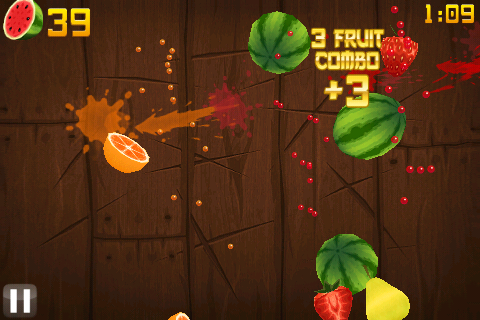
Fruit is tossed in the air, and you use your finger to “slice” it before it drops offscreen. Avoid the bombs and strike multiple fruits for bonus points. You can do it timed, or not-timed, and you can change the color of your blade. Sometimes new fruit appears, and this is more exciting than I’d like to admit. The game is also a bottomless treasure trove of fruit lore and trivia.

This is one of the great dexterity games in the App store. It’s small, simple, and cheap. That’s the point of Apps: they can do one little thing, and because they’re inexpensive and portable, that’s all they need to do. It really is a new kind of gaming.

Monday, August 9, 2010

The King of Kong is King Again

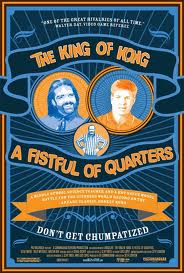
This past weekend, The International Video Game Hall of Fame and Museum in Ottumwa, Iowa (I only wish I was making that up) was formally launched with the announcement of its "Inaugural Class" Inductees, which can be found here.  Individual games, designers, and gamers were all inducted, but for many people, two names stood out. Donkey Kong champions Steve Wiebe and Billy Mitchell have become celebrities beyond the narrow realm of competitive video games, thanks to Seth Gordon's sorta-documentary, The King of Kong: A Fistful of Quarters. The film continues to receive high praise, despite the fact that it seriously distorts the events it claims to document.

As part of the weekend festivities, Mitchell regained the Donkey Kong crown from current champion Hank Chien, scoring 1,062,000. Mitchell also regained the Donkey Kong Jr. crown.

Congratulations to everyone inducted, and I wish the Museum much success if it ever gets built.

In the meantime, I thought I'd share what I wrote about The King of Kong when it first came out. It's an important example of why you shouldn't accept documentaries (or even news) at face value.

The King of Kong
The passionate core of any hobby—be it model trails, sci-fi, or coin-op gaming—is usually comprised of quirky misfits and fringe personalities. People who dedicate all their spare time and disposable income to a single pursuit are rarely the most well-adjusted, mainstream members of society, but they can be the most interesting. Ten years ago, director Roger Nygard’s film Trekkies showed us some of the oddball personalities forming the hard core of Star Trek fandom. Now, first-time feature director Seth Gordon’s The King of Kong does something similar for the classic or coin-op gaming community.

Gordon’s film is the latest in series of classic gaming documentaries, including High Score (chronicling Bill Carlton’s quest to break the Missile Command record) and Chasing Ghosts: Beyond the Arcade (which catches up with top score-holders featured in a seminal 1982 Life Magazine spread). King of Kong enters this world through one very specific rivalry for one coveted world record.

Top score in Donkey Kong is no easy feat. Shigeru Miyamoto’s first masterpiece can be ridiculously difficult to beat, thanks to its tricky timing and the high number of obstacles (barrels, fireballs, springs). The film casts Billy Mitchell as the record-holding goliath in the contest, depicting him as an arrogant jerk willing to do anything to hold onto his record. Mitchell is the top celebrity of the coin-op gaming circuit: a charismatic, mullet-haired entrepreneur who functions as the hobby’s unofficial mascot and spokesman. Though he held numerous records throughout the 80s and 90s, by the time the film was made all but Donkey Kong had fallen, leaving him as more of a figurehead. King of Kong depicts him as little more than a Machiavellian schemer who’s afraid to defend his own record in public.

Pitted against him is the quiet, likable family man Steve Wiebe, a talented obsessive-compulsive high-school science teacher who always seems to fumble just when he seems on the brink of success. Wiebe looks at the Donkey Kong record, says “I can beat that,” wheels a DK machine into his garage, and begins to work on creating a new World Record in Donkey Kong. After he succeeds, he sends the tape of his achievement to Twin Galaxies, the semi-official leaderboard and sanctioning agency for competitive gaming, and waits for his record to be acknowledged.

It’s not to be. As Gordon and his cameras document the process, we get an inside look at the strange personalities that orbit around Mitchell and the coin-op gaming scene. Twin Cities founder Walter Day, judge Robert Mruczek, Mitchell pals Brian Kuh and Steve Sanders, Doris Self (a 79-year-old grandma who has the top Qbert score), and Wiebe’s shady benefactor, a bizarre cartoon of a man named Roy “Mr. Awesome” Shildt, all figure into the story as Twin Cities rejects Wiebe’s high score, and insists he reproduce it in a live venue. At the moment of Steve’s victory, Doris Self delivers a dodgy videotape appearing to show a new record breaking high score by Mitchell.

There is no question that all of this makes for an entertaining film full of interesting characters with mixed motives, many of them appearing to conspire against a likable guy to keep him from getting his due. As a documentary, however, the film is troubling and fundamentally dishonest. Through clever editing and selective omissions, it paints Mitchell as a puffed up has-been who is afraid to play in public, a coward who avoids meeting his competitor, and an obnoxious braggart who uses his influence to steal the record back from an underdog.

In fact, Wiebe and Mitchell had already met and competed in public in 2004, before the events of the documentary: a point never mentioned in the film. More serious is the fact that Mitchell didn’t even hold the record Wiebe was competing against. Mitchell’s original score was broken by Tim Sczerby in 2001. Thus, the entire premise of King of Kong simply collapses, and it becomes clear that Seth Gordon merely wanted the colorful contrast of braggart Mitchell (and even his most obnoxious quotes are little more than the kind of macho smack talk gamers always use against each other, and far from the worst I’ve heard) and the nice-guy Wiebe. 

King of Kong is the work of a new generation of documentarians influenced by the fundamentally dishonest work of Michael Moore, who edits his footage to distort the truth and create events that never happened. They seem to be less interested in the role of the documentary in conveying truth than in polemics and over-the-top reality-TV-style dramatics. King of Kong makes for good entertainment and offers an entertaining snapshot of the world of coin-op competition and fandom, but it’s also dishonest and manipulative.


Monday Puzzle: The Bicycle Thief

A NOTE ABOUT PUZZLES:  I'm going to be running one puzzle a day for the next couple of weeks. Some of these are classics, and some of them are my variations or adaptations of classic ideas. Puzzles will go up at 11am, and solutions will go up at the same time the following day. Please follow us on Facebook, Twitter, Google Friend Connect, or RSS in order to get the daily puzzle and the solution.


Today's puzzle is from Britain's greatest puzzle-maker, Henry Dudeney. I remember getting it wrong the first time I tried it, but it teaches a valuable lesson: don't be distracted by superfluous details.


"Here is a little tangle that is perpetually cropping up in various guises. A cyclist bought a bicycle for £15 and gave in payment a cheque for £25. The seller went to a neighboring shopkeeper and got him to cash the cheque for him, and the cyclist, having received his £10 change, mounted the machine and disappeared. The cheque proved to be valueless, and the salesman was requested by his neighbor to refund the amount he had received. To do this, he was compelled to borrow the £25 from a friend, as the cyclist forgot to leave his address, and could not be found. Now, as the bicycle cost the salesman £11, how much money did he lose altogether?"

App O' The Mornin': SmartGo

The greatest challenge in computer AI programming is not Chess, but Go. It is a game that presents a truly staggering level of complexity. Chess is structured, with a finite number of possible moves and only 64 squares. If a computer can crunch enough of those numbers quickly enough, then it can defeat a master.

Chess masters are routinely defeat by computers, but this never happens with Go masters. There are 361 intersections on a Go board. Play can easily stretch for a couple hundred moves. (The longest game in history had over 400 moves.) Every move affects every subsequent move. Unlike Chess, Go has only a few rules governing stone placement. This results in a staggering number of potential board states, with each new move presenting ever more complex situations.

Obviously, this makes Go a tough game to program, but that doesn’t keep people from trying. Go is heavily represented in the app store, mostly by inferior versions or simple mock-Go variants.

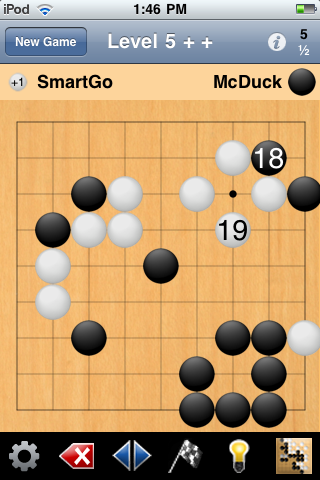
SmartGo, on the other hand, is an old and respected brand that has migrated through multiple platforms, and now arrives as an App in several different flavors. SmartGo 9x9 ($1) is exactly what it sounds like: Go on a 9x9 board for learners and kids. SmartGo ($3) offers a solid computer opponent and various boards ranging up to 19x19. It comes with a thorough tutorial and 100 problems, and will probably be the ideal point of entry for most gamers.

SmartGo Pro ($13) is the full package, complete with a library of 15,000 classic games accompanied by a powerful search tool, game recording and playback, 2,000 problems, multi-language support, and other features for serious users. A unique magnifying glass and crosshairs interface make it easy to place stones even on the full-size board. The entire package is very professional.

It’s remarkable that you can carry around this powerful a piece of software in your pocket. Avoid the other versions and spend a little extra money to get SmartGo. It’s worth it.

NOTE: SmartGo Kifu ($20) is a new version for the iPad. Although it is available, it is still considered a work in progress. Since I don't have an iPad, I haven't had a chance to check it out yet, but I hope to in the future.