I like "Third, That the real object of the amusement shall be gained, namely, that all shall be amused." (Click on the picture to see it full size.)
Sunday, August 15, 2010
Another Neat Item From The Games We Play
I like "Third, That the real object of the amusement shall be gained, namely, that all shall be amused." (Click on the picture to see it full size.)
Labels:
Vault
Saturday, August 14, 2010
Friday Puzzle SOLUTION: The Stopped Clock
When he arrives at Mr. Been's, he notes the correct time.
When he leaves Mr. Been's he notes the time once more. Thus, he knows how long he has been there, and the precise time upon his departure.
When he checks his own clock, all Mr. Leen has to do is subtract the time he spent at Mr. Been's. This gives him his total walking time. If he halves this, he then has the total time it takes to make the trip one-way. He adds this time to the time he noted on Mr. Been's clock upon leaving, and he gets the current time.
For example: He sets his own (incorrect) clock to 12:00, walks to Mr. Been's, and notes that the accurate time is 10:30. He spends 2 hours there, and upon leaving notes that the time is 12:30.
When he arrives home, his own clock reads 3:00. Three hours have passed since he left the house.
Two hours were spent at Mr. Been's, which means that 1 hour was spent walking round trip. Thus, one leg of the trip takes 30 minutes. Since he left Mr. Been's at 12:30, he sets his clock for 1:00.
Friday, August 13, 2010
The Games We Play
Labels:
Board games,
Vault
Friday Puzzle: The Stopped Clock
One day, he returns home to find that his servant has forgotten to wind the clock. Since his watch is broken, he is unable to set the correct time.
However, he has a solution. His friend Mr. Been has recently moved to town. He decides to walk to Mr. Been's, pay his first call at his friend's new lodging, and see what time it is.
After spending a hearty afternoon of fellowship, he returns to set his clock. Although he had never made the trip to visit Mr. Been before, and thus has no idea how long the walk takes, he is able to set his own clock correctly.
How does he do it?
Thursday Puzzle SOLUTION: Judkins's Cattle
"As there were five droves with an equal number of animals in each drove, the number must be divisible by 5; and as every one of the eight dealers bought the same number of animals, the number must be divisible by 8. Therefore the number must be a multiple of 40. The highest possible multiple of 40 that will work will be found to be 120, and this number could be made up in one of two ways—1 ox, 23 pigs, and 96 sheep, or 3 oxen, 8 pigs, and 109 sheep. But the first is excluded by the statement that the animals consisted of 'oxen, pigs, and sheep,' because a single ox is not oxen. Therefore the second grouping is the correct answer."
App O' The Mornin': Knights of Charlemagne
Also, a lot of those games go out of print. Knights of Charlemagne was only released 4 years ago, and it’s no longer available. It was really just a tweaked re-theming of a Knizia design from 1995, called Tabula Rasa. It, too, is long out of print.
But Knizia has two games that never go out of print: Lost Cities and Battleline. In keeping with our theme, Battleline itself was a new version of Schotten-Totten. Are you still following me?
All of these games have Rummy as their bedrock: you’re drawing cards in order to collect certain suits. The fun is in their special rules, themes, and nuances. Knights of Charlemagne is a close cousin of Battleline, and if you’re looking for a Battleline-type experience on your iPhone, this is the game to get.
Play is very simple. Players are dealt cards numbered 1 to 5, in 5 different colors. A row of ten tiles divides the two players: 5 numbered tiles, and 5 colored tiles. Players place cards on either the matching color or number to “claim” that tile. When the game ends, the person who has the most cards on a tile earns points for it. Although the cards are bit too small, this is still a clean, fast-playing implantation of classic style of game.
Knizia is heavily represented on the App store, with more games arriving at a steady clip. The latest are High Society and Medici. I’ll be taking a look at all of them in the upcoming weeks.
Labels:
Apps,
Board games,
Knizia
Thursday, August 12, 2010
Thursday Puzzle: Judkins's Cattle
"Hiram B. Judkins, a cattle-dealer of Texas, had five droves of animals, consisting of oxen, pigs, and sheep, with the same number of animals in each drove. One morning he sold all that he had to eight dealers. Each dealer bought the same number of animals, paying seventeen dollars for each ox, four dollars for each pig, and two dollars for each sheep; and Hiram received in all three hundred and one dollars. What is the greatest number of animals he could have had? And how many would there be of each kind?"
Wednesday Puzzle SOLUTION: Closing the Gap
All you need to do is figure out the rate of closure in miles-per-minute, and you have the distance the rockets will be one minute before they collide. The rockets are closing at a total rate of 24,000 miles-per-hour. This translates to 400 miles-per-minute, which means they will be 400 miles apart one minute before they collide.
App O' The Mornin': Oregon Trail
Oregon Trail was the first computer gaming experience for many kids in 1980s, because someone managed to convince the schools that it was this new thing called "edutainement": it's edumacation, but in an entertaining way! Thus, they became the first generation to use computer technology for dubious educational purposes.
Of course, those who scoff at its educational qualities probably only remember what "dysentery" is because they played this. In truth, there is an element of history and decision-making that made it more informative than most games, and those qualities were improved as the original was enhanced and expanded over the years.
Believe it or not, Oregon Trail is almost 40 years old. Although most gamers of a certain age are probably familiar with the Apple, Commodore, or PC versions, the original game was created back in 1971. It’s been reinvented for new systems ever since, without losing any of its quirky charm or educational value.
The App updating of this classic has captured all of its strange humor and educational content. Gameplay breaks down into a few simple categories: setting a pace for your travel, managing food stores, making decisions about when to stop or who to help along the way, and completing various mini-games such as hunting or fishing.
If you go too fast, and little Mary might break a leg or the wagon may lose a wheel. Go too slow, and you might run out of food. Do you let that rather scruffy-looking old-timer hitch a ride, or pass him by? At certain points, kids can learn a bit about the land and how people survive, or stop to talk with a young Abraham Lincoln. And, yes, the family can still get dysentery.
This isn't just a retro blast for Millennials. Any kid, and most adults, will find this entertaining.
Wednesday, August 11, 2010
Wednesday Puzzle: Closing the Gap
One rocket travels at 11,000 miles per hour. The other travels at 13,000 miles per hour.
Without doing calculations on paper, can you tell how far apart will they be one minute before they hit each other?
Tuesday Puzzle SOLUTION: Sequencing
O T T F F S S . . .
One, Two, Three, Four, Five, Six, Seven.
Thus, the next three letters are ... E N T.
Eight, Nine, Ten.
ThinkFun Has a Blog
I've been a big fan of their puzzles for a long time. Some of them always come along on vacation with us. If you don't have any in your collection, you really should pick up a few.
(I still haven't gotten used to referring to "Binary Arts" as "ThinkFun." I liked the old name better.)
App O' The Mornin': Rush Hour
Rush Hour is played on a simple 6x6 plastic grid filled with little cars. The cars take up either 2 or 3 spaces, and must be slid in such a way that a red car has a clear path to the only exit. Cards instruct you how to set up each puzzle, with solutions ranging from a few moves to several dozen. It’s a game that can be simple enough for a kindergartener and complex enough for a puzzle master. It may be only a variant on the classic sliding-tile puzzles, but it’s a slick, engrossing one.
If you’re already familiar with the original game, all I really need to say is: “It’s Rush Hour! In app form!”
The puzzles can be played in any order, and each one records the Squares Moved, Previous Record, and Minimum Possible score. The complete game costs $1, while Rush Hour Free offers 70 puzzles as a taste, just like drug dealers do!
As an alternative for kids, check out Wriggle, which comes in both full and free versions. The mechanics are a little bit different, since you’re moving fuzzy worms rather than cars, but the puzzle style is very similar
.
Tuesday, August 10, 2010
A Note About Puzzles
Some of these are classics, and some of them are my variations or adaptations of classic ideas. Some of them have been around so long no one even knows who first came up with them. If I know an actual source, I will credit it, but some are just things I remember from a lifetime of reading.
![]() | ||
| Martin Gardner: 1914 - 2010 |
Sadly, Martin Gardner recently passed away. He was a longtime contributor to Games Magazine and an inspiration to many math, logic, and puzzle buffs. He was a true polymath, and his work embraced everything from debunking of pseudoscience; to mathematics, games, and puzzles; to literary criticism.
Bonus Martin Gardner puzzle: what is significant about the number 8,549,176,320? (HT: NY Times)
Labels:
Puzzles
Tuesday Puzzle: Sequencing
O T T F F S S . . .
Monday Puzzle SOLUTION: The Bicycle Thief
The only money that matters is the money lost to the thief. Here's Dudeney's solution:
"People give all sorts of absurd answers to this question, and yet it is perfectly simple if one just considers that the salesman cannot possibly have lost more than the cyclist actually stole. The latter rode away with a bicycle which cost the salesman eleven pounds, and the ten pounds "change;" he thus made off with twenty-one pounds, in exchange for a worthless bit of paper. This is the exact amount of the salesman's loss, and the other operations of changing the cheque and borrowing from a friend do not affect the question in the slightest. The loss of prospective profit on the sale of the bicycle is, of course, not direct loss of money out of pocket."
Some may think this is a cheat because of the misdirection of the salesman having to borrow the £25. Since he already had the £15 change from the cashed check, why would he need to borrow £25?
You need to forget that kind of distraction and just focus on the numbers. Why he borrowed the £25 is not important. All that's important is 1) money lost to the thief, and 2) money actually in hand. Keep the focus on the data.
App O' The Mornin': Fruit Ninja
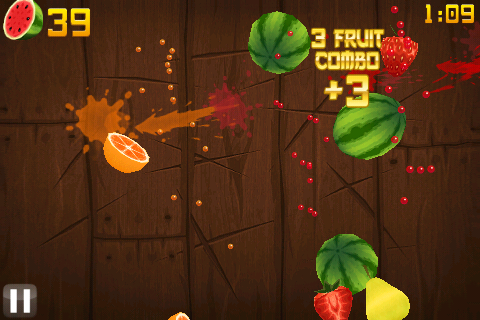
And well you should. I resisted the Fruit Ninja temptation at first, since it looked like a piece of one-note twitchware that does very little.
After I finally spent some time with it, I realized that is was a piece of one-note twitchware that does very little, but I didn’t care. I loved it anyway, and have logged a fair amount of time trying to my nudge my top score ever higher.
Fruit Ninja is based on the simple premise that “Ninjas hate fruit.” I don’t want to know why they hate fruit, and I sure hope the developer isn’t planning on spinning this into some revenge-driven storyline based upon the fruit-related deaths of ninja loved ones.
(On second thought, I would like to see that.)
Fruit is tossed in the air, and you use your finger to “slice” it before it drops offscreen. Avoid the bombs and strike multiple fruits for bonus points. You can do it timed, or not-timed, and you can change the color of your blade. Sometimes new fruit appears, and this is more exciting than I’d like to admit. The game is also a bottomless treasure trove of fruit lore and trivia.
This is one of the great dexterity games in the App store. It’s small, simple, and cheap. That’s the point of Apps: they can do one little thing, and because they’re inexpensive and portable, that’s all they need to do. It really is a new kind of gaming.
Labels:
Apps
Monday, August 9, 2010
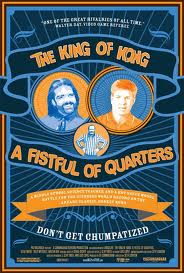
The King of Kong is King Again
As part of the weekend festivities, Mitchell regained the Donkey Kong crown from current champion Hank Chien, scoring 1,062,000. Mitchell also regained the Donkey Kong Jr. crown.
Congratulations to everyone inducted, and I wish the Museum much success if it ever gets built.
In the meantime, I thought I'd share what I wrote about The King of Kong when it first came out. It's an important example of why you shouldn't accept documentaries (or even news) at face value.
The King of Kong
The passionate core of any hobby—be it model trails, sci-fi, or coin-op gaming—is usually comprised of quirky misfits and fringe personalities. People who dedicate all their spare time and disposable income to a single pursuit are rarely the most well-adjusted, mainstream members of society, but they can be the most interesting. Ten years ago, director Roger Nygard’s film Trekkies showed us some of the oddball personalities forming the hard core of Star Trek fandom. Now, first-time feature director Seth Gordon’s The King of Kong does something similar for the classic or coin-op gaming community.
Gordon’s film is the latest in series of classic gaming documentaries, including High Score (chronicling Bill Carlton’s quest to break the Missile Command record) and Chasing Ghosts: Beyond the Arcade (which catches up with top score-holders featured in a seminal 1982 Life Magazine spread). King of Kong enters this world through one very specific rivalry for one coveted world record.
Top score in Donkey Kong is no easy feat. Shigeru Miyamoto’s first masterpiece can be ridiculously difficult to beat, thanks to its tricky timing and the high number of obstacles (barrels, fireballs, springs). The film casts Billy Mitchell as the record-holding goliath in the contest, depicting him as an arrogant jerk willing to do anything to hold onto his record. Mitchell is the top celebrity of the coin-op gaming circuit: a charismatic, mullet-haired entrepreneur who functions as the hobby’s unofficial mascot and spokesman. Though he held numerous records throughout the 80s and 90s, by the time the film was made all but Donkey Kong had fallen, leaving him as more of a figurehead. King of Kong depicts him as little more than a Machiavellian schemer who’s afraid to defend his own record in public.
Pitted against him is the quiet, likable family man Steve Wiebe, a talented obsessive-compulsive high-school science teacher who always seems to fumble just when he seems on the brink of success. Wiebe looks at the Donkey Kong record, says “I can beat that,” wheels a DK machine into his garage, and begins to work on creating a new World Record in Donkey Kong. After he succeeds, he sends the tape of his achievement to Twin Galaxies, the semi-official leaderboard and sanctioning agency for competitive gaming, and waits for his record to be acknowledged.
It’s not to be. As Gordon and his cameras document the process, we get an inside look at the strange personalities that orbit around Mitchell and the coin-op gaming scene. Twin Cities founder Walter Day, judge Robert Mruczek, Mitchell pals Brian Kuh and Steve Sanders, Doris Self (a 79-year-old grandma who has the top Qbert score), and Wiebe’s shady benefactor, a bizarre cartoon of a man named Roy “Mr. Awesome” Shildt, all figure into the story as Twin Cities rejects Wiebe’s high score, and insists he reproduce it in a live venue. At the moment of Steve’s victory, Doris Self delivers a dodgy videotape appearing to show a new record breaking high score by Mitchell.
There is no question that all of this makes for an entertaining film full of interesting characters with mixed motives, many of them appearing to conspire against a likable guy to keep him from getting his due. As a documentary, however, the film is troubling and fundamentally dishonest. Through clever editing and selective omissions, it paints Mitchell as a puffed up has-been who is afraid to play in public, a coward who avoids meeting his competitor, and an obnoxious braggart who uses his influence to steal the record back from an underdog.
In fact, Wiebe and Mitchell had already met and competed in public in 2004, before the events of the documentary: a point never mentioned in the film. More serious is the fact that Mitchell didn’t even hold the record Wiebe was competing against. Mitchell’s original score was broken by Tim Sczerby in 2001. Thus, the entire premise of King of Kong simply collapses, and it becomes clear that Seth Gordon merely wanted the colorful contrast of braggart Mitchell (and even his most obnoxious quotes are little more than the kind of macho smack talk gamers always use against each other, and far from the worst I’ve heard) and the nice-guy Wiebe.
King of Kong is the work of a new generation of documentarians influenced by the fundamentally dishonest work of Michael Moore, who edits his footage to distort the truth and create events that never happened. They seem to be less interested in the role of the documentary in conveying truth than in polemics and over-the-top reality-TV-style dramatics. King of Kong makes for good entertainment and offers an entertaining snapshot of the world of coin-op competition and fandom, but it’s also dishonest and manipulative.
Labels:
Videogames
Monday Puzzle: The Bicycle Thief
Today's puzzle is from Britain's greatest puzzle-maker, Henry Dudeney. I remember getting it wrong the first time I tried it, but it teaches a valuable lesson: don't be distracted by superfluous details.
"Here is a little tangle that is perpetually cropping up in various guises. A cyclist bought a bicycle for £15 and gave in payment a cheque for £25. The seller went to a neighboring shopkeeper and got him to cash the cheque for him, and the cyclist, having received his £10 change, mounted the machine and disappeared. The cheque proved to be valueless, and the salesman was requested by his neighbor to refund the amount he had received. To do this, he was compelled to borrow the £25 from a friend, as the cyclist forgot to leave his address, and could not be found. Now, as the bicycle cost the salesman £11, how much money did he lose altogether?"
App O' The Mornin': SmartGo
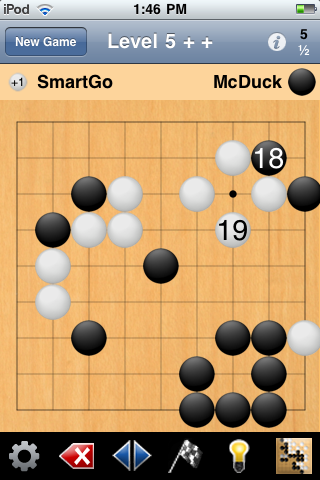
Obviously, this makes Go a tough game to program, but that doesn’t keep people from trying. Go is heavily represented in the app store, mostly by inferior versions or simple mock-Go variants.
SmartGo, on the other hand, is an old and respected brand that has migrated through multiple platforms, and now arrives as an App in several different flavors. SmartGo 9x9 ($1) is exactly what it sounds like: Go on a 9x9 board for learners and kids. SmartGo ($3) offers a solid computer opponent and various boards ranging up to 19x19. It comes with a thorough tutorial and 100 problems, and will probably be the ideal point of entry for most gamers.
SmartGo Pro ($13) is the full package, complete with a library of 15,000 classic games accompanied by a powerful search tool, game recording and playback, 2,000 problems, multi-language support, and other features for serious users. A unique magnifying glass and crosshairs interface make it easy to place stones even on the full-size board. The entire package is very professional.
It’s remarkable that you can carry around this powerful a piece of software in your pocket. Avoid the other versions and spend a little extra money to get SmartGo. It’s worth it.
NOTE: SmartGo Kifu ($20) is a new version for the iPad. Although it is available, it is still considered a work in progress. Since I don't have an iPad, I haven't had a chance to check it out yet, but I hope to in the future.
Labels:
Abstract Strategy,
Apps,
Go
Subscribe to:
Posts (Atom)