Saturday, August 7, 2010

Weekend Puzzle

Three ladies go out for a night on the town: Miss Blue, Miss Green, and Miss Black. One is wearing a blue dress, one a green dress, and one a black dress.

"Look!" says Miss Blue. "We all have on dresses that match our last name, but none of us is wearing a dress that matches her own name!"

"I want another drink," says the lady in black.

What color is each lady wearing?


[This is an old one, which was probably first devised by Martin Gardner.]

Friday, August 6, 2010

eCribbage: An Online Home for Cribbage Lovers

Since today is turning into Cribbage Friday, we might as well make it a full trifecta and talk about the best site for Cribbage online: eCribbage.com.

After you try eCribbage, you won’t want to bother with any other site. This is the real deal: slick, professional, and loaded to the gills with features.

The programs and the site are the work of Damien Blond. This isn’t just any card-playing website. This is the work of someone who has focused on doing one game right. Even more impressive is Blond’s desire to create a real online community of card enthusiasts, where fans can find live opponents, communicate, and, compete.

As of this writing, the site has almost 22,000 registered users, and it’s not at all unusual find a hundred people competing in several dozen games. Leaderboards, messaging, teams, and tournament tracks all come together to create a little corner of the internet that Cribbage fans can call home.

The game software itself is first-rate, with two levels of AI opponent in addition to the live players. Graphics are clean and functional, with a simple interface and plenty of information on each game. The software even rates your play by calculating a Cribbage rating, derived from the CXR system used in Chess.

The only quibble I have with eCribbage is the peculiar use of sound effects, which are jarring. Since I turn off the sound to play cards, this doesn’t bother me, but it’s one of the few awkward spots on an otherwise professional site.

eCribbage offers the traditional game (2, 3, and 4 hands), King’s Cribbage, CrossCrib, Crib With Jokers, Lowball Cribbage, Back Up 10 Cribbage, Crash Cribbage, and Cross 5 Cribbage, plus the opportunity to play with manual scoring, muggings rules, and team play.

Basic gameplay is free, but a $34 Pro subscription offers additional features, such as custom avatars, advanced stats, and the ability to form leagues. It also helps keep the site afloat, so if you find yourself putting in some time there, you might want to pitch a little something in the kitty.

Whether you’re looking for a quick game against a computer opponent, or trying to find a live player, eCribbage is the only place you need to go.

Nobs, Heels, and Muggins: Why Cribbage is King

Sometimes you learn a new game and discover just what you’ve been missing all these years. If I had an opportunity to sit down with a card player and teach him any game I could, that game would be Cribbage.

Until a couple of months ago, my sole point of reference for Cribbage was “that game that Maj. Winchester played on M*A*S*H.” Sure, I knew about the famous board-and-peg scoring mechanic, and even had a couple of boards lying around, but I never just sat down to learn the game.

Between the Cribbage King App and David Parlett’s Penguin Book of Card Games, I was able to teach myself fairly quickly. I began playing several hands on the App every day, and gradually got the hang of its unique elements.

Cribbage is part card game, part race game. The function of the board is to track points for each hand. The first person to make it to 121, wins. The game was invented in the early 17th Century by Sir John Suckling, who not only had a great name, but was also one the Cavalier poets (a group that included Ben Jonson and Robert Herrick).

The point system can be intimidating at first, since it seems to have a lot of fussy details. In fact, it’s governed by a few easy-to-remember rules. Each player is dealt 5 cards (or 6 or 7, depending upon which version you choose to play). They immediately discard 2 cards to the “crib,” which is a second hand that will be scored by the dealer. (The role of dealer alternates each turn, with low card beginning the deal.)

The play is simple: people take turns laying cards, one at a time, face up on the table. Each card has a standard point value, Aces low. Points are awarded based on a few simple criteria. Pairs, triples, and runs peg 1 point per card. If someone places a card that brings the face total to 15, they peg 2 points. If they are the last person able to play a card without going over 31, they peg a point. If they bring the total to 31, they peg 2 points. Card placement then begins again until both hands are exhausted.

When placement is done, players score their hands. They peg points for combinations adding up to 15, pairs, and runs. The dealer also gets to score the “crib” as an extra hand. Thus, when you control the crib, you discard good cards worth points. When the opponent controls the crib, you discard junk (or what you hope will be junk).

I’m leaving out some of the finer points, along with the colorful British terminology. There are points for “His Heels” and “His Nobs,” rules for swiping other people's points (called "muggins"), and other details that add color and depth. Check out the Pagat entry for the full rules.

Cribbage works on several levels, with interlocking strategies that are a delight to manipulate. As with any card game, you're subject to the luck of the draw, but you can bend that luck in ways other games don't allow. A bad draw doesn't have to correlate to a bad hand. The choice of which cards to unload to the crib (as dealer or non-dealer), what order to lay down cards, and which points to attempt all factor into the strategy.


There really is nothing quite like it in the realm of card play. Despite its layered scoring system (which allows cards to score points more than once) and its unique terminology, it’s a fairly easy game to learn and teach. It also plays like gangbusters. People familiar with the rules and scoring system can knock through a full scoring track in about 15 to 20 minutes.

Don’t be put off if the rules seem a bit baroque. A little time spent with an App or web version of the game will get you up to speed quickly. You’ll soon start to see where points are made, and how to manage the crib to best thwart your opponent while rewarding yourself. Print out a simple cheat sheet of the scoring combos and keep it at hand as you learn. A good one can be found here.

Almost every discount store sells a cheap Cribbage board. Target and Walmart sell one by Cardinal that costs about $5, and stores the pegs in a cavity on the bottom. (It also comes with a deck of Cardinal cards, which are good for target practice.)

The eCribbage site is also an excellent way to play, and I plan to cover it in more depth.

It can be played by up to four people, but Cribbage is best as a two-handed game. Although it’s a quintessential English pub game, it doesn’t have a huge following in America.

Let’s try to remedy that.


App O' the Mornin': Cribbage King


I’m going to post a longer item on Cribbage later today, so I wanted today’s App O’ the Mornin’ to focus on my favorite Cribbage App.

Lately, Cribbage King has been the App that gets the heaviest workout on my iPod Touch. I tried a couple of other Cribbage games, and just wasn’t satisfied. Cribbage Lite/Premium has an unappealing design and poor scoring system, Cribbage Deluxe is ugly, and the Cribbage included with Card Shark simply isn’t full-featured enough.

Cribbage King, however, offers a terrific little package, with the main game for free and the registered version for $1. It looks great, and has a very fluid and intuitive touch control scheme. It shows you when points are scored and then pegs them on the animated board. In between each hand, it shows precisely where each point comes from.

Features in the registered version include three different difficulty levels, with three players each; options for up to four hands; and different kinds of scoring. This last feature is quite neat, since it allows you to manually enter your scores. This might just seem like a needless bit of extra work, but it actually has a tactical role in Cribbage play. If you fail to score some of your points, your opponent can claim these points under the “Muggins” rule. Cribbage King incorporates this rule, and the AI will use it every chance it gets.

I do find it bizarre that more options and variants are not included. You have 6-card Cribbage, and that's it. I'd much rather play 5-card.

The Card Sharks compilation is a great App that should be on every card-lover’s smartphone, but there are some games that just require stand-alone versions. Cribbage is one of them, and Cribbage King is the stand-along version of choice.

Thursday, August 5, 2010

Games Magazine for October 2010

The new issue of Games should be arriving within the week. Since it's the October issue (yes, in August: it's absurd) the cover puzzle has a Halloween theme.

There's a feature about the 2010 U.S. Memory Championship, a classic puzzle from the late, great Martin Gardner, and the usual selection of reviews, features, news, and puzzles. I contributed a story about the mysterious success of Zynga and their awful games (Farmville, Mafia, etc), and added an extra page of electronic game reviews this month.

Buy it wherever better magazines are sold.

Gen Con Begins

Summertime is gaming season, with several major conventions, shows and competitions around the globe. Today marks the opening of Gen Con, one of the largest and oldest in the world. Last year, about 28,000 flocked in the Indianapolis for 4 days of gaming, competition, exhibits, and overall geek love. It's kind of an E3 for conventional gaming. (Since Gen Con has been around almost 30 years, I should probably say that E3 is a Gen Con for electronic gaming.)

Gen Con has even produced an App, Gen Con Mobile, with maps, event schedules, and Twitter/Facebook support.

Follow details about this year's show on their site, Twitter, or Facebook.

App O' the Mornin': Zombie Dice


Yesterday, I posted a little outburst about Munchkin games and their transcendent awfulness. Zombie Dice is what prompted that outburst.

Munchkin had long been a sore point, since it really is just about everything that could be wrong with a card game compressed into one over-priced, under-produced waste of shelf space.

But spending time with the Zombie Dice app is what finally made me lose hope that Steve Jackson Games was capable of making a good product.

The Zombie Dice app isn’t really meant to be it’s own game. (At least, I hope not.) Instead, it’s more like an interactive demo for the actual, tabletop dice game, complete with an in-game ad telling you where to buy your very own set.

This is where SJG has made their fatal error. The success of their titles depends upon people thinking they look good in the package and sound like they might be entertaining. They don’t depend upon actual time spent with their gameplay, which only reveals their shortcomings.

Zombie Dice is what Yahtzee would be like if Yahtzee was much dumber and trying desperately to cash in on the zombie fad. (Or the Cthulhu fad, since there’s also Cthulhu Dice.) Basically, you’re a zombie who’s rolling dice to try to determine if he gets to eat some brains. The dice are red, yellow, or green, and have pictures representing SHOTGUN, FEET, and BRAINS. If you roll brains, you get a snack and 1 point. If you roll feet, your victim runs away. If you roll shotgun, you get blasted. If you get three shotguns, your turn is over and you lose the brain points you’ve already accumulated.

The idea is that you have to decide how far to press your luck by choosing when to stop rolling. And … well, that’s pretty much it. If you’re smart enough to stop rolling when you have 2 shotguns, then you’ll probably never get blasted. That’s really not a lot to hang an entire game line on, is it?

And, no, I’m no leaving out some vital part of the gameplay. That’s really all there is to it.

I cannot tell you how glad I am that I downloaded this App. Based on my disappointing encounters with everything else from Steve Jackson Games, I was beginning to wonder if they were capable of making a good game. Now, I no longer wonder.

UPDATE: After I posted this, I received some good comments about Revolution by SJG, so there is hope!

Play in Public

The gaming site Seize Your Turn has kicked off a "Play in Public" campaign for the month of August. The goal is to get adult boardgame fans to set up and play in public places in order to inspire more people to learn abut the hobby. Taking your game session out to a Borders, Barnes & Noble, or other reasonably peaceful, relatively wind-free public place (eg: probably not a food court or park) isn't just a good way to tell people about Dominion or Finca. It's also a fine way to shake up a normal game night.

It's pretty easy to get local bookstores and coffee shops to sponsor open game nights, which has two benefits: 1) more people can learn about games, thus creating 2) more people to play with. So, as the nice man at the bar always tells me, "Take it outside."

Check out the website or the Facebook page for more information.

Wednesday, August 4, 2010

Mammas, Don’t Let Your Babies Grow up to Play Munchkin


Every parent should have a few bare-minimum goals: keep your kids off drugs, make sure they get a good education, and don’t let them play Munchkin games. I’ve already failed at the last of these, so I’m paying extra special attention to the other two.

I have yet to play anything from Steve Jackson Games that I thought was any good. The titles that clog the shelves—Munchkin, Chez Whatever, and those crummy dice games—are simply bad design, period.

The worst of these, by far, is the Munchkin series. I’d rather be strapped down for a 24-hour session of Sorry than sit through another session of Munchkin Bites.

The premise is faintly amusing. In RPG (role-playing game) slang, a “munchkin” is a player who just cares about combat and loot. Munchkin turns that approach into a card game, in which you begin as a Level 1 character with a goal of getting to Level 10. Each turn, you “kick in the door” to generate encounters, and then fight any creatures you encounter. Any items you’ve collected add points to your base level, so that a Level 1 character could fight at Level 12. If you encounter a monster, you compare this number against its number, and either you win, lose, or run away.

That’s it. That’s all you do. Over and over again, game without end, Amen.

The Mysterious Success of Munchkin

As far as I can tell, Munchkin has one thing going for it that makes it fly off the shelves: the art of John Kovalic. The cards and Kovalic’s cartoons are genuinely funny, and always worth a laugh for game fans, particularly those who recognize the clichés and pop culture references being skewered.

Readers who like this kind of humor can save themselves the irritation of bad gameplay and just check out Dork Tower. It’s cheaper, better, and doesn’t involve absurd level mechanics.

Look, any criticism I level at Munchkin will be dismissed by fans as “not getting it.” I can hear lonely Munchkin fans saying, “The gameplay itself is supposed to be a satire of gameplay conventions!”

No. Just … no. Satire is satire, and gameplay is gameplay. Gameplay mechanics are not a satirical medium.

Strip away the humor and you have a truly awful game. The gameplay is nothing but grinding monotony: turn over door card, add up attack value, compare it to monster, and either a) win, b) run away, or c) fail to run away and die. Die and everyone splits your stuff and you have to start over again. It’s maddening.

Fans of the series appreciate this madcap approach to gameplay, perhaps seeing it as more of a social lubricant than as an example of fine gamecraft.

For $25, I'd rather just buy a couple of cases of social lubricant and a pack of playing cards.


It Keeps Going, And Going, And Going…

I assumed Munchkin would vanish long ago, or simply find itself relegated to a small niche of dedicated gamers. Instead, it actually seems to be growing like some hideous fungoid mass, spinning off new editions and taking over shelf space that could be used by better games.

When Barnes & Noble and Borders started expanding their game offerings, I was pleased. It’s great to have a major retailer get behind Euro-titles and adult boardgaming. These are an ideal place for adult games to reach a mainstream audience.

But when you look at the displays, you see a whole section of Munchkin games, each selling for $25. That $25 is the key, since many of the good games cost $40 to $50. Combined with appealing art and packaging, as well as fun themes, that price point helps sell Munchkin to people who might have otherwise bought something that would spark a love of good gaming.

Instead, they get home and find … a box of cards, a die, and a rule sheet. The game is unplayable without counters or character sheets, so why doesn’t SJG games provide these? You have to go to their website and print them yourself. Is it that big an expense to add some character sheets and a few chits? This isn’t an inexpensive title from James Ernest. This is a $25 purchase!

Consumers opening a new game only to find a $25 box of cards are not going to be consumers who think fondly of other new and untried games. This makes Munchkin a kind of anti-game, actually driving people away from the genre.

I know Steve Jackson’s name has a certain resonance among old-timey gamers, but Car Wars and GURPS were a long time ago. Lately, Steve Jackson Games seems mostly committed to churning out endless editions of inferior product.

UPDATE: After I posted this, I received some good comments about Revolution by SJG, so there is hope!

Sometimes words aren't needed

For some gamers (you know who you are), this will be all they need to know about the new Oregon Trail app.

App O' The Mornin': Clue

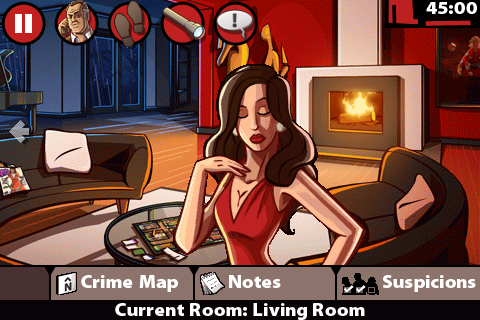
Clue is one of the few classic American games that has actually benefited from being poked, prodded, squeezed, and occasionally reinvented.

Various Monopoly incarnations are essentially the same core gameplay with new proporties and actions cards. Clue, however, has provided some nice variations on the basic theme. Clue Mysteries, Clue Suspects, Clue: The Great Museum Caper, Clue DVD Game and even the much maligned Clue: Secrets and Spies all have their strong points. Heck, even some of the themed clues, such as Harry Potter and even Seinfeld (seriously) are not a total wash.

Never one to leave well enough alone, Electronic Arts has decided to reinvent Clue yet again for the the App market. They seem to have designed their Clue app to be as unappealing as possible to fans of the game. There is no traditional board layout, the classic visuals have been updated to make the characters and locations look more contemporary, and the entire pace and structure of the original game has been dropped.

In its place EA offers something very different, but with its own charms.

Rather than turning the classic whodunit game straight into an app, EA has instead hung a kind of interactive mystery on the bones of the original. Instead of moving around a board or competing against other detectives, you move from room to room asking questions from a menu of dialog options and searching for clues. 

As an ace reporter on a deadline, you can perform only a certain number of actions before your time runs out, and you need to call your editor with the suspect, location, and weapon used to kill Mr. Boddy. You’re able to use a map of the game to place suspects and weapons where they were located when the crime occured, and then cross potential suspects off your list before you make your final accusation. 

The touch controls are a bit fussy, with a little too much screen flipping and awkward input locations. There's also a timing element, which limits the number of moves you can make before you have to solve the mystery. This timing element seems to mimic the "clock" cards that are being added to some clue variants in order to make the game more suspenseful. Actually, they only make the game feel rushed and somewhat random.

Needless to say, the contemporary setting is nowhere near as appealing as the old English country house mystery captured so effectively by the original. Hasbro has so little clue about what people like in this game that they even created an updated edition, called Clue: Discover the Secret, that dispensed with the classic setting in favor of a cast of washed-up child stars, videogame designers, and football players. Note to Hasbro: People like cozy English mysteries. They don't like dated pop-culture pandering.

Those reservations aside, this is a still a fun little interactive mystery. There are ten cases in all, and each has random elements and a scoring system to encourage repeat play. This isn’t Clue, but it has its own appeal.


Tuesday, August 3, 2010

App O’ the Morning: Yahtzee Adventures

Seriously? A Yahtzee app? Yahtzee? The dice thing?

Yeah, I’m reviewing Yahtzee. Even worse, I’m giving it a positive review. And even worse than that, I’m admitting that, from time to time, I find it pretty darn addictive.

That’s odd, because I never play Yahtzee. In preparing for this review, I sat down with my Yahtzee Elvis: Shake, Rattle and Roll Edition and tried to work up some enthusiasm.

It’s poker! With Dice! And scoring! And chips for … actually, I have no idea what the point of the chips is, but they make a nice rattly sound in the plastic cup of the travel edition.

Annnnd ... I just couldn't continue. The specter of vast amounts of dice-rolling stretched out before me, and I quailed at the prospect. I put the pieces away and set the game on the shelf next to my copy of Monopoly Elvis Collector’s Edition, then went back to separating my drier lint by color, which seemed far more interesting.

But for some reason, I keep coming back to the app, which is called Yahtzee Adventures.

Don’t be fooled by the “Adventures” part, which is a just a hopeless attempt to make it sound like this isn’t a game about rolling dice over and over again. It fails for the simple reason that this is a game about rolling dice over and over again.

The Yahtzee Adventure puts you in the role (hah, get it? get it?! … ehhhh, never mind) of Grasshopper to some guy's Sensei, and frankly I could not care less. The idea is that you have to “battle” against a series of opponents across the world to unlock secret dice and become some kind of Yahtzee Bruce Lee in a dice-driven Game of Death. Every character is hideously annoying and someone desperately needs to poke Sensei in the eye with a chopstick. The whole regrettable thing can be finished in about an hour. Plus: you never get to use the special dice, which makes you wonder what the point was. Let us never speak of it again.

Moving on from the Adventure part, however, brings us to plain old Yahtzee, and that was really all they needed to do in the first place. You can burn through a game of Yahtzee in about ten minutes flat, either by click-rolling or shaking the iPhone to roll. Scoring and rolling are all done on a single screen, and it all looks good and controls smoothly.

I have no idea why, but I found this so much more entertaining that I ever found real Yahtzee. Maybe it was the speed, which appeals to my ADD, or maybe it was just the ability to do it while waiting at the DMV. It doesn’t take much thought or effort, but has the right combination of chance with a tiniest bit of skill to keep it interesting.

The game includes a few interesting variants to keep things fresh. The “Rainbow” game uses colored dice, with the ability to score an extra set based on rolling all of one color. The “Battle” game splits the two halves of the scorecard into “attack” and “heal.” Roll an “attack,” and you drain points from an enemy. Roll a “heal,” and you restore you own points. The goal is to get the enemy down to zero points.

The App has its share of little annoyances, such as asking me if I want sound every time I start it, and then completely ignoring the fact that I selected “no.”

Look, I don’t even like Yahtzee, and I liked this App, so that should be a fair indication that Apps function under somewhat different rules than their tabletop versions.


Monday, August 2, 2010

Definitions: Apps


Most readers probably don’t need to be told that “Apps” is short for “applications,” and is most closely associated with software running on Apple’s smartphones and similar portable devices.

Yes, people talk about “Apps” for Android and other mobile platforms, but as far as this site is concerned, if you can’t buy it on iTunes, it isn't an App: it’s an unfortunate byproduct of a poor consumer choice.

I am a hardcore PC loyalist, but I no longer fear the Fruit. I made the mistake of doubting the power of Apple in the early days of the iPod. I would not become a consumer of Apples. I would be different, and buy a portable MP3 player made by … Rio.

Within a year of that purchase, the unit was lying in pieces on my work table, as I tried to dissect its manifest failings and get it functional again. I finally gave up, bought the first of several iPods, and have been happy ever since.

Apple owns this market. Period. Everything else (Android, Windows Phone, etc) is the electronic equivalent of a triceratops glancing into the sky to see the comet streaking to earth. They are doomed: they just don’t realize it yet.

Apps As a New Genre
It took Apple to finally make mobile gaming into a legitimate genre. For years, my Editor-in-Chief at Games Magazine had urged me to cover mobile games, but I resisted. They were still in a formative period, and remained scaled down versions of full-size games. They hadn’t made a convincing claim to becoming a unique format, until Apple created the OS, platform, tools, and marketplace that would unleash the creative power of thousands of developers, thus creating something new.

To become its own genre, something must have a unique language, a core vocabulary that it shares with every other item in that genre. There are distinct qualities to PC, Wii, DS, and Xbox/PS games, primarily based upon control, ergonomics, and aesthetics. Apple mobile software can make a similar claim, due to its unique blend of portability, size, multi-touch controls, and a 3-axis accelerometer (enhanced by a gyroscopic sensor for the iPhone 4).

Developers are using these tools to create remarkable portable gaming experiences. Some of these games are familiar things that have been given a new means of interaction, such as Solitaire, Chess, Scrabble, or Catan. But some of them are fresh ideas entirely, such as Doodle Jump or Jelly Car.

Certain games are Wii games and can only ever effectively be Wii games. And certain games are Apps, and can only ever effectively be Apps.

This is the reason I finally started covering Apps for my magazines, and why for the first time Games Magazine is awarding an “App of the Year” in the annual Games 100 awards issue.

App O' the Mornin': Plants vs. Zombies

Okay, so these zombies are attacking, and the only thing between them and your brains (which are so very very tasty) is … your garden.

That’s bad news for the zombies, since your front yard is planted with the most undead-butt-kicking set of flora ever to take root in a suburban lawn.

The premise is simple: zombies are in the street, and they want to get into your house to eat your brains. Between them and you is a nice stretch of green lawn. On some levels it’s split in half by a water feature, and later in the game the zombies will try to get in through the roof.

To stop the zombies, you place defensive lines of plants. Both the types of plants and kinds of zombies multiply with each level. From a single “pea shooter,” you’ll eventually accumulate a dazzling array of ferocious flora: double and triple pea-shooters, frozen-pea-shooters, watermelon catapults, flaming logs, hopping squash, man-eating plants, gas-spewing fungus, and more.

The zombies aren’t remaining idle while you’re gathering this arsenal. They’re calling on reinforcements: zombies with pails on their heads or football uniforms (for armor), pole-vaulting zombies, zombie dolphins (for the water feature), Michael Jackson zombies with backup dancers, zombie zambonis, zombie bobsled teams, and more.

The puzzle is in figuring out the best combination and pattern of plants to stop the invaders before they get to you. A healthy selection of levels and myriad minigames keep the action going for a good long time.

Clever, challenging, and insanely addictive, Plants vs. Zombies has made a terrific leap from PC to App, losing none of its signature gameplay. You still have to place a variety of lethal plants to halt a zombie attack upon your peaceful suburban home, but this time you use simple touch commands instead of the mouse. It’s a remarkably effective port, with sharp visuals and no loss of scope or control from the radical shrinkage to iPhone size. Everything in the original is here, and portable!

Plants vs. Zombies is pure madness, in the best possible way. It’s funny, clever, and entertaining. Without any hint of shame, I can say that the original was the most fun I’d had playing a game in months, and the App version doesn’t lose a bit of the magic.

UPDATE: Welcome PvZ Facebook fans! This is a new blog which will cover all aspects of gaming, from beginner to advanced, electronic to conventional, high-tech to no-tech. Stick around, read some of the introductory posts, check out our ongoing App coverage, and follow us on Facebook or Twitter!

Saturday, July 31, 2010

Chess Tweets


Now that I'm using Twitter I'm finding all kinds of interesting things, and one of the more intriguing is ChessTweets. This is just a darn clever idea: a tool that reinvents correspondence Chess by using Twitter.

This might require some explanations for any younger readers in the audience. Back when I was a young'un, people used to play "correspondence Chess." Lonely shut-ins would advertise for a partner in a magazine or newspaper, exchange letters, agree to start up a game, write down each individual move, and MAIL IT TO THEM. Using envelopes and stamps and mailmen and everything! Even when I was young, I remember thinking That's plain nuts. It would take months to play out an entire game. (What must someone have thought if they opened up a piece of correspondence Chess by accident, only to read a message saying Rxb7?)

With the advent of message boards, email, Java, multiplayer PC and console gaming, and the other tools of technology, correspondence Chess was significantly streamlined. Play-by-email and other formats allow people to make moves in their own time outside of a live online gaming session, and without relying on the U.S. Snail to stuff an envelope in your box.

ChessTweets is not only taking this to the next logical step, but putting an interesting twist on it. The site allows people to create games that can be played via Twitter. Each side tweets their moves back and forth using standard Chess notation. People can thus play a simple version of correspondence Chess using only twitter.

Even more intriguing are the "public games" hosted by Chess Tweets. During a public game, anyone can choose what they thing the next move should be. The game then uses the move with the most votes. The FAQ at Chess Tweets colorfully calls this a "hive mind" approach to gaming, but it's probably more accurate to call it plain ole Democratic Chess.

Friday, July 30, 2010

The Red Ring of Death

aka, The Red Ring of Doom; aka, The Eye of Sauron...

Every Xbox 360 owner fears it, and I just had my second one. Given the heavy-duty workout this unit gets (it's the original Xbox 360, provided by Microsoft about 5 years ago), I can't really complain.

Okay, I can complain. It happened right as I was beginning work on the Games 100, our biggest issue of the year. Also, and rather suspiciously, it happened only two months after I added an external cooling fan. Since I started using Netflix streaming regularly, I was worried about the wear-and-tear from extra heat. I'd heard complaints about the fans doing more harm than good, and I'm bit more inclined to believe that now.

There was a time when I would have just ripped that sucker open and fixed it myself.  That time is not now.

Microsoft is sending along a new unit for Tuesday, which will get me back in business to finish up this section. In the meantime, we've been using the Wii for Netflix, and it does a respectable job. It's a bit cumbersome, since you need to have a special disc in the drive (?), and the image isn't as good, but it gets the job done.

Parents Who Love Their Kids Don't Give Them Hannah Montana Playing Cards

I'm just sayin'.

Look, I have more than a few "novelty decks" in my collection: Elvis, Looney Tunes, Barbie Classic and Kicky Outfits (what the!?... how did that get in there?), Texas Chainsaw Massacre (yes, really; and don't ask what's on the Queen), more Elvis (there is no such thing as too much Elvis ... except in playing card form), Iraqi fugitives, World War II plane spotters and the like.

They all have two things in common:
  1. I didn't buy them and 
  2. I DON'T USE THEM.
I keep them on a shelf in my library, like little trophies. When someone asks if they can use one for a game, I usually just say, "Oh no, that would ruin the resale value!"

The picture at the top of this post is what a Jack of Spades looks like. We'll talk more about playing card aesthetics in time. (Yeah, I said "playing card aesthetics." Anything that's a) designed, b) produced, and c) has a 600 year history is going to have an aesthetic aspect.) For now, let's just take it as read that this is what a Jack of Spades looks like, and what he should always look like. Each time someone lays out a Royal Flush, everyone shouldn't have to pause to figure out that Elvis 68 Comeback Special in Black Leather is the King, while Cilla is the Queen, and Elvis doing "Clambake" is the Jack.

Look, 9-year-old-girls have enough trouble telling between a small blind and a big blind or when to peg a crib. Don't make them have to learn that Hannah's "come hither" look is a Queen of Hearts ("'cause she's so cute she's the Queen of all our hearts!") , while Hannah singin' & spunky is a King of Clubs. (I'm just angry that I have to type the word "spunky" at all. As Lou Grant said: I hate spunk.)

As for the novelty cards people give kids to get them "into" cards: just don't. Give them their own deck of real cards and teach them what they should look like. They'll like the fact that they're playing with the same kind of deck Dad and his friends use on Friday night, while appreciating that they don't stink of stale beer, cigar smoke, and desperation.

They'll also learn how real cards should look and feel. Yes, many of the novelty decks are made by the US Playing Card Company (the finest manufacturer of playing cards in the world) to their usual high standards. Everyone else is making a buck from Hannah Montana swag, so they might as well get their piece. But that doesn't mean you have to buy them. Walmart sells a two-deck pack of Bicycle Rider Backs (one red, one blue) for $1.97. For a pittance you can place an actual slice of the adult world--one that is instantly recognized the world over, and can be used in hundreds of different ways--in your child's hands. Why pay a premium price for a card where most of the cost is for the product license? (As I mentioned in my entry on American-style games, a company will slap on a brand on anything they can.)

A deck of Rider Backs is one of the most ubiquitous pieces of pop art of our time: instantly recognizable and know the world over. A deck of Naruto-themed playing cards is an abomination.

PS: What the heck is on those Hannah Montana cards anyway? Pillows? Doilies? A two of spades on a DOILY? Are you KIDDING me?!

App O' the Morning: Roll Through The Ages

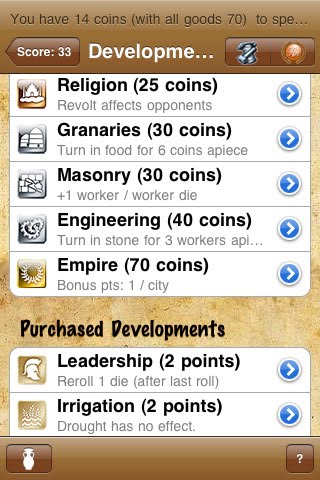
Roll Through The Ages is a game that benefits immensely from an App conversion. Although it loses the tactile element of dice rolling, it gains a lot from having the program handle goods management, which can be a be a little tricky to master in the original game.

I wrote about the tabletop version yesterday, so I’m not going to rehash the rules here. The app is an faithful conversion of the original, with a functional design and few audio/visual embellishments. There are options to play against AI opponents, or against any number of players using pass-back mode. (This means handing the device to the next player when it’s their turn.)

Each turn brings you to a Turn Order screen, which enables you to Roll, Build, Buy Development, and End Turn. Rolling is simple enough: push a button, click on any dice you want to save, and move on to the “Feed” stage when you’re done. If you’ve rolled enough food, or have enough banked, it’s automatically deducted. If not, you suffer a penalty.

This moves you straight to a Cities and Monuments screen, which looks like a color version of the paper scoresheet. Touch inputs allow you to check off boxes to assign workers, and separate buttons allow you buy developments and manage goods. When everything is done for one turn, you move right on to the next. This allows you to dash through a 10-round solitaire game in as little as 10 minutes. Even if you can’t finish a game in a single sitting, the App will save any number of games in progress.

On the downside, I thought that the flow from one screen to the next could be smoother and more logical, and not all of the feedback is helpful. (The main screen doesn’t tell you if you’ve assigned your workers or not.) Fortunately, the game won’t allow you to continue if you forget to complete a stage.

As a bonus, the Roll Through the Ages app offers the alternative Bronze Age variant, which adds some interesting items to the Developments menu, including an the “shipping” advance.

This a very plain port, but an extremely entertaining one. It loads fast, the controls are very simple, and it allows you to play a quick game of RTTA without any setup or fuss. I played the app version before the tabletop version, and found that it really helped teach the the game. If nothing else, it provides an excellent tutorial and practice mode for your live games.

Roll Through the Ages is available in the App Store for $3.  (Warning: this link will open iTunes.)

Thursday, July 29, 2010

REVIEW: Roll Through the Ages


Roll Through the Ages
Gryphon Games
1-4 players
ages 8 and up
30 - 45 minutes playtime


Tomorrow's App O’ The Mornin’ will be Roll Through the Ages, but I thought I’d get a jump start on that review by talking a bit about the original game.

Roll Through the Ages is a fast-playing, dice-based version of a very long, complex civilization game called … yeah, you’re already ahead of me on this one: Through the Ages.

Since I’ll bet hard money (or at least Monopoly money) that the majority of people reading this have not heard of, much less played, the original game, let me summarize Roll Through the Ages this way:


Yahtzee + Civilization = Roll Through the Ages

I am not one of those people who hate Yahtzee. It’s an okay game, and the app version can be addictive.

Roll Through the Ages, however, does something quite interesting with the dice rolling formula.

The game comes with 7 special dice. Each die has the following illustrations: 3 sheaves of wheat (representing food), 3 people (workers), a coin (7 gold pieces), a jug (goods), two jugs with a skull (2 goods + 1 misfortune) and 2 wheat with 2 people (you can choose 2 food or workers).

I’m not going to get into all the nuances, but the basic idea is this:

Everyone gets a score sheet that shows the cities, monuments, and developments that you either already have, or can build by rolling dice. They also each get a peg board (similar to a truncated Cribbage board) that allows them to track their goods.

Players start out with 3 cities, allowing them to roll three dice. They get three rolls each time, and can “save” good rolls, just like Yahtzee. They need to roll food to support their cities, workers to build more cities and monuments, and goods and money to buy civilization developments (which provide bonus points and in-game benefits).

As you build more cities, you get to roll more dice, up to 7 dice total. Each worker you roll allows you to check off various boxes on your score sheet. Check off enough boxes for a particular item (such as The Great Wall or a new city) and you’ve “built” that item. Although the rules for counting, spending, and discarding goods are bit tricky at first, they soon become second nature. Final points are scored based on monuments and other bonuses, with high score winning.

None of this should work at all. Even writing it down makes it sound more complex than it really is, and the idea of a civ-building dice game sounds loopy. The real accomplishment of designer Matt Leacock (of Pandemic and Forbidden Island fame) is taking the heart of the Civilization genre and, through some weird bit of alchemy, converting it to fast-playing, dice rolling fun. I know an innovative (and tricky) design when I play one, and this is as innovative as Pandemic, albeit in a subtler way.

It’s not a “simple” game, but my 9-year-old daughter grasped it perfectly well, and is even beginning to work out some advanced strategies. It can be explained to a novice group in about 10 to 15 minutes, and takes about 30 minutes to play, making it a great light game for both experience and novice gamers alike. It's also fine as a solitaire game.

UPDATED 6/9/11: This review originally included a photo I assumed was a publisher shot because of its professional quality, but which was actually created by a reviewer from BoardGameGeek named "EndersGame". I have removed the image, but it can be found here, along with many, many more detailed photos of the game. It's quite an excellent post, and well worth your time.

App O' the Mornin': Helsing’s Fire


This one took me completely by surprise. Expecting some kind of mindless action game or dungeon crawl, I instead found a remarkably clever and even innovative puzzle game with an appealing style and easy wit.

Helsing’s Fire pits Dr. Helsing (he’s lost his Van) and his Jeeves-like manservant Raffton against Dracula and his army of skeletons, werewolves, bats, robots (?), and other nasties. The visual style is so deliberately like the art of Hellboy creator Mike Mignola that it’s clearly meant as an homage, as is the dry wit and banter among Helsing, Raffton, Dracula, and the various minions they encounter. The narrative is just a linking device for levels, but it manages to be quite entertaining.

Gameplay is unlike anything you’ve played before. This isn’t an action game in which you dispatch foes with weapons and quick reflexes. It is, instead, a clever puzzle game that revolves around the correct placement of Helsing’s torch. Each level is see from the top-down, and consists of various solid obstacles, enemies, and bystanders. The torch throws a killing light across the entire map, except where obstacles create shadows. This light can also be modified by color potions. A colored torchlight will only kill an enemy with the same color. If it strikes an enemy with a different color, it raises a shield. If it strikes a bystander, you lose.

Since you have a very limited number of torches and potions (often one per level) the entire game is based upon finding just the right location to trigger the torchlight. It’s a remarkable, completely fresh puzzle mechanic. Torch placement and triggering is done with simple gestures, and each level can be defeated in as little as a few seconds. The trick is managing your resources and finding just the right placement.

Selling for $1, this gem from the publisher of Angry Birds and indie developer Ratloop easily earns its top-ten slot on the App Store

Direct link to the game. (Warning: this will open iTunes.)