Friday, October 29, 2010

PUZZLE: A Friendly Holmes Quiz

This quiz accompanied the Sherlock Holmes piece when it ran in Games Magazine. 

There are two kinds of readers of the Sherlock Holmes stories: those who have read and enjoyed them, and those who have read and memorized them. The following quiz attempts to find a happy medium between the two.

1. Watson used numbers in the titles of several stories.  Add the following together: Napoleons, Orange Pips, Gables, Students, then multiply by the number of Garridebs,

2. Name four shades of red hair described by Jabez Wilson.

3. What was the hiding place of the blue carbuncle?

4. What made the face yellow?

5. This was the first case Holmes tackled.

6.  Who was the victim at Thor Bridge?  Who was the perpetrator?

7. Where in London is 221B Baker Street?

8. What kind of tobacco does Holmes prefer?

9. What does Holmes write in bullet holes in a wall of 221B?  (Take extra pipe and plug of shag if you can name the kind of bullet he uses)

10. What was one of the books Holmes dropped when, in disguise, he bumped into Watson in “The Empty House"?

11. Which original stories were not written by Watson?

Weekend O/T Post: A Three Patch Problem

I finally caught the new Sherlock series on PBS this week, and I thought they did an excellent job of updating the stories in clever ways while still being true to the characters. For example, Sherlock (played by a man with the marvelously Dickensian name of Benedict Cumberbatch) refers to the case being very much a "three patch problem," and then rolls up his sleeves to show his arm covered in nicotine patches. This is a riff on a direct quote from "The Red-Headed League," and it works perfectly.

It was also interesting to see Martin Freeman in action, since he was just cast as Bilbo in Peter Jackson's Hobbit movies. He'll be perfect: he already looks half-hobbit.

I thought I'd use this opportunity to publish a piece I wrote about Holmes in 2004 for Games Magazine. Although this is one of my off-topic posts, it's not that off-topic, since I focus on the gamesmanship that's a part of the stories and fandom. 

Although I don't get to write about fiction much any more, that's how my career began. My first credits were writing about horror for The Horror Show and Cemetery Dance, mysteries for Armchair Detective and Mystery Scene, and literature for The Thomas Wolfe Review and Bookpage, among others. Then I discovered that I could make a whacking huge amount of money as a tech and game writer, and my lit crit days pretty well ended. (Eventually, so would the whacking huge amount of money as a tech and game writer after the bottom fell out of the publishing industry. Which reminds me: have you bought anything through my Amazon links lately? [sound of tin cup rattling])

I'm a pretty hardcore Sherlockian. I've read the canon through several times, and I collect as much other Holmes media (Old-Time Radio, movies, TV, pastiches) as I can lay hands upon. This is one of the few times I really got a chance write about it, however.


Sherlock Holmes: The Great Game

To a small but dedicated group of followers, Arthur Conan Doyle’s Holmes and Watson stories are more than just great literature. They are part of what they call “the game,” in which Sherlockians maintain that Watson and Holmes were real, their adventures actually happened, and the stories were truly written by Watson with Conan Doyle serving as his literary agent. From this “gentle fiction,” as one author calls it, springs a wealth of writing of sometimes astounding imagination and wit, speculating on every detail of the stories and weaving elaborate theories to reconcile Conan Doyle’s sometimes dodgy dates and details. A massive new annotated set of the tales promises to reinvigorate the game for a whole new generation.

Leslie S. Klinger’s The New Annotated Sherlock Holmes (Norton, 2 vols., $75) takes a different approach from William S. Baring-Gould’s Annotated Sherlock Holmes, the two-volume set at the heart of every true Sherlockian book shelf (usually at the end of the shelf, propping up the rest of the books). Originally published in 1967, Baring-Gould’s massive work collects and annotates the 56 short stories and four novels, explaining obscure aspects of Victoriana and often elaborating on various hot-button Holmes-Watson issues, such as the marriages of Watson, Holmes’ missing years, and torrid speculations about Holmes’ relationship with Irene Adler (of “A Scandal in Bohemia”).

Though beloved by Sherlockians, Baring-Gould’s work (including his terrific mock biography, Sherlock Holmes of Baker Street) has long been a source of mild controversy for its chronological organization. Baring-Gould was dedicated to determining the order in which the adventures actually happened, and his placement of individual stories within the timeline has been hotly disputed among Sherlockians, who are capable of hotly (and quite amiably) disputing pretty much anything.

Hand Me My Gazetteer 
As an indicator of exactly how much material Klinger had to work with, one need only look to The Complete Baker Street Journal on CD-ROM (available at www.bakerstreethournal.com for $100). Published since 1947, the BSJ is the main journal of Sherlockian scholarship, and its complete archives fill four CD-ROMs in PDF format, adding up to some 16,000 pages of material. Every issue of the BSJ is included, from its origins to the year 2000, accompanied by cumulative indices and searchable through the included Adobe Reader software. Aside from the usual news and records of meetings one would expect in a publication such as this, there are countless articles dissecting every aspect of the “canon,” or “sacred writings” as it is known to the Baker Street Irregulars.

For instance, in Scandal in Bohemia, Holmes refers to the landlady as Mrs. Turner, yet we all know the landlady is Mrs. Hudson. The answer is, of course, prosaic: in the manuscript of "The Empty House," Doyle made the same mistake, but crossed out "Turner" and wrote "Hudson." In "Scandal," however, he didn't catch the error. This is a feast for Sherlockians, who have speculated that it was actually Martha Turner (the second victim of Jack the Ripper); that Turner was an alias used by Mrs. Hudson during a tryst with Holmes in a country hotel or inn, and Holmes simply slipped by using this name; that it was a character from The Boscombe Valley Mystery; and so on.

The late pulp writer Manly Wade Wellman used the Holmes/Hudson affair for a delightful flight of fancy called “The Great Man’s Great Son: An Inquiry into the Most Private Life of Mr. Sherlock Holmes” (found on Disc 1, Volume 1, Number 3 of the BSJ on CD-ROM). Wellman lays out a detailed case to prove that the illicit love child of Holmes and Mrs. Hudson was none other than … Jeeves, Bertie Wooster’s redoubtable gentleman’s gentleman in the P.G. Wodehouse stories. By the time Wellman fills in all the lacunae, you begin to believe it. (Wodehouse himself idolized Conan Doyle, so the speculation would have no doubt amused him.)

Making these connections is all part of the game, and the BSJ archives are a treasure trove of material, with such Holmesian figures as Christopher Morley, Edgar Smith, and Vincent Starrett sharing space with notable writers such as Wellman, Robert Bloch, John Dickson Carr, and Ogden Nash. The BSJ is still a thriving publication with four issues plus a special Christmas annual each year, with subscriptions starting at $25.

The Game is a Footnote 
Klinger has mined this treasure trove, much of it unavailable to Baring-Gould, for his New Annotated Sherlock Holmes. He dodges the chronological issue by organizing the 56 short stories according their order in the five collections Doyle published in his lifetime. (A third volume collecting and annotating the four novels is scheduled to appear in Spring 2005.) Though it will no doubt spare him many dissenting articles in the Baker Street Journal, it’s ultimately a less satisfying order than the Baring-Gould chronology (which links the tales into a flowing biography of Holmes and Watson) or even an arrangement by composition or publication (which would allow us to see Conan Doyle’s development as a writer).

Measured against the quality of the rest of Klinger’s work, however, this is a trifle. Klinger engages in the game with gusto. The new annotations and essays largely sidestep issues of mainstream literary criticism to integrate the last 30 years of Sherlockian scholarship, offering numerous alternate theories while elaborating on the lives and connections of peripheral characters. Was Moriarty a figment of Holmes’ imagination? Was Holmes replaced by an imposter after his death at Reichenbach Falls?

The notes also explain many details of Victorian life, helping to establish locations, explain slang, and place story aspects in their historical and cultural context. The book begins with a brisk but immensely informative introduction explaining the time and place of the stories and offering biographies of Doyle, Holmes, Watson. Both volumes are heavily illustrated with the original Strand drawings and period photographs, which prove quite useful when trying to visual a gasogene, for instance. Some of Baring-Gould’s annotations are carried forward intact, but much more is added.

On the other side of the aisle is the nine volumes of the complete Oxford Sherlock Holmes, which offers A Study in Scarlet, The Sign of Four, The Hound of the Baskervilles, The Valley of Fear, The Adventures of Sherlock Holmes, The Casebook of Sherlock Holmes, The Memoirs of Sherlock Holmes, and The Return of Sherlock Holmes. (Most of these titles are available in matching paperbacks for less than $10.) Each has a lengthy introduction about the background and writing of the world, with extensive endnotes dedicated to Conan Doyle’s sources as well as Victoriana. Frankly, most devoted fans will find the books nicely complimentary: Klinger focusing on the inner life of the stores, and the Oxford editions focusing on them as works of literature.

The Final Problems 
And the Holmes industry continues to thrive. New books, novels, stories, and pastiches are published each year, creating a modest cottage industry dedicated to chronicling the adventures of the Holmes, Watson, and even peripheral characters from the series. Loren D. Estleman’s entertaining Sherlock Holmes vs Dracula: The Adventure of the Sanguinary Count and Dr. Jekyll and Mr. Holmes are back in print, and Laurie King recently published volume 6 of her critically acclaimed Mary Russell series. Beginning with The Beekeepers Apprentice (Holmes retired to the country to become a beekeeper in his later years), King’s series teams Holmes with a young American woman in a series of vastly entertaining mysteries. A quick Amazon search for “Sherlock Holmes” will yield a surprisingly wealth of new material ranging from pedestrian pastiches to polished fiction.

He continues to thrive in other media, as well. Over the past few years MPI Home Video issue a dozen of the original films starring Basil Rathbone and Nigel Bruce as Holmes and Watson, and the complete run of Grenada television series starring Jeremy Brett. Holmes even made his long awaited-return to computer games with the adventure “Secret of the Silver Earring” (see our review this issue).

This fall [2004] saw the publication of Sherlock Holmes: The Hidden Years, a terrific new hardcover anthology edited by Michael Kurland, author of a series of novels about Professor Moriarty and editor of the previous Holmes tribute My Sherlock Holmes. The Hidden Years recruits authors Peter Beagle, Carolyn Wheat, Richard Lupoff, Rhys Bowen, and others to fill in the gap of “The Great Hiatus,” the three years between Holmes alleged death at Reichenbach falls and his reappearance in “The Empty House.” Only one of these stories is a true pastiche (that is, a work written in the style of the original), while others use a variety of styles to challenge the great detective (sans his Boswell) in mysteries ranging from Tibet to San Francisco to New Orleans and beyond.

Conan Doyle’s work uniquely lends itself to this kind of lavish attention due to its wealth of detail, from place names to odd characters. The Sherlockians take mystery stories that are, in themselves, literary puzzles solved by a master, and apply his techniques of observation and deduction to tease interesting theories from the text. Had Doyle written more, or been more careful with some of his dates and characters, perhaps the game never would have evolved the way did.

Or perhaps not. The game began while the stories were still being written, with Andrew Lang’s 1904 “open letter to Dr. Watson” (published in Longman’s Magazine), analyzing the story “The Three Students.” Klinger cites Father Ronald Knox’s 1911 “Studies in the Literature of Sherlock Holmes” (written as a parody of Biblical scholarship) as the beginning of Holmes studies. Knox favored using a “method by which we treat as significant what the author did not mean to be significant, by which we single out as essential what the author regarded as incidental.” In this, he was merely following the dictum of the Master: “the little things are infinitely the most important.”

These “little things” continue to fascinate over a century after the original tales appeared. Indeed, can any other author lay claim to such a serious examination not of his work, but of the fictional life of his characters? As legendary Sherlockian Christopher Morley famously observed, “Never has so much been written by so many for so few.” Perhaps a book like The New Annotated Sherlock Holmes will prove that it’s not for so few after all.


App O' The Mornin': OTR Streamer Review

Grade: B (design), A (content)
Price: Free

Looks like today is going to be off-topic Friday all the way through, but stick around: it'll still be interesting.

I wanted to write about OTR Streamer because, along with Pandora, Inquisitor, MobileRSS, Mobi Net, and a few others, it probably gets the heaviest workout.

That's because I'm a total OTR junkie. OTR is shorthand for "Old Time Radio," and it refers to radioplays produced from the 1920s to the early 1960s. Collectors also tend to use it for modern radioplays, which are still produced by British radio.

You probably know some of the basic radio shows of the time: Orson Welles War of the Worlds, The Shadow, The Lone Ranger, Gunsmoke, Superman, Abbott & Costello, Amos & Andy, and maybe a few others. It was an entire art form that was born, thrived, and died in a span of about 40 years.

Not only was it brief, but it has also largely vanished. I believe only about 10% of the output from these 40 years has survived in some recorded form. That still leaves a whole lot of radio programming for anyone to collect, and the age of the internet has been a boon for collectors. The quality ranges from unlistenable to crystal clear, but there's certainly no shortage of good programming out there for free on sites like archive.org. I built my collection many years ago thanks to traders on the usenet binary groups, but you can still fill in gaps and upgrade recordings if you hunt around.

OTR Streamer is a delight for any fan of radio, or for anyone who'd like to just explore it. It's a simple interface with a generous selection of shows divided into 8 categories: Adventure, Comedy, Crime/Police, Detective, Drama, Mystery, Science Fiction, and Western. There are about 80 different shows listed, with any number of episodes for each show.

For example, there are only 17 episodes of Nero Wolfe, but 138 episodes of Sherlock Holmes, with versions of Holmes ranging from the 1930s up to the 1980s. I have a complete collection of all Holmes OTR, but OTR Streamer allows me to stream them without taking up any space on my device.

The streams are actually quite stable. They rarely fail, and even if they do they usually start right up again. The sound quality is good, and the download time is perfect. Although you can instantly stream any episode at any time, you can only download and save one episode.

This lack of additional save slots, as well as the bare bones production and interface, is what earns this one a B. The Vintage Radio Lite app has a far better interface, complete with show notes, but fewer episodes. I use them both, but OTR Streamer gets the heavier workout.

OTR may or may not be your cuppa joe, but you really should check it out. Once you get into the rhythms and narrative devices unique to radio, it becomes an incredible experience that you just can't find anywhere else.

Thursday, October 28, 2010

PUZZLE: SQUARE NUMBERS

I've been a bit negligent with my math puzzles lately, so here's a frustrating one to make up for it:

Name two numbers with the following properties:

  • The square of the first number plus the second number equals 11.
  • The square of the second number plus the first number equals 7.

App O' The Mornin': Topple! Review

Grade: B
Price: $2 (lite version available)


There are two apps called Topple: one with an exclamation point, and one without. The one without a ! is a stacking game, and not a bad one at that. The one with a ! is a word game, and I have no idea why they gave it this name. It doesn't make sense, and this just confuses me. I live in New Jersey, so I have enough confusion in my life every time I read a sign telling me to make a lefthand turn from the righthand land.

Anyway, the mysteriously enthusiastic Topple! (it almost seems like it should be written TOPPLE!!!) is a plain old word jumble game. That's it. It's basically Wheel of Fortune with a selection of letters at the bottom of the screen.

Okay, so it's a little more than that. Empty blocks show where the words of a quote or saying were once spelled out. The letters have fallen into columns at the bottom of the screen, and the goal is to drag these letters up to their proper place.

The production is bare bones, and yet it's strangely entertaining. There are 288 puzzles in the full game, and none of them will slow down serious wordies for very long. Yet the lack of a time limit or arbitrary scoring system makes this kind of appealing as a light fill-in game when you don't want to tackle something more challenging. I find myself coming back to it now and then less as a real gaming challenging than as a nice little stress reliever.

Check out the Lite version for a free taste

Wednesday, October 27, 2010

App O' The Mornin': Doodle Jump Review

Grade: D
Price: $1
I was planning to post a quick addition to my Doodle Jump review in order to mention the Halloween update, but then I looked at the index and realized I'd never even reviewed Doodle Jump. My bad.

I probably passed it over because there really isn't much to say about it. It remains remarkably popular for reasons that continue mystify me. I just don't get the appeal. It's a shameless ripoff of PapiJump (another snooze-fest) but adds a little more meat to the bone. And by "more meat on the bone" I mean about as much as you'd find clinging to an extra-crispy chicken leg out in the KFC dumpster.

Instead of just climbing from platform to platform a la PapiJump, you climb from platform to platform and occasionally hit some special items. Some are breakaway platforms, while others boost you higher. There are enemies along the way, and rather than just avoiding them, you can tap the screen to shoot ... something. I don't what. Boogers, maybe.  Doesn't matter, since I've never been able to really hit anything this way, and just typing all this out makes me bored.

The goal is to get as high as possible before you fall to your death. I guess we needed games like PapiJump and Doodle Jump in order to get to interesting games like Bird Strike, but that doesn't mean I need to keep the sucker on my device.

Oh, and about that Halloween update. It's an update. With a Halloween theme. Monsters, broken-bone platforms, Frankenstein jumper, etc. Much excitement ensues, if by excitement you mean making the little icons jiggle so you can delete these sucker and get back to playing Axe in the Face.

Note: About that grade ... I originally gave Doodle Jump a C because many people find it appealing and it is certainly competently made. Then I realized that Many People aren't writing this blog: I am. If Many People want to give it a C, or a B, or an A+ with a smiley face sticker and write "Super Job!!!!" in the margin in purple bubblegum-scented ink, they should start their own dang blog. As far as I'm concerned, this game needs about 90% more axes to the face before I'd even consider bumping it up to a C, and even then I'd be grading on the curve.

Tuesday, October 26, 2010

REVIEW: Super Scribblenauts

Grade: A
Platform: DS

The original Scribblenauts made a splash on the DS gaming scene by allowing gamers to conjure almost anything out of thin air. Thanks to a vast database of nouns and the use of jointed sprites, people could type in a word and see an item materialize before them.

Was there a portion of the game level you couldn’t reach? Well, you could type in LADDER and a ladder would appear, just in case you wanted to prove to everyone that were boring and pedantic. Typing in WINGS was a bit of an improvement, since you could attach these to you character and just fly where you needed to go. Or you could type PEGASUS and ride a flying horse. The only limit was your imagination.

This immensely appealing gameplay was placed at the service of a pretty good puzzle/arcade platformer. There were some things to fight, but most of the gameplay was centered upon collecting stars by solving problems or getting access to hard-to-reach areas.

Super Scribblenauts has expanded and improved this gameplay in a number of ways, though not all are sure to appeal to fans of the original. The most notable change is the addition of adjectives to the game database. Now, instead of just conjuring a VAMPIRE, you can conjure a GIANT vampire, or perhaps a RED VAMPIRE or even a GIANT RED VAMPIRE. You don’t just have to ride a flying pig to reach that higher lever: now you can ride a BIG POLKADOT FLYING PIG.

The folks at 5th Cell, who also gave us the original Scribblenauts and Drawn to Life, have used this adjectival bounty to reshape the gameplay a bit. The original game tended to suffer from JETPACK/WINGS syndrome, in which people just banged through puzzles by typing in the same couple of objects over and over again. Super Scribblenauts focuses on more structured puzzles that require more precise nouns and adjectives to solve. It may be as simple as making a red key for a red lock, or creating a sequence of animals with long necks.

This leads to some awkward word fishing, as you try to read the minds of the designers to come up with the word DIETICIAN rather than HEALTH TEACHER, but an in-game hint system makes these problems minimal.

Fans of the original might not like that the game is less freewheeling, but the invidual puzzles are simply better with more structure. And there’s still a sandbox mode in which you can pit CTHULHU against HUGE SANTA and see who wins. That's good, because I like to get two mismatched enemies fighting and then use a catapult to fling DIRTY ANGRY PEASANTS and PUDDING at them. The knowledge that a game can do such things should be all the recommendation you need.

App O' The Mornin': Skycat and the Starchildren Review

Grade: B
Price: $1

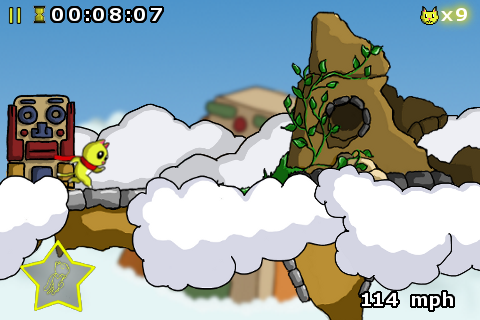
Skycat has a lot going for it, which is why some if its flaws are so disappointing. This is a running platformer in the Canabalt family, but with a greater degree of control and style than most run-to-the-right games.

The action follows the adventures of an adorable little cat with as he runs through a fluffy cloud land filled with stars, his magical scarf flapping in the breeze as it gives him wonderful powers to leap and dash. And yet I can not only write that sentence, but admit that I enjoyed the setting and the game without any concern that people might question my masculinity.

That's because Skycat is just that damn cute.

Skycat has a couple of controls, and even after finished the game I'm still not sure I can explain how they work together. There is a simple jump button that allows him to, well ... jump. But there's also a slash-gesture input that gives him a dash in the direction of the slash: vertical, straight, or down. Vertical increases his leaps, dash increases his forward speed (usually as a forward tumble), and down slows his momentum. Used together, they allow you to more precise control over the running speed and leaping distance.

The problem lies in the screen size, which is a bit too small for Skycat's grand ambitions. It's far too easy to loose track of either the upper or lower reaches of a level, meaning that you need to feel your way through each level, failing along the way, until you really have a sense of its layout. I've said it before, and I'll say it again: any game that requires you to fail in order to understand the nature of its environment and challenges is fundamentally flawed.

The other problem is that Skycat is short. I mean, really really short: 9 levels lasting about 45 second each. Since you can't solve these levels in a single pass (see previous paragraph) it takes longer to finish the game, but that's just not enough content.

People keep lumping this one in with Robot Unicorn Attack, but there's no contest: Skycat is far better. It's also shorter. On other platforms, that would be a deal-breaker, but that's not the case with apps which a) only cost a $1 on average and b) usually get free content updates.

I liked Skycat's visuals and controls enough to overcome some pretty serious problems, but I'd like to see it evolve a bit and address some of these issues. Until then, it's a still a nice diversion for a buck.

Monday, October 25, 2010

Microsoft "Doubles Down" on PC Gaming?

File this one under "I'll believe it when I see it."

This Kotaku story does have some interesting points.  Next month's relaunch of the Games for Windows Marketplace is a good thing for PC gaming, particularly since digital delivery is the future of all electronic media. And although the idea of a cross-platform gaming between Xbox and PC platforms really never amounted to much, another attempt will be nice, if not particularly vital.

The most comical part of the Kotaku story, however, is the reference to the "tremendous line-up of computer games" for 2010. I searched in vain for some idea that this was meant ironically, but no: I think the writer is serious. He goes on to say that "computer gaming isn't just still around, it's making a resurgence," and cites ... 3 sequels, 3 ports, and an expansion set as proof. (And he doesn't mention the most exciting part of PC gaming this year: Minecraft.)

I guess it's a kind of "resurgence," if you redefine what that word means. My writing career parallels the entire rise and fall of computer gaming, so I remember when there were hundreds of releases in a year. In a way, there are still hundreds of releases, if you count casual and Java games, which also migrate to mobile phones and other platforms. But the big-ticket games that drove the PC gaming boom have simply vanished. We put out a 300-page issue of PC Gamer one Christmas during those heady days of the 1990s. We didn't do it based on an average PC-gaming output of 0.5 releases per month.

The muscular years of hardcore PC gaming are not about the return in the midst of a full-blown recession-bordering-on-depression. That's just crazy talk.

CONTEST ENDS TODAY: Bejeweled Photo Frame


Zombie hand not included
We have a heavy metal (as in the actual heavy metal kind, not the Black Sabbath kind) picture frame encrusted with real fake jewels. These frames are pretty rare, actually. PopCap produced some to celebrate the 10th anniversary of Bejeweled, but they were never sold.

To enter, all you have to do is:

1. Share a link (even this one) or follow State of Play via:
Please note: if you already follow us on Google, RSS, Twitter, or Facebook, just let me know that you'd like to enter, and please do a retweet or some other kind of link share.

AND

2. Let me know you want to enter. Do this in any of the following ways:
  • Leave a comment.
  • Tweet me @StateOfPlayBlog
  • Post a message on the State of Play Facebook Page
  • Send an email to "games=at=aptopub.com" (replace the =at= with @) to have your name entered.  
  • Please don't forget to do one of these things or I won't know you've entered!
Deadline is Monday, October 25!

I'll choose winners by the scientific process of writing names on little pieces of paper and pulling them out of my Mario hat.

ONLY NORTH AMERICAN ENTRIES PLEASE!

COLONIAL GAMING: Other Board Games

Ben Franklin's Chess Set
Colonial Americans knew most of the ancient board games familiar to us today. Some were more popular than others due to various factors. To appeal to Colonials, games had to be easy to play and fairly sociable. They needed to play quickly so that many rounds could be squeezed into a single evening. This was almost certainly related to gambling, since games that played quickly allowed for faster turn-over and more chance to wager, even if it was just for miniscule pots. Finally, gamers of the 18th century preferred chance over strategy. Their passion for cards and dice was very high, while games that lacked this random element tended to bore them.

Chess 
Chess, for instance, was considered exceptionally boring. Charles Cotton, author of The Complete Gamester (1674) found it tedious and “more difficult to be understood than any other game whatever.”

Due to its length and reliance on skill rather than chance, it also makes a very poor gambling game, which certainly added to its unpopularity. There were surely a number of chess sets in America in the 18th century, but oddly enough only a few survived, including two owned by Thomas Jefferson and one by Ben Franklin.

Franklin almost certainly was the man who brought Chess to America. He was playing by 1733, and wrote an important essay on the game. His efforts to popularize it didn’t spread far beyond members of the Franklin's American Philosophical Society, however.


Checkers (Draughts) 
Although it was also known to the colonists, Checkers was as unpopular as Chess. The rules in use would have been similar to English Draughts. These are the same rules we use today in Checkers, rather than the rules for Spanish or French Draughts, or other variations.

Whatever they called it, it wasn’t nearly as popular as it was to become later.

The game does show up in Virginia court records, however. In 1679, Mr. John Edwards and a servant were arrested and put before the grand jury because they played Checkers on a Sunday.


Backgammon 
Backgammon had a bit of a following in the Colonies for a simple reason: it used dice, which promised chance, which meant it was a good game for betting. Many Backgammon tables appear in Colonial inventories, and Backgammon games (and monetary losses) are mentioned in many diaries of the period. Thomas Jefferson played, and would win or lose several shillings in a session.

In Colonial Virginians at Play, Jane Carson describes the variants used at the time:

In the French versions, tric-trac or tick-trac, all the men started from the ace-point and penalties were different. Sice-ace was a modification for five players, each using six men. In dubblets the fifteen men used were placed differently on the tables, and in ketch-dolt all the men were piled in the center of the board. 

Dominos
Although very popular in France, Dominos didn’t make any impression in America until the 19th century. In 1801, it was still considered a “childish sport” by one writer of the time, who also noted that it “could have nothing but the novelty to recommend it to the notice of grown person in this country.”

App O' The Mornin': Catapult Madness Review

Grade: F
Price:  free

I know that the word "free" has a powerful appeal. I get that, really I do.

But sometimes even free isn't enough to justify something's popularity. I'm not sure why Catapult Madness has been squatting atop the Free Apps charts for the past week. I'd love to see the number of downloads compared against a more relevant statistic, such as "time on device." I'm betting Catapult Mania would appear on some other charts, such as "Fastest Deletion" or "Most Likely to Make You Want to Kick the Developer in the Face."

This is kind of your basic ballistic app, only lacking anything that might make it interesting or appealing. Your task is to fling a peasant as fas as possible using a catapult. The trigger control is basic powerbar combo: hit one button to set the power of the throw, and another to set the angle. It's not too hard to land your taps right in the sweets spots for maximum power and ideal angle.

The peasant starts flying through the sky, end over end. Let me tell you something: this is one of the most unappealing animations I've ever seen in an app. The spinning peasant gave me a headache after about 3 seconds. The little cartoon character just spins around and around, slowly coming to earth only to bounce again and again. Sometimes it hits objects that increase its bouncing and thus the total distance traveled.

At certain points, you can apply various boosters, such as bombs, magic, wings, and flatulence to help extend the total distance. The goal is to get the longest distance possible, with an unlimited mode unlocked at 50,000 feet. Along the way, you earn money to buy more powerups to increase your distance. Although traveling long and far is the prime objective, the game is so horrible to look at that you don't even want the sucker to keep going.

Look, I like throwing things as much as the next guy.  Sometimes I just wander around my yard throwing stuff until the nice men bring me the thorazine--because that's just how I roll. The desire to fling lies at the heart of Angry Birds and many other fine apps.

And you know what else lies at the heart of Angry Birds and many other fine apps? A freakin' game, that's what.

Oh, and it crashes. A lot. Please don't tell me this has to do with my memory. I run all my review games with a clean boot. This thing doesn't need memory problems to make it crash. The programming code is probably so appalled at being used for such a wretched purpose that it actually tries to flee in horror and shame.

I almost gave this one a D because the background art is okay. And then I thought: I'm actually giving a full letter grade for background art that doesn't quite rise the same level of incompetence as the rest of the production? Thus, the F.

Friday, October 22, 2010

PUZZLE: Longfellow's Bees


Henry Wadsworth Longfellow introduced several Sanskrit puzzles to American audiences as part of his novel, Kavanagh. Among them was this one:

"One-fifth of a hive of bees flew to the Kadamba flower; one-third flew to the Silandhara; three times the difference of these two numbers flew to an arbor; and one bee continued flying about, attracted on each side by the fragrant Ketaki and the Malati. What was the number of the bees?"


App O' The Mornin': The Secret of Grisly Manor Review

Grade: A
Price: $2

The Secret of Grisly Manor is a wonderful change of pace from the usual app fare. This is an old-school object-based adventure game, and it works surprisingly well in the handheld format.

In Grisly Manor, Fire Maple Games finds an appealing middle ground between Myst-style puzzle games and Sierra-style object-based games. Although visually and tonally it’s closer to Myst, there’s a lot less lever-pulling and a lot more common-sense inventory manipulation.

The premise is rather thin and underdeveloped. Your grandfather is a sweet but eccentric engineer who has summoned you to his house on the proverbial Dark & Stormy Night. From there, it’s mostly a straight path through the puzzles to a final epilogue that explains what grandpa was up to. A little explosion along the way would have been nice. As it stands, a story that begins with some promise soon becomes merely a closeline to support the puzzles.

Those reservations aside, the gameplay and production are uniformly excellent. Although the graphics are static screens with minor interaction animations, they are all exceptionally well done. Aside from a mildly awkward transition between the central hallway and the two adjoining rooms (caused by a perspective shift), this is all top-notch work.

The puzzles are all quite good, although none of them should stop experienced adventure games for too long. Most of the game is occupied by exploring the house, collecting any loose objects, and stitching together clues to solve puzzles. Sometimes this means using an object in the right place, and other times it means using clues from the house to manipulate environmental puzzles.

It took me about an hour to solve it, but I’ve been doing this for a long time. Less experienced puzzlers might take about two hours to finish the game. This would be too short for a standard PC/Mac adventure game, but for a $2 app, it’s just about right. You certainly get your money’s worth.

This is really a top-of the line production all the way through, and I really hope Fire Maple does more in this vein. There’s a lot of room in the mobile market for good, traditional adventure games, and I haven’t seen many indies delivering this level of quality on handhelds.

Thursday, October 21, 2010

REVIEW: Small World


In preparation for reviewing the new Small World expansions, I decided to do a full review of the original game. As I’ve said, age is irrelevant in determining what I’ll write about. Any game you haven’t played is new to you, and my goal is to get more people thinking of good games. Only time can reveal just what games have lasting qualities. 


Publisher: Days of Wonder
List Price:  $50
Grade: A

When I first sat down with Small World, I thought I detected a whiff of eau de Risk. It’s an understandable mistake. Both have maps divided into regions, are driven by cross-border conquest, and use a “stack-and-attack” mechanic. But whereas Risk was belched forth from the fifth circle of hell, wherein the sullen and wrathful boil beneath the stagnant surface of a black pool of rancid water without hope or joy, Small World comes from Belgium. (If you thought I’d use this opportunity to make some cheap joke about Belgians, well … I’m better than that. Fortunately, Monty Python isn't.)

Small World is the work of designer Phillipe Keyaerts. It’s really just a great redesign and re-theming of a Keyaerts game called Vinci, but thanks to the changes and the superb production job by Days of Wonder, it’s now a far better game with a much wider appeal. It was so good, in fact, that we awarded it the Game of the Year medal for 2010 at Games Magazine. (My personal pick for that year would probably have been Dominion, with Small World as a close runner-up.)


The Elements
As usual, Days of Wonder does a bangup job on the production. The art is terrific, with a combination of whimsy and expressiveness that just makes you want to pick it up and examine all the little details. I’d go so far as to say that the illustrations by Miguel Coimbra are a large factor in the success of the game. Any number of games can (and do) tackle this kind of territorial conquest, but none draw in the player as effectively as Small World, and much of that is thanks to the art.

The 14 races in the game (with more added in multiple expansions) are all stock fantasy characters: elves, halflings, humans, orcs, trolls, wizards, giants, dwarves, amazons, ghouls, ratmen, skeletons, sorcerers and tritons (sea creatures). It takes a lot of skill for an artist to make these feel fresh and fun, but Coimbra does it. Look closely at some of the tiles to find funny touches, such as a man controlling a giant dragon by dangling a little person (rather than a carrot) from a stick.

There are a lot of bits in the box. Races are depicted on banners, while special powers are depicted on badges. Each time you play, you randomly fit a race banner together with a power badge, thus creating a unique kind of unit for each session. For instance, Dwarves may be matched to the Flying power to create Flying Dwarves. Or Ghouls may be matched to the Merchant power to create Merchant Ghouls. We’ll talk more about just what this means in the next section. 

Each race is represented on the board by small, square tokens. There are 168 of these, distributed unevenly among the races. In addition, the game comes with victory coins, geographical features (mountains, fortresses, etc), and other special tokens. There’s just a lot of stuff in the box.

Finally, there are the boards. There are two, and each is double sided in order to create a balanced experience for 2, 3, 4, and 5 players. The boards are colorful and sturdy, and pack in a lot of detail without becoming confusing.


The Play 
In this Small World, space is limited. Territories are crowded together, and they simply can’t accommodate all the races. Your goal is to build and expand your territory, earning victory coins by holding land as long as possible.

To accomplish this, you begin with a race with its own special power. Six race/power combos are laid out in column next to the board, with each player selecting a starting force. Each race/power combo gets a total number of tokens to represent their forces, as well as some starting coin and any other power bonuses. These bonuses may be extra units, more cash, movement benefits, special attacks, or more. The huge array of powers and races, which are randomized for each game, is one of the main appeals of Small World, and keeps the game feeling fresh each time out.

Once everyone has their race and forces, they simply start claiming territory by placing and moving unit tokens. It’s a simple mechanic, with the player who has more units conquering the player who has less. There other factors and modifiers having to do with terrain, power, and lost races, but the basic mechanism is like a diceless version of Risk. Each turn, you collect one coin for each region you hold.

But that’s not where it ends. After grabbing and expanding your territory, you may find that your current race is stretched too thin. At this point, you can put a race into “decline.” You flip the banners and tokens, choose a new race/power combo, and continue the conquest with a new force. Your old race continues generating coin until it’s overrun, but now it’s weaker and you no longer control it directly.

In this way, you ride a sequence of races to victory, finding different ways to exploit the powers and weaknesses of each. In the end, the game is won by the person who collects the most coins.

The Verdict 
Small World is a blast. It plays very fast, and has a loose feel that’s very appealing. It doesn’t require a lot of high-level strategy and military finesse to get ahead. Instead, you find particular ways to use each race to capture and hold a certain part of the map for as long as you can, and then use another race to keep that momentum going.

The appeal lies in the combination of races and powers, which makes every game different. There are a lot of ways to uses these combos to go for the coin. Some units can capture water tiles, while others are better in the mountains. One player may be able to ride a dragon into an enemy region, while another conquers with sheer force of numbers. Some race/power combos allow a player emphasize the monetary aspect or use a sneaky bit of magic, while others let you work the brute force or fast attack approach.

The mechanics are different from anything most mainstream American gamers have seen before, and this might make it seem like a very difficult game to learn at first. Don’t be fooled by that. It is, in fact, a very simple game and plays well across all age and skill levels. My wife and I can play with my son (age 12) and daughter (age 9) on an equal level. (In fact, the kids usually win.) You just have to understand a few key concepts such as race benefits, earning money from territories, and placing a race into decline. It’s actually a lot easier to learn than a quick read of the manual might suggest.

This is just a fun game. It’s not particularly deep, but it still manages to be rewarding thanks to all the variables and interactions among elements. If you know someone who insists on dragging out Risk, and that particular person cannot be sold off as cheap labor to Venusian slime farmers, then try to nudge them toward Small World.


About the Grading System

As you may have noticed, I've been playing around with a grading system for reviews. I'm not a big fan of quantified ratings, but I know they can be helpful. When we were launching PC Gamer in the US, I argued against the 100-point rating system, and I still think it's dumb. When I asked my editor Steve Poole what was the difference between a 72 and a 73, he said, "well, that depends on much you had to drink the night before."

After considering a few different systems, I decided to just go with the old grade-school A, B, C, D, F system. But what does that mean for apps?  Here's a handy summary of what I consider some representative ratings:

A (recommended without reservation for all gamers): Carcassonne; Cut the Rope; Axe in the Face

B (somewhat flawed, or intended for a limited audience):  Undercroft; Cribbage King; Roll Through the Ages

C (some good elements, some bad): Crazy Parachute; Urban Ninja; Splode; NCIS

D (simply bad in almost all of its particulars): Deer Hunter: Bow Master; Pocket Frogs

F (incompetent or aggressively awful): any Zynga game; Zombie Dice; Ugh Find It; all zit, fart, sudoku, and Katy Perry apps

That breaks down to:

A: Excellent game.

B: Good game with problems, or a game meant for a very small audience. For instance, you may well make the best simulation the world has ever seen of trainspotting in East Anglia between 1894 and 1899, but it's still not going to get an A. Life is cruel sometimes.

C: Eh.

D: The developer really should consider another line or work, such as human test subject for dangerous and/or potentially lethal medications.

F: The developer hates you and all life and probably drinks a breakfast shake made of blended puppies every morning.

I probably won't do a lot of D and F reviews, not because I'm afraid to take a game out to the woodshed and lay a switch across its hindquarters, but because most games that fit that rating simply aren't interesting enough to review. The app store is full of low-rent garbage that simply can't sustain a whole review. Unless I need to put in some verbal bag time to keep my writing up to snuff, I don't usually bother.

I also won't be doing half-grades ("+" or "-"). Five grades are more than enough.

By the way, I'm calling it a "Grading" system rather than a "Rating" system because the word "rating" is used as a gauge of content by the ESRB (Rated: E, E10, T, M).

If you are a developer, fan, or PR person who has a problem with any of my reviews or ratings, please take it up with the management:

The Management

App O' The Mornin': Deer Hunter -- Bow Master Review

Price: free
Rating: D


It's a good thing I like my readers, because nothing other than grim duty would have kept me playing Deer Hunter: Bow Master as long as I did.

Look, I'm not some namby-pamby anti-hunting bed-wetter who hates these games on principle. I grew up in a family of hunters, and have eaten my fair share of God's wild critters. The only PETA people I want to know about are People Eating Tasty Animals.

So, I don't hate hunting games per se. I just hate them when they suck so bad they could siphon all the water out of Lake Michigan.

Bow Master is just a hot mess. The graphics aren't terrible for iPhone, but their lack of awfulness is about the best thing I can say for them. You're plonked down in a random woody area with a limited range of vision. Enough critters to fill a season of Wild Kingdom come bounding into view like commuters trying to board the 8th Avenue Local at rush hour. Chipmunks come so close they might as well be standing on your feet, and every moose that enters the screen makes the same mad dash down the center until he tramples you into a puddle of jelly.

The aiming system seems to have been invented by someone who has neither aimed a weapon nor played an iPhone game, or perhaps even heard of these strange things you humans call a "bow and arrow" or "hands." You aim by placing one finger on the screen, and then placing the other finger somewhere else on the screen in order to draw back. The problem is that aiming and drawing are kind of mutually exclusive actions. It's maybe possible to position your finger so you can kind of aim while sort of drawing on the bow, but don't expect to achieve this with any level of accuracy.

Speaking of accuracy, it's not actually possible to drop a 150 lb. 8-point buck with a single arrow to the ass, as I did on multiple occasions in Bow Hunter. This does not happen in the real world--ever--unless the deer has been living on a steady diet of bacon, eggs, whiskey, and Lucky Strikes, and the shot just scares him into a sudden heart attack.

Oh, and every new hunt begins with a horn blast that sounds like the Battle of Helm's Deep is about to commence. It's probably supposed to sound like the cry of the lovesick moose, which might explain why the the sucker keeps trampling me. The menu music is some kind of ren-faire synth music that would be more appropriate ... well, nowhere, actually. It's really rather awful.

Right now, the game is free. At that price, they are still charging entirely too much.


Wednesday, October 20, 2010

PUZZLE: The Four 5s

Can you arrange four 5s so they equal 6?

REVIEW: Scrabble for Kindle

Price: $5
Grade: C (The solo game is a solid B, but the lack of multiplayer drags down the overall grade.)

Scrabble gets a heavy workout on all of my devices. I play it every day, usually in multiplayer games via app and Facebook.

Having it on my Kindle seemed like a natural fit. Although I have a huge book collection (about 6,000 volumes), I still love my Kindle for its portability. I've had a 2nd generation model for over a year, and I just got hold of a 3rd generation model. The new screen is fantabulous, with superb contrast and clarity. The web browser is vastly improved, the storage capacity is higher, and the WiFi option is welcome. The new design is more compact and sleek, with a redesigned book cover that features a built in light. Overall, it's a good improvement on the last model, although it still lacks a touchscreen.

Until that's resolved, gaming on the Kindle is going to be difficult. I've already written about the two free games, both of which have their merits. Now we come to the Big Daddy of word games.

Scrabble for Kindle is a half of a good game. Given the interface limitations, the controls are fairly effective. You use the directional controls to choose your space, and then just type in your word. All the rest works just as you'd expect, with a full Scrabble dictionary, scoring, and a few setup options.

Unfortunately, not all the setup options are winners. For starters, games versus AI opponents are limited to you and one computer-controlled player. Although pass and play can accommodate up to 4 players, solo play can only handle two. Not good enough. "Game Style" settings allow you to select various point or round limitations for shorter games, but there is no option for choosing alternate dictionaries.

The biggest failing, however, is the lack of multiplayer mode. Scrabble is not a hard game to adapt for turn-based multiplayer, and, depending on the model, the Kindle has at least a WiFi connection and perhaps 3G. Why not enable the Facebook/PC/app-linked multiplayer support? Because people might use their free 3G time playing Scrabble online? If that's the reason, it's a pretty poor one.

It's nice to have Scrabble on my e-reader, but without online support it's not going to get a heavy workout. Other gamers may be just fine with solo/pass-n-play as a break from reading. If that's all you want, this does a perfectly good job.Publish Post


App O' The Mornin': Moxie 2 Review

Rating: A
Price: $1 (on sale now: normally $3)

Moxie is a word game in the UpWords/Scrabble/Boggle family, but with a fresh feel that’s often lacking in the genre.

The goal is word building. The original Moxie has three rows with five spaces each, while Moxie 2 increases that to six spaces each. The game creates a list of 64 tiles distributed in random order.

You get one letter at a time, which you can place in any space on the board.

As you fill in these spaces, you’ll begin to create words from three to six letters long. Once you create a word, you get points depending upon its length and the point value of its letters. Words remain on the board after being formed and scored. By adding letters and placing new letters on top of old, you create new words.

For instance, you place SAT and score the points. Your next letter is an I, so you create SIT, which also scores. Depending upon your letters, you can then form SITE, SITED, CITED, and so on, scoring for each.

If you place a letter that fails to form a real word, points are deducted from your score. This is called a “twaddle.” (Why is it called a twaddle? What else would you call it?)

Thus, if you think you have a chance for a higher score, you can break a chain in order to play for a longer or better word. Using the previous example, you can changed CITED to CITID. This breaks the chain and incurs a one-time penalty. You follow up with CITIE (no points added or subtracted), and then finally the scoring word, CITIES.

Moxie 2 has a helpful screen that tracks the letter distribution during the game. This means you’ll always know how many “E”s are left, but you won’t know when you’ll pull them. The dictionary appears to be based on standard Scrabble Tournament lists.

Bonus points are awarded for forming any of the “Moxie words,” which are found on a list. Each of these is worth anywhere from 100 to 500 bonus points depending upon length. They’re grouped in three categories—animal, vegetable, and mineral—and contain words such as ZIPPER and WOMBAT.

There’s also a fresh Daily Challenge every day. These place three words on the board at the beginning of the game, and you need to build new words from these.

Letter replacement games are hardly new, but Moxie does it very well. This is remarkably addictive little game, and probably the best single-player word game on my device. It has a very laid back feel, with muted colors, an appeal visual style, and no time limits. There is a very appealing strategic element in Moxie, as you decide whether to go from the quick score or take your time building towards larger words and bonus points.

There’s no reason to take my word for it. Go try Moxie 2 out for yourself.