Friday, December 10, 2010

Gadsby: The Novel Without An "E"

A "Lipogram" is a written work--a sentence, paragraph, poem, or longer work--in which the author deliberately leaves out a particular letter, usually a vowel. ("Lipogram" is Greek for "missing symbol.") As Martin Gardner points out in the Colossal Book of Word Play, the most famous lipogram is the probably the first stanza of "Old Mother Hubbard."

Old Mother Hubbard
Went to the cupboard,
To get the poor dog a bone:
When she came there,
The cupboard was bare,
And so the poor dog had none.

But all writers, word buffs, and sane people must doff their hats to the man who raised the lipogram to unimagined heights. Ladies and gentlemen, I give you Ernest Vincent Wright, who wrote an entire 50,000 word novel without once using the letter "E." 

The novel is called Gadsby, and although it's quite rare, you can read it all online thanks to Spineless Books. Here's how it begins:

Christmas Shopping At Amazon

Please remember that accessing Amazon through one of my links helps support the site. (And that's my last Amazon post for the holiday season. Honest and for-true.)


The Longest Palindromic Word Is ...

... well, I'll get to that in a minute. I've begun reading Martin Gardner's last book, the Colossal Book of Word Play. I'll pull out some good bits as I read along, and then write a full review. This is Martin's final work, gathered from a life-time of collecting wordplay, assembled with the help of Jeopardy super-winner Ken Jennings, and posthumously published by Puzzle Wright Press.

Anyway, back to the headline question. The longest single-word palindrome is, sadly, not in English, but in Finnish. The word is saippuakivikauppias and it means ... soap-stone vendor. This raises the question, "Why did they need a word for that?" (Actually, I'm guessing Finnish must be like German, which pushes multiple words words together, as in the German herzkreislaufwiederbelebung, which literally means "heart-circle-run-again-revive," or as we say in English, "C.P.R.")

Gardner also included examples of "whole-word" palindromes, in which a sentence can be read forward or backward word-by-word. For example: You can cage a swallow, can't you, but you can't swallow a cage, can you?


App O' The Mornin': App Store Reviews Review

Since this is my 100th app post, I'm going to do something a  bit different and review the reviewers; that is, the reviewers in the app store, who range in quality from quite cogent and literate, to almost bone-shatteringly stupid.

I'm not going to get into the thousands of poorly-spelled reviews that say things like "wont run" or "crashed evry time a started it u SUCK" or "fix this dostn work." There are, in fact, some games that crash because they are badly programmed or have show-stopping bugs, but not that many. I would put hard money down on the fact that the vast majority of people screaming about crashes and failure to run are working with about 8MB of free memory. Dear App Gamers: Your device is not a Nintendo DS. It's a tiny computer, which means it needs free RAM to run. Spend a buck on the FreeMemory app and quit yer bitchin'.

I'm also not going to belabor the countless reviews that say something like "sux" or "lame" or "4 loosers only." There's just no point.

Thursday, December 9, 2010

The Smurfberry Economy

Rather than fueling hyperinflation in a failed attempt to fix the economy, maybe Fed Chairman Ben Bernake should have just invested in Smurfberries. I hear they're a growth commodity, with China investing heavily in $59.99 wheelbarrows full of what they're now calling "blue gold."

It turns out that people are still a little bit fuzzy on the whole "in-app purchase" concept. Their first mistake was downloading Smurfs Village, Capcom's freemium/social-gaming mashup of Farmville, blue Belgian fairies, and raw sadism. Now is not the time for another rant on the evils of this particular compulsion-loop design motif, except to say that it's the worst thing to happen to gaming since E.T. on the Atari 2600. Except that E.T. didn't spawn any imitators. I guess that makes Farmville the worst thing to happen to gaming ever. Thanks again, Zynga!

Parlor Game: Alphabet Stories

Players: 2 or more

Equipment: None necessary, but if you'd like to randomize topics and starting letters, then have some paper and pencils on hand.

We've been playing this game around the dinner table lately, but it's also good for long drives or as a party game. It's adapted from other alphabetical conversation games in which you write down a series of subjects on slips of paper, choose one randomly, and then take turns having a conversation on that subject. The catch is that each new sentence in the conversation must begin with the next letter in the alphabet.

Alphabet Stories uses the same structure. If you want to keep it simple, you can just pick a subject, or you can write 5 or 6 subjects on pieces of paper and draw one randomly. These can be broad subjects like "Christmas" or "Summer" or "Harry Potter," or narrow ones like "Homer's Odyssey set in contemporary New York" or "Santa and the Easter Bunny go on a pro wrestling tour." The subject can be as broad or as specific, as serious or funny, as high-minded or immature as you like.

The idea is to use this subject to create a story, with each person taking turns adding a single sentence to the story. The sentence needs to connect to the previous sentence and must be on topic. It also needs to begin with a word that starts with the next letter in the alphabet. You can start anywhere in the alphabet that you like, going from A-Z, or from M all the way through and back to L.

For example, if we start with the letter "S" and take the Santa & Easter bunny idea, the story could go like this:

Player 1) "Santa entered the ring in his red tights, tucked his beard into his shirt, and looked dubiously at his new partner."

Player 2) "'This is gonna be a bloodbath,'" growled Jolly Old St. Nick.

Player 3) "Us Leporidae are natural fighters thanks to our giant feet," the Easter Bunny shot back, waving the appendage in question.

And so on.  You can set limits and rules so that people are "out" if they don't come up with a sentence within a few seconds, or if the other players think they aren't following the narrative closely enough. But, really, this is best played as a casual game, particularly with kids on a long trip. The stories get silly very quickly, and often take off on funny tangents. You don't need to set particular time limits, but do try to keep the game moving quickly: people come up with wilder ideas when they don't stop to think for too long.

App O' The Mornin': Aces Cribbage Review

Grade: B
Price: $1 (lite version available)

Aces Cribbage may well wind up replacing Cribbage King as my iOS Cribbage game of choice. So far, I'm really liking the look and layout, and the feature set has almost everything I could want.

I've already written about Cribbage, so I won't rehash all the details of the game. Short version: two people play cards for points which are tracked with a distinctive board-and-peg system. If you haven't yet taken the Cribbage plunge, do so immediately by trying the free Aces Cribbage Limited Edition.

Aces brings a fresh style to the party. It has a much better layout than Cribbage King, filling the entire screen with a handsome board, running point system, cards in play, and cards in hand, with the crib and cut card off to one side. Some might find it a bit crowded, but after the small board and large expanse of blank space in Cribbage King, I'm kind of liking it.

I consider manual scoring features to be mandatory in any Cribbage game, and Aces has a pretty efficient one that makes it possible to play with an optional muggins rule. There is a "slow count," in which you choose the different cards and their scoring category (15s, pairs, runs, etc), or a "fast count," in which you just add up your total score. The game never seems to miss a muggins, but that's okay. I did have a weird muggins error once, with the game taking 1 point when it should have taken 2, but otherwise I haven't encountered any persistent errors. Naturally, there's an option to bypass this and just let the game count all the hands to speed things along.

There are plenty of customization features, including various table, board, and peg styles; three difficulty levels; statistics; and Game Center support. It is, however, missing a couple of features I'd like to see, such as multiplayer support (even pass-and-play would be welcome) and variable card counts (5 and 7 card Cribbage variants are rare, but they do exist). Those reservations aside, I'd count this as my new favorite Cribbage app.

Wednesday, December 8, 2010

Assassin's Creed: Brotherhood First Impressions and a Bit of History

Sorry for the absurdly light posting week. I've been cranking out pages for Games and Maximum PC, and I also just got my Xbox 360 back from the shop. Losing one of my main reviewing platforms for the busiest three weeks of the gaming year is not cool, and I've been chipping away at a mightily impressive backlog.

First up was the game that's been taunting me for weeks now: Assassin's Creed: Brotherhood. I was a big fan of AC2, for the reasons outlined here. I've been looking forward to the sequel, but also a bit dubious about how the new features and multiplayer would come together.

I've read a number of comments complaining that this is just an elaborate set of downloadable content, little more than an add-on disk. Those comments are written by ... what's the word I'm looking for? .... oh, yes: morons. DLC doesn't usually come with 20 hours of gameplay and an entirely new multiplayer mode.

Rayman 2: The Great Escape App is Free Today

Gameloft's Advent Calender delivers a good value today: Rayman 2 is usually $5. Today it's free.

If, like me, you like to hoover up those free apps while they're free, there's an easy way to do it. Rather than messing about with individual "free app" apps like FAAD, just get the AppShopper app. It tracks all price shifts, updates, and new releases all day long, and the links work much faster than many of the individual free app apps.

If you prefer to download apps straight to your computer, you can use their web page to find the deals of the day.

Tuesday, December 7, 2010

NY Times Science Section Writes About Puzzles

The Science section of today's New York Times ran a rather large selection of articles on puzzles. I don't quite know what prompted it, but you can check them out here.

GAMES Magazine: February 2011

This is going to be a light blogging week for me, since I have columns and pages due all week long.

I did want to mention that the new issue of GAMES is available, and it's a good one. The lead feature by Wayne Schmittberger is on chess variants, and includes photos of exotic boards from his incredible collection. It's a really good piece, and shows the amazing diversity of the chess family of games.

The cover puzzle (shown at right) depicts vanity plates for certain real and fictional people. For example, the one reading 39 STPS could be for John Buchan (who wrote the thriller novel, The Thirty-Nine Steps) or Alfred Hitchcock (who directed the movie).

It also has the usual assortment of news, reviews, and pencil puzzles. Buy it wherever better magazines are sold.

Monday, December 6, 2010

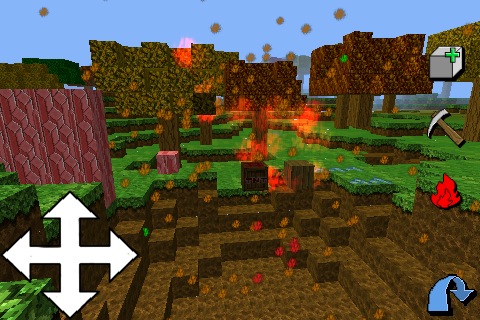
App O' The Mornin': Eden Review

Grade: B
Price: $3

Although my new column in Maximum PC is about Minecraft (PC/Linux/Mac),  I haven't written much about it here on State of Play. I played Minecraft Alpha a bit last summer, and decided to wait for it to develop a little further before I did much additional coverage. 

That's when I learned about it again ... from my son. Kids were discovering the game, and the work-in-progress nature of it was part of the appeal. Now my son and his friends are trading crafting recipes and tips, talking about their workbenches and adding new wings to their houses. They pour over the Minepedia like it’s the Dead Sea Scrolls and commiserate on the challenges of obsidian farming.

Minecraft is a world-building game in which you have an entire landscape to shape and develop using blocks and tools. The gameplay falls somewhere between a 3D Dwarf Fortress (albeit a version of Dwarf Fortress playable by actual humans) and the crafting element of certain MMOs, but done with vintage early-1990s PC graphics. That’s not a knock, by the way. Since the entire game is based around cubes and their manipulation, the blocky visuals actually suit the game quite well, giving it a consistent cubist aesthetic that’s oddly pleasing.
Eden for iOS is not Minecraft. It is a copycat that falls somewhere in the awkward lacunae between "homage" and "ripoff." Minecraft already made a brief cameo appearance in the app store via Minecrafted, a Minecraft client adapted for iOS, before being summarily yanked. 

But Eden is something different. It's an effort to recreate a piece of the "Minecraft Classic" experience for iPhone. As such, it does a good job, but falls well short of conveying the complete Minecraft Alpha experience. 

Eden is basically the building portion of Minescape without any of the other features.  There are three interactions: dig/destroy, build, and burn.  The dig & burn elements are self-explanatory, although it should be mentioned that neither yields any kind of useful secondary items. You don't get wood from chopping down a tree or charcoal from burning wood. The world is also completely lifeless, which means you can't punch sheep.

The build feature is the heart of the game. It provides a large palette of block designs which can be used for construction purposes. These are just standard blocks skinned to look like stone, brick, wood, and so on. One of the blocks is TNT, which can be used to blow things up real durn good. 

The movement and look-around controls work very well, and everything is put together nicely. There just isn't a lot to do in this world without the entire crafting/workbench/lava/zombie-pig element. Perhaps that's in the works. 

There is an integrated community function that allows you to upload and download your worlds, but beyond that Eden just feels like the initial steps of a better game. It's quite possible that new features will be added in future updates. It's equally possible that it will be yanked from the App Store for copyright infringements. Right now, it's a pretty nice way to carry a bit of the Minecraft experience around in your pocket. 

Saturday, December 4, 2010

Comment Moderation

Comment moderation is off again. I was hit by a pretty aggressive spammer (named "stalin," of all things: I hate communists more than chiggers and cold oatmeal combined), so I had moderation on for a time. He seems to have moved on to another purge or show trial, so I'm turning it off.

I also started to have a debate with someone on my charity post, until I realized it was a spambot which was tasked with posting a vegan screed whenever anyone mentioned or linked to Heifer International. Apparently Heifer is an evil entity because it gives poor and starving people meat rather than soy milk and tofurky.

Friday, December 3, 2010

PUZZLE: English into French

My Editor-in-Chief at Games, Wayne Schmittberger, sent me this puzzle from Martin Gardner's final, posthumously-published Colossal Book of Word Play (Puzzlewright, $8.95).
What English word when spelled backward becomes its own French plural (i.e., the plural of itself translated into French)?
Answer: STATE (ETATS) [ignoring that etat has an accent aigu on the e]


New From ThinkFun: Chess, Knots, and Patterns

I've been getting so many new games over the past couple of weeks that my crack play-testing team can't keep up with them all. I'll start with quick impressions today and then write  longer reviews as I put in some real play time.

First up are three fine products from my friends at ThinkFun, the people who made Rush Hour and all its multiple sequels and variations.

Solitaire Chess
This is a great little combination teaching tool and puzzler. It comes with 2 pawns, 2 bishops, 2 rooks, 2 knights, 1 king, and 1 queen, all in blue plastic. There are 60 puzzles on double-sided cards, each depicting a 4x4 chess board and the starting positions of certain pieces. The goal is to capture all the pieces so that only only 1 remains. I've already spent a bit of time with this, and I'm loving it. The early puzzles are pretty easy, but there are some real challenges here.


Trango
I haven't had a chance to test this one yet, but it looks promising. It's a game for 2-4 players in which you place tiles to complete shapes for points. Using four different Trango tiles, each player attempts to create a particular shape, while other either work on their own shapes or try to block.


Knot So Fast
This one is going to be a big hit at our Scout meetings. Seriously, if ThinkFun isn't heavily marketing this to the Boy Scouts of America, then they're missing a golden opportunity. The game comes with ropes, a scoring device, a timer, and 40 different knot-tying challenging. The game is a race to see who's the fastest at tying the knot shown on the card.


State of Play's New Domain

Since I appear to be sticking with this whole blogging thing, I've purchased the www.stateofplayblog.com domain. It shouldn't make any difference for you, since both the old blogspot links and the new stateofplayblog links should work fine. Please let me know if anything is broken or otherwise missing.

App O' The Mornin': Words With Friends Review

Grade: A
Price: free and $2 versions

After doing the news post on Zynga's acquisition of Newtoy, I realized I'd never done a full review of Words With Friends. I don't play it that much, simply because I'm pretty wired into Scrabble and its ability to allow play from iOS to Facebook. That's not to say I don't like it: I do.

Words With Friends is a very good game, with effective matchmaking and connectivity. The interface works well, and the game loads quickly and functions smoothly. Unlike some of the confusing setup issues with Scrabble's matching system, which requires you to begin creating a new game in order to continue an old one, Words With Friends just pops you right into the action.

You can get into a game almost instantly with either friends or strangers. There's an integrated text chat system, and the ability to play 20 games simultaneously. These don't have to be "live" games: push notifications let you know when your opponent has made a move, so games can be played over the course of minutes, hours, days, or even weeks.

The bonus square distribution is different in Words With Friend than it is in Scrabble, which requires an adjustment in strategy for those of us hardwired into Scrabble. My style tends heavily towards board management and blocking, and the WWF layout is different enough that it takes some time to adjust. The point values are also different in places, with J worth 10 points in WWF rather than 8 as it is in Scrabble.

Some pretty obvious features are missing. A point count for the letters in your current move is mysteriously absent. Sure, you can do this in your head, but why should you have to? There's also no shuffle button for your tray. I like Scrabble's ability to just shuffle your tiles around as you look for ideas. Words With Friends allows you to shake in order to shuffle, but this is needlessly awkward when a button would do fine.

For multiplayer word gaming, Words With Friends does work better than Scrabbles multiplayer functions, and perhaps the new connection with Zynga will bring a WWF app to Facebook.


NOTE: The free version is burdened with an aggressive advertising feature, which is removed in the pay version. 

Evilcorp Acquires Words With Friends

I've made my disdain for FarmVille creators Zynga pretty clear, and now the thing I feared is beginning to happen. Zynga is using their money and power to scoop up good companies. Newtoy, creators of the popular Words With Friends and Chess with Friends, is the first victim. Zynga promptly renamed them Zynga with Friends. I only wish I was making that up.

Zynga head Marc Pinkus allegedly considered renaming them Zynga With Friends With Benefits, but nobody could figure out what the benefits were, or how many Zynga coins they'd cost.

Newtoy also made their own FarmWille ripoff called We Rule. Compared to other compulsion loop games, it really wasn't bad, in the same way that Attack of Clones wasn't as bad as The Phantom Menace.

The Games With Friends network created by Newtoy is the most popular social gaming system on iOS systems, and Zynga has the most popular social gaming titles on other systems, so it's a pretty natural match. No word on whether the Zynga model (Step 1: Steal, Step 2: Lie, Step 3: Screw your customers) will be applied to the "With Friends" line.

Maybe we'll have to buy some Zynga coins in order to get a "Q". Or perhaps come back in 15 minutes to see if our "Z" is ready.

Thursday, December 2, 2010

Giving: Mercy Corps

One charity I forgot to mention in my Getting and Giving post was Mercy Corps which, like Heifer, does tremendous work around the world. They have a special gift program that allows you to make donations for specific things, such as outfitting a classroom, planting a field of rice, or giving someone a sewing machine. A card is then sent to the recipient notifying them what was donated in their name. It's a concrete symbol of something good, and beats the hell out of that sweater you were looking at.

It's like The Human Fund, only for real.

Jane Austen's Word Game

In Chapter 41 of Jane Austen's novel Emma, several of the characters use an impromptu game of anagrams to convey thoughts and feelings they cannot express. In the case of Mr. Churchill, he offers a kind of oblique apology to Miss Fairfax by spelling the word "blunder," in acknowledgment of his mistake, and then proceeds to taunt her by spelling "Dixon," the name of another young man.

The game is played with "letters" used by Emma's young nephews for their lessons. They are probably not children's alphabet blocks, but more like Scrabble tiles. They work well for playing anagrams, which was a favorite parlor game of the English middle- and upper-classes, who delighted in puzzles and wordplay. 

Anagrams was a simple game of turning the letters of a word into another word. The characters in the novel create their words in secret, then scramble the letters and pass them to another person, who has to discover the original word. 

It's remains an easy filler game to play while waiting for others to join a game of Scrabble, or just as a fun way to help children learn their words.

Here's the entire passage from Emma, with the rest coming after the break.
"Miss Woodhouse," said Frank Churchill, after examining a table behind him, which he could reach as he sat, "have your nephews taken away their alphabets -- their box of letters? It used to stand here. Where is it? This is a sort of dull-looking evening, that ought to be treated rather as winter than summer. We had great amusement with those letters one morning. I want to puzzle you again."