Showing posts with label Literature. Show all posts

Wednesday, December 7, 2011

INTERVIEW: Alf Seegert Takes the Road to Canterbury

Alf Seegert and friend playing Road to Canterbury
I don't recall when I first heard about The Road to Canterbury, but I knew I had to have it. I'm a huge fans of Middle English literature in general and Chaucer in particular, and was a member of the New Chaucer Society for a time. There's something in the strange beauty of the language, at once alien and familiar, that makes Middle English remarkably appealing. The Canterbury Tales in particular pulse with life and meaning, capturing a huge range of styles and emotions from highly cultivated to utterly base. (If the language is a real obstacle for you, just pick up a decent translation, such as David Wright's from Oxford World Classics rather than the newer one from Burton Raffel. It's worth taking the time to learn the original language, but if it's between a translation and nothing, then read a translation.)

Regular readers of SOP will know that I've covered the game several times since I first learned about it, but I like to have a number of plays before I commit to a final review. Short version: it's very good! A longer version will have to wait until it gets to the table at least one or two more times.

Recently, I got a chance to sit down with designer Alf Seegert (and by "sit down" I mean that we were both sitting at our computers at opposite ends of the country doing an email interview) to talk about his career and his latest game.

Alf's first two games, Bridge Troll (Z-Man games, $25) and Trollhalla (Z-Man Games, $50), each made the Games 100, and his newest game, The Road to Canterbury (Eagle Games, $60) is heading for the list as well., Seegert, a professor of English at the University of Utah, started designing game 10 years ago, and five of his early designs were finalists at the annual Hippodice board game design competition in Bochum, Germany: The Vapors of Delphi (2nd place, 2004), Bridge Troll (end-round finalist, 2005 -- later published by Z-Man Games), Ziggurat (end-round finalist, 2005), Mont-Saint Michel (end-round "Recommended Title," 2007), and TEMBO (3rd place, 2008 -- later published by Z-Man Games as Trollhalla). With Road to Canterbury, Seegert finally gets to merge his love of literature with his love of gaming, offering a unique take on Chaucer’s famous tales of garrulous pilgrims on their way to Canterbury.

Give us a bit of your gamer biography. What genres and styles have appealed to you throughout your life?

I didn’t become completely captivated by games until I was a teenager, when fantasy role-playing systems like Dungeons & Dragons and Tunnels & Trolls became a safe-haven for me. I loved Milton Bradley's electronic board game Dark Tower and in ninth grade I programmed a version of it into the high school mainframe computer (I used little monochrome ASCII characters to represent each player, the Tombs, the Bazaar, etc.). But except for an occasional session of the fantasy game Talisman, I didn't play many board games again until I hit thirty. I was spending a lot of time by myself playing computer games--and my girlfriend (now my wife) wanted me to play games with her instead. We did some research and stumbled on The Settlers of Catan, which proved a potent gateway drug into the brave new world (well, new to us) of Eurogames. Once we introduced Catan to our friends, Saturday nights quickly became a regular and much-anticipated “game night” event, which has continued now for over ten years.

What prompted you to make the leap from player to designer?

After encountering the brave new world of Eurogames, it wasn’t long before I felt compelled to take themes that interested me and make board games out of them. Sometimes it worked. Before long, I had several prototypes based on everything from geology to archaeoastronomy to ancient mythology to fairy tales. I sent some of my better designs to the Hippodice board game design competition in Bochum, Germany where several became finalists. With help from my fellow designers in the Board Game Designers Guild of Utah (www.bgdg.info), eventually I was able to interest major publishers in my designs and I’m on my way to my fourth published game as we speak.

Tell us a bit about your first published games, Bridge Troll and Trollhalla. How would characterize them, and what let to their development and publication? Also: what's with the troll thing?

I had encountered a sculpture in downtown Salt Lake City showing a Navajo woman leading sheep across a narrow bridge. I thought to myself how fun (and silly) it would be to put one of those wild-haired Scandinavian “Troll Dolls” beneath it, in homage to the fairy tale of “The Three Billy Goats Gruff.” Somehow the idea of actually playing one of these trolls became very appealing to me. In Bridge Troll you get to play as a troll who eats and extorts the travelers who try to cross your bridge. In Trollhalla I took these trolls out to sea where they became Viking-like marauders out to pillage and plunder islands full of pigs and peasants, nervous monks, and panicked princesses. Although these are both Eurostyle board games, they feel a bit like role-playing games to me because the players actually get to play the monsters. Part of my fascination with trolls was instilled in me during childhood by my Danish mother, who was convinced that scary trolls lived beneath the bridge in her hometown. Trolls are big in Scandinavia!

What elements of The Canterbury Tales made you think they might make a good theme for a game? Were you concerned that some might be bothered by the religious satire?

I grew up on British comedies like Monty Python and Black Adder, and I see both of them as inspired by Chaucer’s irreverence six hundred years on. In The Canterbury Tales, a company of medieval pilgrims journeys together from the Tabard Inn at the outskirts of London to the shrine of Thomas Becket at Canterbury, entertaining each other with stories along the way. Some of these tales are incredibly bawdy (and very funny). Many challenge existing social hierarchies and expose the hypocrisy of those who supposedly represent God and the church. Satire is a useful tool for cultural critique, and Chaucer was a Christian genuinely disturbed by religious corruption—and he found humor a better (and safer) vehicle for critique than direct denunciation. I thought it would be fun to make a humorous and “Chaucerian” game inspired by Chaucer’s own work. In The Road to Canterbury you play a greedy pardoner, and to succeed in filling your coin purse, you need to pardon pilgrims’ sins for quick cash. But to keep yourself in business you also have to tempt pilgrims to commit these very sins in the first place! You will bring along a special supply of bogus relics like “The Miraculous Moustache of Saint Wilgefortis” (a female, I might add) to help the pilgrim drive away unwanted sins and the like. So far, it appears that the theme of my game is sufficiently absurd that it draws more laughter than ire, even from the religiously inclined.

How does the theme mesh with the mechanics of play?

The game combines hand management, area control, and press-your luck mechanics: you must always make tough choices on whether to tempt a pilgrim to sin or to collect coins by pardoning sins in play. The catch is that the value of pardoned sins increases geometrically as the Sin cards accumulate, so you are “tempted” to let them really pile up—although doing so risks another player beating you to the punch! You can also cleverly play Relic cards to add some chaos to the game and deviously foil your opponents’ plans. I’ve put together a little Flash tutorial to help new players get a grip on how it all works at www.theroadtocanterbury.com

How did you choose the art and develop the aesthetic elements of the game?

A few years ago I stumbled upon Hieronymus Bosch’s tabletop painting The Seven Deadly Sins and the Four Last Things. Bosch’s deranged and demonic imagery and the rondel-style circle in the middle of the tabletop made me think that his painting might serve well as a game board, so I attempted a “posthumous collaboration.” It seems to have worked very well! Players say they love Bosch’s art on the board and on the Sin Cards, which give close-up images of Bosch’s representation of each individual “Deadly Sin.” I am a professor of English, so it was only natural to bring in seven pilgrims from The Canterbury Tales to create an unnatural Bosch-Chaucer hybrid. Each pilgrim has their own “favorite sin”: the Knight suffers from Pride, the Miller from Wrath, the Monk from Gluttony, etc., and for these illustrations Gryphon Games secured images from the early 15th Century Ellesmere Manuscript of The Canterbury Tales. The game’s “fine art” approach made it a suitable successor to Gryphon’s recent game Pastiche.

I understand you've achieved some measure of fame as a bad writer. What is the worst sentence you've ever written?

Well, my “claims to fame” in fiction writing are indeed all bad fiction entries in the Bulwer-Lytton Fiction Contest, where the goal is to compose the worst opening sentence to a novel. I have scored several “Dishonorable Mentions” so far. My most efficient example is this one:

“The Zinfandel poured pinkly from the bottle, like a stream of urine seven hours after eating a bowl of borscht.”

And here is my best attempt to write an entire story in the self-enclosing style of Borges in a single sentence:

“Wet leaves stuck to the spinning wagon wheels like feathers to a freshly tarred heretic, reminding those who watched them of the endless movement of the leafy earth--or so they would have, if only those fifteenth-century onlookers had believed that the earth actually rotated, which they didn't, which is why it was heretical to say that it did--and which is the reason why the wagon held a freshly tarred heretic in the first place.”


Friday, September 16, 2011

The Road to Canterbury Arrives

To my house does The Road the Canterbury wend. As a lover of all things Chaucer and Middle English, I've been following Alf Seegert's The Road to Canterbury since I heard about it earlier this year. Alf was kind enough to have an advance copy of the game sent along, and it looks terrific. The art is derived from Hieronymous Bosch's famous Table Top of the Seven Deadly Sins and Last Four Things, as well as medieval illuminated manuscripts. Components are very well made and solid, although cards are a little small.

The gameplay, as my daughter remarked, is "EEEEEVIL." We did one full trial playthrough and enjoyed the mechanics, even though we made a rules mistake that we didn't catch till half-way through.

The game has you playing as The Pardoner, the cynical and corrupt churchman from The Canterbury Tales.  The Pardoner peddles forged indulgences and counterfeit relics in order to fleece the pilgrims. In this role, you draw a combination of Sin, Pardon, and Relic cards, which are played to various pilgrims from the tales. Sins are pardoned in sets, earning influence (known in the game as "corruption") as well as coin for the Pardoner. It's a pretty unique mechanic, and we need to run it through a few more test plays to see what we think, but first impressions are positive. As the daughter said at the end of the first test game, "It's still evil, but fun."

Friday, July 15, 2011

Snapdragon: A Festive Children's Game Played With Flaming Food

Thou art easier swallowed than a flapdragon.
Wm. Shakespeare, Love's Labor's Lost

In Lewis Carroll's Through the Looking Glass, Alice is introduced to various fanciful insects by a gnat the size a chicken. To an American child, these creatures appeared to be little more than whimsical creations, but one insect had special connotations for the British:
A snap-dragon-fly

`Look on the branch above your head,' said the Gnat, `and there you'll find a snap-dragon-fly. Its body is made of plum-pudding, its wings of holly-leaves, and its head is a raisin burning in brandy.'
`And what does it live on?'
`Frumenty and mince pie,' the Gnat replied; `and it makes is nest in a Christmas box.'

I'd never really paused over this reference to a "snapdragon fly", but the most recent episode of Masterpiece Mystery, an adaptation of the Inspector Poirot novel Hallowe'en Party, included an alarming scene of kids playing a party game during a Halloween celebration. Children kept reaching into a flaming bowl, grabbing something, and popping it in their mouths while chanting "snip snap dragon." You can find the scene (for as long as it stays up on Youtube), at the 7:00 mark here. I hadn't the faintest idea what they were doing until we looked it up and learned that it's an old game (no one knows just how old) called snapdragon or flapdragon.

from Poirot: Halowe'en Party (2010)

Here's how Martin Gardner describes it in The Annotated Alice:
Snapdragon (or flapdragon) is the name of a pastime that delighted Victorian children during the Christmas season. A shallow bowl was filled with brandy, raisins were tossed in, and the brandy set on fire. Players try to snatch the raisins from the flickering blue flames and pop them, still blazing, into their mouths. The burning raisins also were called snapdragons.
The chant that accompanies the game goes like this:
Here he comes with flaming bowl / Don't he mean to take his toll!
Snip! Snap! Dragon!
Take care you don't take too much / Be not greedy in your clutch!
Snip! Snap! Dragon!
With his blue and lapping tongue / Many of you will be stung!
Snip! Snap! Dragon!
For he snaps at all that comes / Snatching at his feast of plums!
Snip! Snap! Dragon!
But Old Christmas makes him come / Though he looks so fee! fa! fum!
Snip! Snap! Dragon!
Don't 'ee fear him but be bold / Out he goes his flames are cold!
Snip! Snap! Dragon!
Snapdragon is normally a Christmas tradition, although it's played at Halloween as well. There's no clear indication of the game's origins, but some sources trace it to the ancient Greeks or Druids, which seems rather fanciful. It pops up several times in the works of Shakespeare, where he uses "flapdragon"  and "snapdragon" interchangeably to indicate something that's easy to swallow. You know: like flaming fruit. That pushes the game back to the 16th century at least. Like so many indoor amusements, it became traditional during the Victorian era, because nothing says "fun for kids" like sticking your hand in a burning bowl of liquor.

I'm annoyed that I even have to add this, but if you try this game at home, please remember that fire is hot and if you're injured it's totally your own fault, not mine.


Saturday, May 21, 2011

Uncle Chestnut's Table Gype on Kickstarter

Paul Nowak of Eternal Revolution has begun a Kickstarter Campaign to continue the production of Uncle Chestnut's Table Gype, which just won a MENSA select award and was also on our Games 100 list for 2011. Paul just sent me a copy of this wonderful game, and I hope to have a review of it here in the near future. In the meantime, enjoy these video that explain a bit about the game, G.K. Chesterton, and Distributism.


Chesterton On Chess and Madness

The previous post about Bobby Fischer calls to mind a famous passage from Orthodoxy, by G.K. Chesterton. Long before Bobby Fischer, G.K. Chesterton wrote of the madness of chess players, the sanity of the imagination, and the challenges of reason. (I've paragraphed the passage to make it easier to read on the blog.)

Imagination does not breed insanity. Exactly what does breed insanity is reason. Poets do not go mad; but chess-players do. Mathematicians go mad, and cashiers; but creative artists very seldom. I am not, as will be seen, in any sense attacking logic: I only say that this danger does lie in logic, not in imagination. Artistic paternity is as wholesome as physical paternity. Moreover, it is worthy of remark that when a poet really was morbid it was commonly because he had some weak spot of rationality on his brain. 
Poe, for instance, really was morbid; not because he was poetical, but because he was specially analytical. Even chess was too poetical for him; he disliked chess because it was full of knights and castles, like a poem. He avowedly preferred the black discs of draughts, because they were more like the mere black dots on a diagram.[...] 
The general fact is simple. Poetry is sane because it floats easily in an infinite sea; reason seeks to cross the infinite sea, and so make it finite. The result is mental exhaustion, like the physical exhaustion of Mr. Holbein*. To accept everything is an exercise, to understand everything a strain. The poet only desires exaltation and expansion, a world to stretch himself in. The poet only asks to get his head into the heavens. It is the logician who seeks to get the heavens into his head. And it is his head that splits.


*Note: This is a reference to Montague Holbein, who tried to swim the English Channel.

Tuesday, May 10, 2011

Chesterton On Games

I'm an avid Chestertonian, so I loved this shirt from Eternal Revolution, the makers of Uncle Chestnut's Table Gype. Make sure you look around their shop while you're there, and learn a bit about Distributism while you're at it.

UPDATE: Brett J. Gilbert shot me a Twitter message with a link to the entire essay from which this quote is taken. People, if you love language, if you love a man with a cheerful hunger for life, if you simply love good humor, then you need to read more G.K. Chesterton. He is the great author that your teachers kept you from all those years because of his dangerous ideas. You become a better person for having read him.

Tuesday, May 3, 2011

Updates on The Road to Canterbury

Game designer Alf Seegert sent me a couple of links about the progress of his upcoming game, The Road to Canterbury (Gryphon Games), which I previewed last month.

First up is a long and interesting designer diary written by Alf in in which he explains the origin and evolution of his concept and the way he turned his love for the writing of Geoffrey Chaucer into a game.

The game also now has a Kickstarter Campaign, which is an intriguing new trend to fund and support projects during their development. If the game reaches the $10,000 threshold for support and pre-sales, then publication is guaranteed. As of this writing, they're already past the $7,000 mark with 42 days to go. A $45 "investment" gets you free copy of the game. (It functions like a pre-order.) Higher donations come with nifty bonuses. Check out the Kickstarter site for more details.

Alf and I have exchanged a few emails as we discussed his concerns that people with religious sensibilities might be offended by the game. (I'm a Catholic catechist and lecturer, and I begin work on my Masters in Theology this summer.) The game focuses on Chaucer's character of the Pardoner, a corrupt churchman who sold indulgences and preyed on people's sins. The game places each player in the role of the Pardoner, attempting to get people to commit sins and then profiting from them. These are deadly sins, however, so push too far, and a player could simply die.

Chaucer is one of my great passions, as is medieval Catholicism. The game is true to its period and sources, and if it seems to play lightly with the serious matter of sin and clerical corruption, it also shows the deadly effects of both. In a society that tends to dismiss the very notion of sin, that's a valuable thing. Chaucer himself remained a pious Catholic until his death, and at the end of his life made an "apology" disavowing and repenting for his more bawdy works. (Though this, too, may have been his idea of a joke. Sometimes it's hard to tell with Chaucer.) His satirical work was meant to be medicinal, much like In Praise of Folly by Erasmus. (Erasmus was shocked to learn that his biting satire on Church corruption was thoroughly enjoyed by its main target, Pope Leo X: the man who turned the selling of pardons into an art form.)

I'm looking forward to Road to Canterbury. I think it looks fun and I like the subject matter, but I also think it may be a useful teaching tool.

Tuesday, March 22, 2011

The Road to Canterbury

Designer: Alf Seegert
Publisher: FRED/Gryphon
Players: 2-3
Ages: 10+
Time: 45-60 minutes
Due: Summer 2011

One of my useless skills is the ability to read and recite Middle English, the language of Chaucer (The Canterbury Tales) and Langland (Piers Plowman). It's an ability that serves absolutely no purpose whatsoever other than giving me pleasure, and those are the things that tend to make life worthwhile.

I am an unapologetic medievalist. Civilization started to go pear-shaped with the Renaissance and really went to Hell in a handbasket (or perhaps Sheol in a sackbut?) with the Enlightenment. Medieval literature, art, history, and theology are fascinating to me. So, naturally, I was thrilled to see all of them converging with my love of gaming in Alf Seegert's upcoming game The Road to Canterbury.

Seegert is the designer of Trollhalla and Bridge Troll (both from Z-Man Games) as well as an English professor at the University of Utah. When I read Seegert's discussion of the game in his interview with Dice Hate Me, I wrote to him asking for details. 

"It might sound weird considering that it's based on Chaucer and I'm a literature professor," he replied, "but it's not too heavy on narrative--it's a more Euro-style design with different cards (Pilgrim, Sin, Pardon, and Relic cards--with art largely drawn from the Ellesmere Manuscript of the Canterbury Tales) that all interact together with a main gameboard that tracks the progress of the journey to Canterbury and shows which sin is currently denounced by the Parson, and which Pilgrims are currently available to tempt with sins and then pardon for ready cash. The board is itself based on Hieronymus Bosch's 16th c. tabletop of the Seven Deadly Sins."
Bosch: The Seven Deadly Sins and the Last Four Things
Here's the official description of The Road to Canterbury.
Greed, Pride, Gluttony, Wrath, Luxury, Idleness, and Envy—the infamous “Seven Deadly Sins.” For the faithful, they instill horror. For you, on the other hand, they present a wonderful business opportunity! In The Road to Canterbury, you play a medieval pardoner who sells certificates delivering sinners from the eternal penalties brought on by these Seven Deadly Sins. You make your money by peddling these counterfeit pardons to Pilgrims traveling the road to Canterbury. Perhaps you can persuade the Knight that his pride must be forgiven? Surely the Friar’s greed will net you a few coins? The Miller’s wrath and the Monk’s gluttony are on full public display and demand pardoning! The Wife of Bath regales herself in luxury, the Man-of-Law languishes in idleness, and that Prioress has envy written all over her broad forehead. And the naughty stories these Pilgrims tell each other are so full of iniquity they would make a barkeep blush! Pardoning such wickedness should be easy money, right?

Not quite. For you to succeed as a pardoner, you’ll need to do more than just sell forged pardons for quick cash. To keep your services in demand, you will actually need to lead these Pilgrims into temptation yourself! Perhaps some phony relics might help? There is also one big catch. The Seven Deadly Sins live up to their name: each sin that a Pilgrim commits brings Death one step nearer, and a dead Pilgrim pays no pardoners!

So much to forgive, so little time. Will you be able to outwit your opponents by pardoning more of these Pilgrims’ sins before they die or finish their pilgrimage to Canterbury?
Chaucer in the Ellesmere Manuscript
The game is due from FRED/Gryphon this summer, and Seegert is working with the publisher to finalize the art for the board and cards. I'm guessing the "Last Four Things" part of the painting, with Bosch's typically vivid depiction of the torments of Hell, will probably not appear in a game intended for family play. The Ellesmere Manuscript, which is the other artistic inspiration for the game, is the most famous and elaborate illuminated manuscript of The Canterbury Tales, with illustrations of the pilgrims and Chaucer himself. 

(Pointless Digression: As an added bonus for conspiracy theorists, the Ellesmere Manuscript was owned by John de Vere, the 12th Earl of Oxford, who wound up at the wrong end of the headsman's ax for his loyalty to the House of Lancaster in the Wars of the Roses. He was the ancestor of Edward de Vere, the 17th Earl of Oxford and the man some people believe wrote the works of William Shakespeare, despite the inconvenient fact of his being dead when Macbeth, The Tempest, and Henry VIII were actually written. However, I think these connections prove incontrovertibly that Geoffrey Chaucer actually wrote the complete works of William Shakespeare! Alas. the whole Oxford/Shakespeare debate is about to go massively mainstream thanks to a big-budget movie from crap-auteur Roland Emmerich.) (These rambling asides are bonus content, and are added free of charge.)

I'll write some more about The Road to Canterbury as it gets closer to completion.

Other games by Alf Seegert:


Monday, March 14, 2011

Playful Quotes

"The life of a man is a combination of seriousness and play, and only he who knows the delicate act of balancing the two deserves to be called the wisest and happiest of men."
                                                           Goethe

"You can discover more about a person in an hour of play than in a year of conversation."
                                                           Plato

"Man is most nearly himself when he achieves the seriousness of a child at play."
                                                           Heraclitus

Monday, March 7, 2011

Emily Dickinson's Puzzle Poems

Emily Dickinson's poetry is characterized by its highly compressed, idiosyncratic use of language to convey intense emotions. But she also wrote a series of light "riddle" poems in which the subject is never directly stated, leaving the reader to determine what the poem is about. They aren't difficult as riddles (except maybe for #1489), but they're important because of their use of language.

Here is the first, with the other three after the jump. I'll leave off the solutions for now in case readers want to solve them.

#291
It sifts from Leaden Sieves --
It powders all the Wood.
It fills with Alabaster Wool
The Wrinkles of the Road --

It makes an Even Face
Of Mountain, and of Plain --
Unbroken Forehead from the East
Unto the East again --

It reaches to the Fence --
It wraps it Rail by Rail
Till it is lost in Fleeces --
It deals Celestial Vail

To Stump, and Stack -- and Stem --
A Summer's empty Room --
Acres of Joints, where Harvests were,
Recordless, but for them--

It Ruffles Wrists of Posts
As Ankles of a Queen --
Then stills its Artisans -- like Ghosts --
Denying they have been --

Tuesday, February 22, 2011

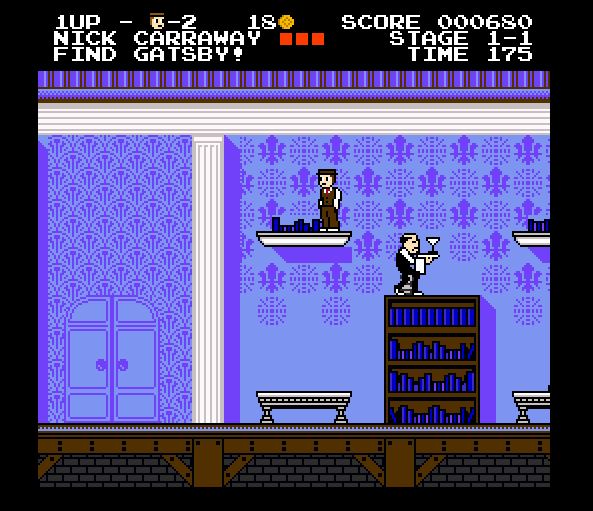
The Great Gatsby: The Long-Lost NES Game

Kotaku pointed me at a "lost" gem of the classic Nintendo Entertainment System days: the 8-bit adaptation of F. Scott Fitzgerald's The Great Gatsby.

Writer Michael McWhertor fills in the details of just how lead developer Charlie Hoey created a spoof of the iconic Great Gatsby cover art done in an 8-bit visual style. It was such a good idea they decided to turn the whole thing into a flash videogame done in the classic NES style, complete with a period advertisement and scans of the "real" insert for the original cartridge.

There's a certain mad genius in the game, a classic platformer in which Nick Carraway hops around Gatsby's mansion and other locations, collecting money and martinis while dodging flappers, Wilfred the butler, and other foes.


You can play the game online at GreatGatsbyGame.com. Can a version of Thomas Wolfe's Look Homeward, Angel, complete with avenging ghost of Ben Gant, be far behind?

Wednesday, January 19, 2011

Poe's Cipher Fascination

Pen and ink by Gabriel Caprav
Today marks the 202nd anniversary of the birth of Edgar Allan Poe. Poe's writing made a huge impression on me when I first discovered it in junior high, and has stayed with me ever since. His picture hung over my desk for years, which is pretty apt, since Poe was frequently hungover.

Poe had a madness for ciphers. This was most famously exhibited in "The Gold Bug," which includes a substitution cipher (and a lengthy explanation of its solution) as a key plot point.

That cipher reads as follows:
53‡‡†305))6*;4826)4‡.)4‡);806*;48†8
¶60))85;1‡(;:‡*8†83(88)5*†;46(;88*96
*?;8)*‡(;485);5*†2:*‡(;4956*2(5*—4)8
¶8*;4069285);)6†8)4‡‡;1(‡9;48081;8:8‡
1;48†85;4)485†528806*81(‡9;48;(88;4
(‡?34;48)4‡;161;:188;‡?;
And is solved thus:
A good glass in the bishop's hostel in the devil's seat forty-one degrees and thirteen minutes northeast and by north main branch seventh limb east side shoot from the left eye of the death's-head a bee line from the tree through the shot fifty feet out.
Poe Cipher
But there was another Poe cipher mystery that was lost in the pages of Alexander's Weekly Messenger for almost 150 years. Poe had used the newspaper to challenge all comers to send him ciphers, and he would crack them all. He claims to have solved at least 100 of them, and then signed off with two new ciphers by a "Mr. W.B. Tyler." There is some convincing evidence that Tyler was Poe himself, and that these final ciphers were his parting mystery.

They remained forgotten and unsolved until Professor Louis Renza of Dartmouth College brought them to light in 1985. Prof. Renza subsequently established the Edgar Allan Poe Cryptographic Challenge, complete with a $2500 prize, to crack the codes. In 2000, Gil Broza managed to do it and claimed the prize


There was some hope that these ciphers would turn out to be new, previously unknown writing by Poe, but this is almost certainly not the case. One was a passage from Cato, by the English essayist Joseph Addison. The other remains unidentified, but is not in any style recognizable as Poe's.

Thursday, December 2, 2010

Jane Austen's Word Game

In Chapter 41 of Jane Austen's novel Emma, several of the characters use an impromptu game of anagrams to convey thoughts and feelings they cannot express. In the case of Mr. Churchill, he offers a kind of oblique apology to Miss Fairfax by spelling the word "blunder," in acknowledgment of his mistake, and then proceeds to taunt her by spelling "Dixon," the name of another young man.

The game is played with "letters" used by Emma's young nephews for their lessons. They are probably not children's alphabet blocks, but more like Scrabble tiles. They work well for playing anagrams, which was a favorite parlor game of the English middle- and upper-classes, who delighted in puzzles and wordplay. 

Anagrams was a simple game of turning the letters of a word into another word. The characters in the novel create their words in secret, then scramble the letters and pass them to another person, who has to discover the original word. 

It's remains an easy filler game to play while waiting for others to join a game of Scrabble, or just as a fun way to help children learn their words.

Here's the entire passage from Emma, with the rest coming after the break.
"Miss Woodhouse," said Frank Churchill, after examining a table behind him, which he could reach as he sat, "have your nephews taken away their alphabets -- their box of letters? It used to stand here. Where is it? This is a sort of dull-looking evening, that ought to be treated rather as winter than summer. We had great amusement with those letters one morning. I want to puzzle you again."

Monday, November 22, 2010

COLONIAL GAMING: Hazard (Craps)

This Thanksgiving week, I’m concluding the series on Colonial Gaming with an item that would have gotten you stocked if you played it in front of our Pilgrim forebears. Hazard is, essentially, craps, and it was probably the most played “game” in both the New World and the Old.

Dice go back at least 5,000 years, and almost certainly much further. They were highly portable, easy to make, and provided a regular medium for gambling, which has always been a popular recreation. The Pilgrims frowned on dice not merely as part of their general prohibition on gambling and frivolous games, but because they would have associated them with the lots cast by the Roman soldiers for the garments of Jesus. Other regions of America, however, embraced dicing with a passion, and wherever common people gathered, dice appeared sooner or later.

There’s no telling just when the game of Hazard first emerged in Europe and England. Geoffrey Chaucer showed a ready familiarity with it, so we can place it in England at least as early as the 14th century, and almost certainly earlier. In the Pardoner’s Tale, Chaucer plays on the words “chance” and “hazard” several times, and makes an explicit reference to the game itself.
And if a prince plays similar hazardry 
In all his government and policy, 
He loses in the estimate of men 
His good repute, and finds it not again.
 And later:
And when he came, he noticed there, by chance, 
All of the greatest people of the land 
Playing at hazard there on every hand. 
And again, as part of a list of sins
O cursed sin, full of abominableness! 
O treacherous homicide! O wickedness! 
O gluttony, lechery, and hazardry! 
O blasphemer of Christ with villainy 
So hazard = not good. Check. (Although I'm pleased to see that "abominableness" is a real word.)

The word hazard comes to us from the Spanish word azar, meaning a “bad roll of the dice.” The word stopped off in France to pick up a final letter D before arriving in England via the French courts. Yes, our word “hazard,” meaning “potential danger,” comes from the name of this game.

Playing Hazard 
As with modern craps, Hazard is driven by bets placed on the likelihood of certain rolls. One player rolls at a time, using two dice.

Before the player rolls, he picks a main, which is a number between 5 and 9.

If he rolls the main, he wins. This is called throw in, or in, or nick.

If he rolls a 2 or a 3, he loses instantly. This is called throw out, or out.

The other combinations are contingent upon the main itself. They break down this way:

If the main is a 5, then 5 is in, and 2, 3, 11, or 12 are out.

If the main is a 6, then 6 or 12 are in, and 2, 3, or 11 are out.

If the main is a 7, then 7 or 11 are in, and 2, 3, or 12 are out.

If the main is a 8, then 8 or 12 are in, and 2, 3, or 11 are out.

If the main is a 9, then 9 is in, and 2, 3, 11, or 12 are out.

If the roll is neither in nor out, the number thrown becomes the chance.

On the next roll, the chance wins and the main now becomes a losing number. The roller keeps going until he hits the main or the chance, and then the dice are passed.

Wagering is done by the player and the observers at various stages and at various odds, with people betting either for or against the next roll of the dice. 

Craps
There is a straight line between Hazard and modern casino craps, so remember when you're sweating over the Pass/Don't Pass line that our forefathers were doing the same thing hundreds of years ago.

And if you’re utterly sure you have a foolproof system for beating craps … you don’t. No, really, you don’t. (And if your theory includes the names “Pascal” or “Fermat,” then you really don’t.) All of the odds set by a casino for each roll are set below the actual odds for the roll itself. The odds are better if you know what you are doing, but there is no casino game in which you can fully bend the odds in your favor. The house always has the advantage. 

Most "systems" are based on what's called the Gambler's Fallacy, which is this idea that someone who stays in a game long enough will eventually find probability turning in their favor. Probability is not cumulative. It resets itself with each roll of the dice. A gambler with a system always thinks he's "due" for a hit after a long series of misses. If the chances of flipping heads on a coin are 50/50 for the first flip, and you get tails, that doesn't mean they're 60/40 for the second flip. But that's the way many gamblers approach their games.

Here's an example just from yesterday. My daughter and I were waiting for people to join a game. We drew through an entire deck of cards, with high card winning. That's 26 draws for each of us. We "should" have each drawn 13 high cards. I drew no high cards. She drew 26. As Ralph Wiggums would say, "That's unpossible!" 

Consider this: I know games inside and out, and I never bet money in a casino unless I'm just enjoying the process of being there and willing to pay for the pleasure of a hyperoxygenated atmosphere and $10 beers. Skill does matter. Skill can improve your odds, but it never tilts them wholly in your favor. And casinos don't trade in games of pure skill: they trade in games where luck dominates. There's a reason casinos don't have chess or backgammon tables. It's the same reason that neither chess nor backgammon were all that popular in Colonial times. These are games where skill outweighs chance, and, like modern casinos, early Americans didn't favor games of skill. They only found real excitement when chance and luck were involved.


Tuesday, November 9, 2010

Ecarte: Poe and Doyle Play Cards

"The game, too, was my favorite Ã©carté!"
Edgar Allan Poe, "William Wilson" (1839)

Card games have been such a popular pastime for so long that it's not at all unusual to come across references to specific games in literature, such as Ombre in Alexander Pope's Rape of the Lock, or Speculation in Jane Austen's Mansfield Park

In Edgar Allan Poe's classic doppleganger tale "William Wilson," a major plot point turns on a card game in which the narrator is caught cheating. The characters are playing a French game called Ecarté, and although it's no longer popular, it was a common gambling and casino game in the 19th century. Observers, as well as players, often bet on the outcome.

There is no solid evidence that Poe was a serious gambler. Biographies usually only mention a single period of his life, when he was in school and near-penniless, when he turned to gambling to supplement his income. That he was able to do this shows he had some skill with cards, but of the many sins (both real and imaginary) laid at the feet of Poe, card-sharping was not one of them.

Nonetheless, he showed a ready familiarity with certain cheating techniques, as William Wilson explains when he is exposed during a game of Ecarté:
In the lining of my sleeve were found all the court cards essential in ecarte, and, in the pockets of my wrapper, a number of packs, facsimiles of those used at our sittings, with the single exception that mine were of the species called, technically, arrondees [rounded]; the honours being slightly convex at the ends, the lower cards slightly convex at the sides. In this disposition, the dupe who cuts, as customary, at the length of the pack, will invariably find that he cuts his antagonist an honor; while the gambler, cutting at the breadth, will, as certainly, cut nothing for his victim which may count in the records of the game
But the literary pedigree of Ecarté doesn't end with there. The works of Arthur Conan Doyle contain at least 9 references to Ã©carté in various stories and novels.

In Hound of the Baskervilles, for instance, Watson remarks:  "Mortimer had stayed to dinner, and he and the baronet played écarté afterwards." 

Doyle's Brigadier Gerard stories are full of Ecarté references. For example, in The Exploits of Brigadier Gerard, the narrator says: "I took up the cards from the table where Morat had left them, and I tried to work out a few combinations at Ã©carté. But I could not remember which were trumps, and I threw them under the table in despair." (This passage doesn't really make sense.)

And that's not even the end of it. A quick keyword search of just the books on my Kindle show Ã©carté popping up multiple times in the writing of Anthony Trollope, Wilkie Collins, Charles Dickens, Andrew Lang, J.S. Le Fanu, Gustave Flaubert, Honore de Balzac, W.M. Thackery, and Mark Twain.

In 1895, the Lumiere Brothers filmed a short which shows two Frenchmen playing a five-card trick-taking game. Given the time period and the fact that it's a two-handed game, they are probably playing Ecarté. This is interesting for a simple reason: it's the first time a card game appeared in a motion picture. You can see the clip as part of the Lumiere compilation here.  It begins at the 3:40 mark. 

One of the fascinating things about the clip is the speed with which the old men play. The onlooker doesn't even finish pouring the drinks before the game is over. This speed is what made it a popular game for people to watch and wager upon.

How to Play Ecarté
Ecarté is a simple trick taking game with a unique scoring mechanic. It's related to Euchre, and descended from the French game Triomphe.

Preliminaries
The game is played with 32-card deck, with all the cards from 2 to 6 stripped. (This is your basic Piquet deck.) 

The rankings are K, Q, J, A, 10, 8, 9, 7.

The cards are shuffled and dealt 5 to a player. The standard deal is in packets of either 3 + 2, or 2 + 3, but any agreed-upon deal is fine. Stock is placed between the players

One card is turned face-up as Trump. If the card is a King, the dealer immediately scores 1 point.

Exchange
Non-dealer can request an exchange of a certain number of cards. The dealer may refuse this request. If the dealer refuses the card exchange, then he commits himself to making 3 tricks and play commences. The non-dealer may come back with another request to exchange a different number of cards, with the same conditions: if the dealer refuses, he must earn 3 tricks.

If the dealer accepts the card exchange, the player discards the agreed-upon number of cards and draws replacements. Dealer must discard and replace at least 1 card.

Play
Play is straight trick taking, with high-card or high-trump winning. 

If either player holds the King of trumps, he may show it and score a point before playing the first trick.

Players score 1 point for taking 3 or 4 tricks, and 2 points for taking all 5 (this is called a vole).

However, if the dealer refused the exchange and then failed to win 3 or more tricks, the non-dealer does not score his own tricks. Instead, he earns 2 points automatically. 

Play continues to 5 points. If the loser only scores 1 or 2 points, the pot is doubled. If he scores no points, the pot is tripled.