
Showing posts with label Videogames. Show all posts
Showing posts with label Videogames. Show all posts
Friday, January 27, 2012


Thursday, January 12, 2012
Xbox Workers Threaten Suicide in China
It doesn't seem like the most effective way to keep your job, but the subtleties of Chinese labor negotiations are lost on my Western Imperialist mind.
Dozens of workers assembling Xbox video game consoles climbed to a factory dormitory roof, and some threatened to jump to their deaths, in a dispute over job transfers that was defused but highlights growing labor unrest as China's economy slows.
The dispute was set off after contract manufacturer Foxconn Technology Group announced it would close the assembly line for Microsoft Corp.'s Xbox 360 models at its plant in the central city of Wuhan and transfer the workers to other jobs, workers and Foxconn said Thursday.
Also of note: the writing at Associated Press (and, frankly, all mainstream journalism) just keeps getting worse and worse. I wrote better than this for my high-school newspaper: "The site previously had a couple of suicides or attempted ones a couple years back, prompting the government to take over the operations of the dormitories, said Wang, the equipment engineer."
Tuesday, January 10, 2012
Strange Stories of an Accused Spy
 |
| Amir Hekmati |
Amir Hekmati was born in Arizona to Iranian parents, and graduated from high school in Michigan. In his confession, he claims to have entered the US military in 2001, where he was trained and deployed as an interpreter because of his familiarity with the Farsi language. The US military regularly uses Iranian-Americans as translators in Afghanistan because Farsi is spoken in both countries.
After serving in Iraq for several months (the confession claims), Hekmati went to work for the Defense Advanced Research Projects Agency. DARPA is a super-secret group that is described, on their publicly-available website, as being established in 1958 “to prevent strategic surprise from negatively impacting U.S. national security and create strategic surprise for U.S. adversaries by maintaining the technological superiority of the U.S. military.” DARPA is, essentially, a high-tech R&D contractor for the US Department of Defense.
Now, here’s where things get weird. In the interest of just reporting the facts as stated, this is what Hekmati said in a confession broadcast on Iranian state television and obtained, we are certain, without any coercion, threats, or use physical force:
“After DARPA, I was recruited by Kuma Games Company, a computer games company which received money from CIA to design and make special films and computer games to change the public opinion’s mindset in the Middle East and distribute them among Middle East residents free of charge. The goal of Kuma Games was to convince the people of the world and Iraq that what the US does in Iraq and other countries is good and acceptable. The head of Kuma called me and said I have received your resume from DARPA, and we have a program in which you can help us. It [Kuma] was also a cover for the CIA and only the chief of company knows that you're working with the agency.”
Hekmati’s father, Ali, a professor of microbiology at Mitt College in Flint, Michigan, contradicts this version of events. He told the UK Telegraph that his son was in Iran visiting his grandparents. "He is not a spy. It's a whole bunch of lies on my good son. They have lied about any American ... captured in Iran for visiting or tourism, or for any other reason. The first two weeks went without incident. The third week in Tehran, some people visited him and took him away. Nobody heard from him in the next three months."
Kuma Reality Games was founded in 2004, and is based in New York. They are best known for a series of poorly-regarded downloadable military first-person shooters, often with a “ripped from the headlines” premise. Users can download new episodes containing missions such as the capture and killing of Osama bin Laden. They’re also responsible for Dinohunters, a game of almost sublime awfulness. One of their few innovations is the use of sponsored advertising in free games.
Some of Kuma’s shooters may well be intended for the military, which often uses software for recruitment and training purposes. In 2006, Keith Halper, the head of Kuma, admitted to Kotaku.com that Kuma created training simulations for the US Army.
 |
| Dionohunters (Kuma Games) was created by the CIA to convince Iranians that the US has an elite force of dinosaurs on flying scooters equipped with machine guns. |
Kuma also releases a steady stream of machinima, which are short films created using game engines. Some of these are just silly or promotional, while others depict military operations. The tone of the military shooters is sober and undeniably pro-American, with coalition soldiers shown taking down terrorist targets or conducting important military operations. It’s not particularly hard to see it as a coordinated propaganda effort, but it’s also not hard to see it as yet another military shooter with a Western/American point of view. Aside from its use of contemporary missions, nothing about Kuma’s work stands out one way or another.
The uniquely peculiar part about the “trial” of Hekmati is that the main charge against him was not for his work—real or not—with Kuma, but for working in Iran as a CIA spy. He was allegedly ordered to give Iranian Intelligence good information in order to get their trust, and then to start providing them with misinformation. He was allegedly captured before he could begin this alleged mission.
Of course, this version of events would ask us to believe that Hekmati’s employment at a company producing widely-available pro-American propaganda was merely cover for his role as a CIA agent, which would be a rather curious way of approaching a covert operation.
Although Iranian death sentences are usually carried out quickly and brutally, it’s more likely than Hekmati will be kept alive and used as a pawn in the ongoing geopolitical struggle between Iran and the West.
Written for Games Magazine
Monday, January 9, 2012
Yeaaaah! Skyrim Gets a Little Macho Magic
I was going to title this one, "Snap Into a Skyrim," but Kotaku beat me to it. A Skyrim mod in which dragons are replaced with the late, great pro wrestler Macho Man Randy Savage? Yeah, that's awesome.
Thursday, January 5, 2012
REVIEW: Skyrim

The Elder Scrolls V: Skyrim is vast. It is epic. It achieves moments of grandeur unlike anything I have encountered in three decades of roleplaying, both conventional and electronic. Yes, it is flawed in places, but these are the flaws of a system that occasionally breaks down under the immense strain created by pushing current technology to its very limits.
Players familiar with its immediate predecessors from Bethesda Softworks—The Elder Scrolls IV: Oblivion and Fallout 3—will see much that is familiar, on the surface. This is a still an open-world, action-oriented RPG, heavy on dialog and filled with quests, places to go and things to kill.
But everything is simply better this time around. The potential hinted at in Oblivion and developed further in Fallout 3 is now fully manifested in Skyrim. Bethesda has created a dynamic, highly-developed fantasy world populated with an immensely diverse selection of characters and spread across the most fully realized landscape ever seen in an electronic game.
There is much to love in Skyrim, but the biggest star of the show isn’t the graphics, the story, the character, or even the gameplay, but Skyrim itself. This world just cries out for exploration, from its sunlit valleys to its frozen mountain peeks, from the depths of monster-haunted dungeons to the frozen plains where peaceful giants (deadly if provoked) act as shepherds for wooly mammoths. Farms, homesteads, fortresses, and ancient ruins dot the landscape, beckoning travelers. The different cities each have a unique character and even a socioeconomic profile, from grand imperial seats to squalid, poverty-blighted areas where thieves and cutthroats lurk in shadows. Never has a fantasy world been so thoroughly and appealingly realized in a video or computer game, not even World of Warcraft.
Within this world, the NPCs (non-player characters) go about their lives in a more dynamic way that we’ve ever seen, farming, trading, crafting, stealing, drinking, brawling, flirting, and just living out their lives. It’s hard to tell just how dynamic the economic model really is, but there’s no question that the fortunes of people and locations fluctuate with time and the actions of the player. Driving off a threat helps a town or city return to normal, and people’s actions and moods change accordingly.
Skyrim is not a true sequel to Oblivion, but a new series set in the same world. The action picks up 200 years after the end of Oblivion. The Empire has begun to recede, and with the assassination of the High King of the Skyrim region, the area is slowly descending into chaos and civil war. The natives of Skyrim, known as the Nords, are divided into various camps: those who want to remain in the Empire, those who want out, those who want to manipulate either side for power, and those who just want to keep their heads down and avoid trouble.
You begin the game by choosing a race and appearance for your character. This doesn’t effect the plotline of the game, but it does effect interactions with individual characters. The world of Skyrim is highly race-conscious, with xenophobia leading to inevitable conflict. Whatever race you choose, you start the game as a prisoner on his way to execution, suspected of being a member of the rebel group known as the Stormcloaks. The execution is interrupted by the shocking reappearance of dragons, which had long since vanished from the land.
From there, you learn that you are yourself “Dragonborn,” meaning you are able to speak the “language” of dragons. Known as “shouts,” this dragon language enables you to harness incredible power, but also marks you as someone destined to play a major role in the fate of Skyrim. Soon, you find yourself meeting a wide array of people and factions, each with their own needs and agendas. People appear offering opportunities for adventure, treasure, and a chance to uncover the mystery of the return of the dragons. Some are just folks who need your help, and you can assist them or not depending upon your desires.
Factions are groups that provide certain benefits and potentially align you with certain forces. You can join the Empire or rebellion, become an assassin or thief, rise to be Archmage of the magical college, or follow any number of other paths to carve out a unique career in the world of Skyrim. Impress the local leader, and you can even buy a home and decorate it.
The Dragonborn mystery is really the central plotline of Skyrim, but you can pick it up or drop as you please. The difficulty level scales along with your skill level, so no matter what order you tackle missions, the strength of the enemies will match your character’s abilities. No matter how you approach the Dragonborn plot, dragons will appear throughout the world. These dragon battles are large and somewhat challenging, but not so difficult as to become frustrating. Plus, at the end of each battle, you absorb the soul of the defeated dragon, thus adding more opportunities to expand your selection of shouts.
The combat mechanics are quite simple but provide for ample flexibility. Each of your character’s hands is bound to a button and can be assigned a weapon, shield, or spell. Favorite spells and gear can be called up while the game pauses, allowing you to cast a spell, switch to weapon and shield, and then switch back to a spell, with each hand acting independently. The spells themselves come in a wide array of categories, such as healing, summoning, attacks, traps, and more. The game also features an incredibly robust crafting element that allows you to make, improve, and sell all manner of items from armor to potions.
A character earns points towards his next level as he performs tasks and defeats foes, and with each new level comes one “perk” point. These perks are a complex matrix of enhancements to various skills, adding bonuses and new abilities in order to gradually customize your character around your style of play. Thus, you can spend points to enhance anything from haggling and lockpicking to shield bashing, sword skills, and spell power. As these points are spent, each character develops a unique set of abilities.
The flaws in Skyrim are intermittent and mostly technical. The game crashes occasionally on all platforms, and there are graphical glitches aplenty. Frankly, for a game of this size and complexity, I expected far more of these problems than I found, and the ones I did encounter rarely had a huge impact on the overall experience. I’ve seen far worse in far less ambitious games.
And this is an ambitious game, perhaps moreso than any other open world game yet created. It is a masterpiece of worldbuilding and epic storytelling, rich in content and featuring an immense amount of gameplay. It’s impossible to say how long it would take to see and do everything in the game, but Bethesda has claimed 300 hours of potential gameplay. It’s easy to believe. This is a monster of a game, and a masterpiece of interactive art.
Wednesday, November 2, 2011
DC Universe Online Goes Free

There are three access levels in DCUO: Free, Premium and Legendary. All three levels will provide access to the game and include all game updates and fixes to the game, with each level offering differing game options and features. DLC content and features will also be included for Legendary players, and can be purchased by Free and Premium players. The levels include:
Free Access: New players now have access to the base game content in DC Universe Online, including Gotham City, Metropolis, and all current raids and alerts outside of DLC packs. Free Access provides players with the ability to create two characters, join a League and many other benefits. Free level players can also purchase DLC packs, additional character slots, and more in-game.
Premium Access: Any player who has spent at least $5 USD (including former paid subscribers and new players who have purchased $5 of in-game items) qualifies for the Premium Access level. Premium level players have more benefits available to them than the Free level player, including additional character slots, additional inventory slots, and higher cash limits. DLC packs, additional character slots, and more can be purchased in-game. All previous subscribers are granted Premium Access automatically.
Legendary Access: Legendary Access provides the most content, features and benefits of the three access levels. Loaded with enhanced features, Legendary Access is available for a $14.99 USD monthly fee (multi-month discounts are available) and includes access to all DLC packs at no cost, more than 16 character slots, over 60 inventory slots, the ability to form Leagues, and many other benefits.
REVIEW: Space Marine

Why yes, I am raising nerds. You got a problem with that?
You see, the “Warhammer” system isn’t just a game: it’s a lifestyle choice. First introduced by Games Workshop in 1983, the series provides rules and settings for tabletop miniature wargames. Set in a fantasy universe heavily derived from the work of JRR Tolkien, the initial Warhammer Fantasy series pitted humans, “Orks,” elves, and other typical fantasy races against each other in epic battles carried out with little painted models. Five years later, Games Workshop projected their entire system 40,000 years into the future with Warhammer 40,000, creating an even more popular science-fiction universe.
The model-building element, combined with the constant additions, upgrades, and rules changes, makes Warhammer an expensive and labor-intensive hobby. Entire stores are dedicated to selling products, running tournaments, and providing gaming space.
In the decades since its creation, the Warhammer worlds have spawned an immense amount of published material, adding extraordinary layers of detail and baroque flourishes to these imaginary worlds. They have provided the setting and inspiration for a number of excellent games on both PC and videogame consoles. The latest, Space Marine, is an unusual extension of the popular Warhammer 40,000: Dawn of War strategy games into the realm of third-person acting gaming.
The Dawn of War titles are the work of Relic Entertainment, creators of inventive computer strategy games such as Homeworld, Impossible Creatures, and Company of Heroes. These real-time strategy games allow the user to command Warhammer armies in a series of mission-based battles set within a narrative framework. One of the appealing qualities of Dawn of War is the ability to zoom out to a view of the entire battlefield to make command decisions, and then zoom down to ground level to watch the soldiers as they fight.
Essentially, Space Marine removes the strategy element and puts the gamer at ground level for a more intense, wholly action-driven experience. In the process, Relic has stripped out all the depth and finesse that characterizes their best work to focus solely on melee combat and gunplay. The result is a fairly exciting game, but one that misses multiple opportunities to create a deeper, more fulfilling gameplay experience.
The game follows the exploits of Captain Titus and two other soldiers as they attempt to fight back an Ork invasion of a “forge world”: a planet comprised solely of factories turning out vital military equipment. There is a narrative of sorts, but its primary purpose is to glue missions together and imbue them with some sense of urgency. Peripheral characters merely exist to swoon over the awesomeness of the Ultramarines, or to kill and/or betray them. On the positive side, the production values are very good, with strong voice acting from the leads and effective cinematic sequences.
The gameplay features somewhat simplistic third-person action fare, with endless waves of expendable foes and a minimal level of sophistication. Gamers proceed on a very linear route through various locations in the forge world. Along the way, they gather new weapons and ammo and utterly obliterate everything in their path.
The primary enemy is the Ork, a green-skinned brute that comes in various shapes, sizes, and threat-levels. In the world of Warhammer, Orks are a genetically engineered fungus imbued with a rudimentary intelligence. This means that they attack every situation with thousands of shock troops, attempting to make up in sheer quantity what their soldiers lack in quality.
Ultramarines cut through this canon fodder like butter with a weirdly implausible array of weapons, such as giant shock hammers and chainsaw-bladed swords. This close-in combat is the heart of Space Marine, allowing gamers to string together attacks in order to chop through the onrushing wall of murderous monsters. New guns are collected as the gamer proceeds, adding more strength or new features to the available firepower.
It’s hard to deny the visceral appeal of the combat. The Ork blood and gore is so extreme that it verges on parody, like the encounter with the Black Knight in Monty Python and the Holy Grail. Nevertheless, the violence is brutal, constant, and vivid. It is the entire point of the game, and thanks to the squishing and crunching sound effects, it’s not for the faint of heart.
Late in the game, a new enemy emerges: Chaos marines, accompanied by hoards of demonic shock troops. These require a subtly different strategy to fight, but they don’t change the equation all that much. The game is at the end what it was in the beginning: pure hack-and-shoot action. Since Captain Titus is always accompanied by two other Ultramarines, it would have been a simple matter to add a tactical control element to Space Marine, thus giving the game the depth it’s sorely lacking.
The model-building element, combined with the constant additions, upgrades, and rules changes, makes Warhammer an expensive and labor-intensive hobby. Entire stores are dedicated to selling products, running tournaments, and providing gaming space.
In the decades since its creation, the Warhammer worlds have spawned an immense amount of published material, adding extraordinary layers of detail and baroque flourishes to these imaginary worlds. They have provided the setting and inspiration for a number of excellent games on both PC and videogame consoles. The latest, Space Marine, is an unusual extension of the popular Warhammer 40,000: Dawn of War strategy games into the realm of third-person acting gaming.
The Dawn of War titles are the work of Relic Entertainment, creators of inventive computer strategy games such as Homeworld, Impossible Creatures, and Company of Heroes. These real-time strategy games allow the user to command Warhammer armies in a series of mission-based battles set within a narrative framework. One of the appealing qualities of Dawn of War is the ability to zoom out to a view of the entire battlefield to make command decisions, and then zoom down to ground level to watch the soldiers as they fight.
Essentially, Space Marine removes the strategy element and puts the gamer at ground level for a more intense, wholly action-driven experience. In the process, Relic has stripped out all the depth and finesse that characterizes their best work to focus solely on melee combat and gunplay. The result is a fairly exciting game, but one that misses multiple opportunities to create a deeper, more fulfilling gameplay experience.
The game follows the exploits of Captain Titus and two other soldiers as they attempt to fight back an Ork invasion of a “forge world”: a planet comprised solely of factories turning out vital military equipment. There is a narrative of sorts, but its primary purpose is to glue missions together and imbue them with some sense of urgency. Peripheral characters merely exist to swoon over the awesomeness of the Ultramarines, or to kill and/or betray them. On the positive side, the production values are very good, with strong voice acting from the leads and effective cinematic sequences.
The gameplay features somewhat simplistic third-person action fare, with endless waves of expendable foes and a minimal level of sophistication. Gamers proceed on a very linear route through various locations in the forge world. Along the way, they gather new weapons and ammo and utterly obliterate everything in their path.
The primary enemy is the Ork, a green-skinned brute that comes in various shapes, sizes, and threat-levels. In the world of Warhammer, Orks are a genetically engineered fungus imbued with a rudimentary intelligence. This means that they attack every situation with thousands of shock troops, attempting to make up in sheer quantity what their soldiers lack in quality.
Ultramarines cut through this canon fodder like butter with a weirdly implausible array of weapons, such as giant shock hammers and chainsaw-bladed swords. This close-in combat is the heart of Space Marine, allowing gamers to string together attacks in order to chop through the onrushing wall of murderous monsters. New guns are collected as the gamer proceeds, adding more strength or new features to the available firepower.
It’s hard to deny the visceral appeal of the combat. The Ork blood and gore is so extreme that it verges on parody, like the encounter with the Black Knight in Monty Python and the Holy Grail. Nevertheless, the violence is brutal, constant, and vivid. It is the entire point of the game, and thanks to the squishing and crunching sound effects, it’s not for the faint of heart.
Late in the game, a new enemy emerges: Chaos marines, accompanied by hoards of demonic shock troops. These require a subtly different strategy to fight, but they don’t change the equation all that much. The game is at the end what it was in the beginning: pure hack-and-shoot action. Since Captain Titus is always accompanied by two other Ultramarines, it would have been a simple matter to add a tactical control element to Space Marine, thus giving the game the depth it’s sorely lacking.
The game plays fairly well on Xbox, but is a wretched, glitch-filled, completely unacceptable experience on PC.
Wednesday, October 19, 2011
REVIEW: Deus Ex: Human Revolution

When a playwright in ancient Greece found himself with an irresolvable plot problem, he would have a pagan god appear to set everything aright. Athena, or perhaps Apollo, would be lowered onto the stage by a crane (in Greek, “mechane,”) as though descending from the clouds. This “god out of the machine,” or “deus ex machina” as it came to be known in Latin, was regarded as a cheap trick even then.
In the modern industrial age, however, the idea of a deus ex machina takes on a new resonance, as men exploit rapidly advancing technology in an attempt to synthesize the creative and destructive powers of God himself. The nightmare of eugenics is already a reality; transhumanism -- the use of technology to fundamentally alter the human body -- is not far off. This is the dystopia proposed by the Deus Ex games, and Human Revolution shows us where it all begins.
The Deus Ex and Bioshock series are both the offspring of 1997’s System Shock, one of the most important titles in the history of computer gaming. All of these game share a few common traits. They allow players to customize their characters with various kinds of biotechnology; they provide a flexibility of play that enables gamers to approach problems through wits, stealth, or force; and they engage complex ideas in a depth rarely seen in the medium.
Deus Ex: Human Revolution takes place in 2027, 25 years before the events of the first Deus Ex game (released in 2000). Biomechanical augmentations, originally developed to replace limbs lost on the battlefield, are becoming mainstream accessories used to enhance human abilities. They can make you stronger, faster, smarter, more persuasive, invisible, and deadly, and not everyone is happy about it.
Sarif Industries, a leading producer of augmentations, is under intense pressure from political leaders, activists, and militant anti-augmentation groups to slow down and consider the implications of a world in which human evolution is altered and accelerated in such a radical way. David Sarif is not a typical evil CEO. He believes he’s helping humanity, and may well be oblivious to the shadowy forces seeking to exploit his technology for their own reasons.
The plot is heavily populated (perhaps overpopulated) with conspiracies and double-crosses. Rival corporations, crime lords, and even the Illuminati are attempting use this new technology to control people as a means to power. Meanwhile, a fringe group of anti-augmentation activists wages a guerilla war in order to end this new age of augmentation.
The game begins with an attack on Sarif’s headquarters that leaves Adam Jensen, head of security, in pieces and near death. Although ambivalent about augmentations, Adam awakes to find himself heavily augmented with the latest Sarif technology. The game allows the user to shape Adam’s character through his reactions and responses. He can be reluctant and unhappy about the alterations done to his body without his consent, or fairly pleased about his new superhuman abilities.
The gameplay itself may unfold in myriad ways depending upon the preference of the player. Although the core experience resembles a standard first-person action role-playing game, the element of choice allows players to tailor the approach that best suits them. It is possible to pass through the entire game as an unstoppable killing machine, but it’s also possible complete the game without killing anyone at all, aside for a few select set-piece battles.
This is accomplished by allowing players to choose their augmentations by spending “Praxis points.” Praxis can be purchased, discovered, or earned by leveling up. These points allow you to enhance computer hacking skills, physical features, stealth abilities, or any combination of these elements. There is a huge amount of hacking in the game, so a minimal hacking level upgrade is essential. Most players, however, will find a balanced approach works best. Someone who has placed all their points in hacking will be at an extreme disadvantage in certain parts of the game, as will people who put all their points into combat or stealth.
Combat is still a part of the game, but it doesn’t have to be a huge part. You can play the game all-guns-blazing and wind up with an experience not unlike any other first-person shooter, but that’s hardly an ideal way to approach a game with such a rich level of content. The game actually rewards the player more for leaving an enemy alive than for killing him, which makes the inclusion of several set-pieces (known to gamers as “boss battles”) rather mystifying. These battles always end in the death of an enemy, with no other option. At one point, Adam is asked if he will save the life of a defeated foe. Adam says he’ll think about, and then leaves her to die.
There are two problems with this. First, you are encouraged to develop a character with no combat abilities at all, and then placed in a heavy combat encounter. Second, Adam’s choice of mercy may be exercised throughout the game, but not at some of its most important moments. This is simply a missed opportunity.
Human Revolution is a game with serious issues on its mind. With a running time of about 30 hours—and more if you explore all of the sidequests—it has a lot of space to develop these ideas. Cinematic sequences, writing, animation, and voice-acting are all top-notch. Adam Jensen sounds (and looks) and little like a young Clint Eastwood, and his quiet authority and strong character provide a strong grounding for the game. As the world starts to come apart and powers realign themselves, you start to get a sense of how the landscape of the original Deus Ex was shaped, and wonder how much worse it would have been if not for Jensen’s efforts.
Wednesday, September 28, 2011
Can Amazon Produce an iPad Killer?

I'm putting the full press release after the jump. It describes all the new models of Kindle, which is probably one model too many. Consumers get confused over too many price points and model variants.
You can order today:
Tuesday, September 27, 2011
The Diablo is in the Details
New column at Maximum PC. Excerpt:
Complaints against the column seem to come down to 1) the industry totally exaggerates piracy losses, and it's really no big deal (which explains why they spend millions on loss prevention), or 2) I totally don't mention mods (which I totally don't mention not because I forgot or was covering up for Blizzard, but because I really, truly don't care), or 3) I've been bought off by Blizzard (in which case my check is way overdue).
I've got the Diablo III beta all loaded up and ready go, but I haven't been able to spend any time on it thanks to a) the flu (in case I haven't told you, immunosuppressants really suck), and b) Space Marine, which I need to write up this week. (Advance tip: DO NOT play Space Marine on PC. It's a mess.)
So, if you want kvetch, go on over to the Max PC forums. They love that stuff.
Online communities need an outrageous outrage every once in a while to give the forum jockeys some opportunity to vent. The latest tempest in an A-cup is Blizzard's decision to give Diablo III an "always online" DRM system, meaning you need a live Internet connection to play the game. People were reacting to this with the kind of disbelief, betrayal, and fury usually reserved for something like Neville Chamberlain signing away Czechoslovakia.You cannot fathom my indifference to this issue. I play everything on Steam, and my connection is always on. Yes, I know I am fortunate and that some people have bad (or no) internet connections. They're already missing out on all kinds of great things like cute puppy videos and an uninterrupted Twitter streams, so they must be used to the poignant sting of disappointment by now. I don't know why "always on" DRM for Diablo III should really wreck their day. It's not like there's really a shortage of ways to waste your time in the modern world.
Complaints against the column seem to come down to 1) the industry totally exaggerates piracy losses, and it's really no big deal (which explains why they spend millions on loss prevention), or 2) I totally don't mention mods (which I totally don't mention not because I forgot or was covering up for Blizzard, but because I really, truly don't care), or 3) I've been bought off by Blizzard (in which case my check is way overdue).
I've got the Diablo III beta all loaded up and ready go, but I haven't been able to spend any time on it thanks to a) the flu (in case I haven't told you, immunosuppressants really suck), and b) Space Marine, which I need to write up this week. (Advance tip: DO NOT play Space Marine on PC. It's a mess.)
So, if you want kvetch, go on over to the Max PC forums. They love that stuff.
Friday, September 23, 2011
The Elder Scrolls: Bound
As anticipation for Skyrim, the latest game in the Elder Scrolls series, reaches a fever pitch, one loyal fans has created the ultimate ES: Oblivion labor of love. He has formatted, printed, and bound all of the texts from Oblivion into one massive volume.
Bethesda's series is famous for peppering their games with hundreds of pages of eldritch tomes, most of which I scan with faint interest before moving on to kill something. Well, reddit user "notadoctoreither" has collected them all for easy reading, and even made his print files freely available so you can make your copy. It's a handsome piece of work, but not, technically, a scroll.


Wednesday, September 21, 2011
A Couple of My CNS Stories
As I've mentioned, I'm now contributing to a new game review/news department for Catholic News Service (CNS), a wire service with several hundred outlets. Mt first two pieces are on the wires now.
The first one is merely a general survey of video and computer games, and is meant to introduce readers to the new service.
The second is a recap of the important Supreme Court decision which struck down a ban on sales of violent games to minors. So far it's only up on a few sites. Both should start appearing in newspapers and magazines over the next few weeks.
The first one is merely a general survey of video and computer games, and is meant to introduce readers to the new service.
The second is a recap of the important Supreme Court decision which struck down a ban on sales of violent games to minors. So far it's only up on a few sites. Both should start appearing in newspapers and magazines over the next few weeks.
Friday, September 9, 2011
Three Quick Takes: Bastion, Toy Soldiers, Deus Ex

Some here are a few quick takes on what I've been playing this week:
Deus Ex: Human Revolution
Spectacular. And maddening. Everything about it is so good, and then you get to the boss battles and have this overwhelming urge to fly to Montreal and punch someone. Penny Arcade even did a comic about it. I'm merrily rolling along, doing the whole stealthy-hacky-persuader thing, and then every few hours I'm popped out of my bubble to fight some modified boss from hell in a level of spectacularly bad design. This is the kind of thing that shaves 10 points right off the top of a final score.
I'm not just complaining because I find these moments difficult. I'm complaining because these moments are a like a musician suddenly playing off key in the midst of a spectacular performance. Every element of the design has encouraged me to make choices, and those choices are chucked back in my face at random, arbitrary moment as the designers say, "You know, you really should have invested in that Typhoon."
Aside from that, everything else is wonderful. It just shows how we're starved for good, deep content. There aren't enough Mass Effects and Bioshocks out there to feed the need. This is a game with something on its mind, and it will be my debut review for the new Catholic News Service game review department, just to show how powerful games can be as a narrative medium.
Bastion

Bation is just something you need to play to really understand its charm. It’s a solid action/RPG hybrid with an old-school vibe: you bash stuff, collect things, upgrade, and move along. What sets it apart is a wonderful design and sense of style, featuring a floating world that constructs itself as you explore. The landscape is a colorful, richly-imaged fantasy realm that draws you in and demands to be explored. It’s almost impossible to stop playing. I'm picking this one up for about a half hour every day. It doesn't make too many demands, but it rewards you with loads of fun and a surprising bit of depth for its genre. I even used it at the backdrop for a new headshot that publisher requested, just because it looks so sweet.
Toy Soldiers: Cold War
This sequel to last year’s insanely entertaining Toy Soldiers updates the series from little iron soldiers fighting in the trenches of WWI to GI Joe-style action figures fighting those pesky Reds. The novelty of the design was in the way it takes elements of tower defense games—such as placing weapons—and mixes them with action elements. You can actually take over and fire certain weapons and aircraft, which is a whole lot of fun. The entire game is steeped in 1980s nostalgia, complete with a Stallone action figure, lots of Cold War settings, and a complete 1980s action-movie vibe and cheesy synth soundtrack. If you have fond memories of either GI Joe or movies like Red Dawn or Rambo, this game is for you. We're mostly down to multiplayer on this one, and it's still great fun in 1 hour bursts of split screen. More maps are needed, however.
Toy Soldiers: Cold War
This sequel to last year’s insanely entertaining Toy Soldiers updates the series from little iron soldiers fighting in the trenches of WWI to GI Joe-style action figures fighting those pesky Reds. The novelty of the design was in the way it takes elements of tower defense games—such as placing weapons—and mixes them with action elements. You can actually take over and fire certain weapons and aircraft, which is a whole lot of fun. The entire game is steeped in 1980s nostalgia, complete with a Stallone action figure, lots of Cold War settings, and a complete 1980s action-movie vibe and cheesy synth soundtrack. If you have fond memories of either GI Joe or movies like Red Dawn or Rambo, this game is for you. We're mostly down to multiplayer on this one, and it's still great fun in 1 hour bursts of split screen. More maps are needed, however.
Gesundheit!
This is just a real charmer, thanks in no small part to the wonderful children's-book aesthetic. Beneath the cute visuals, however, is a game of surprising depth. You need to use a little green pig's (green pigs again!) prodigious mucus output to lead monsters into traps in order to survive a level. I'll get a full review of this one up soon.
Wednesday, August 24, 2011
The Electronic Games 100: Done
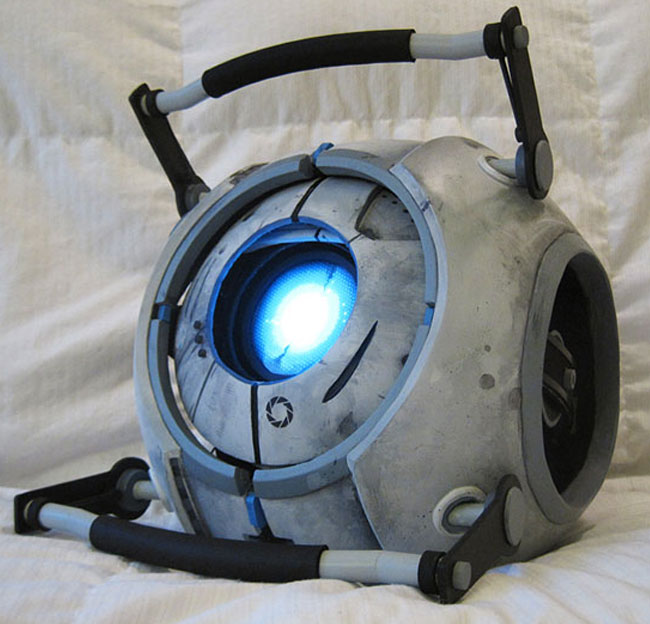 |
| Wheatley, by TRP-Chan |
You'll have to wait for the December issue to find out what we picked, but I can talk a bit about the general contours of the game industry as it stands in 2010-2011.
The game industry continues to grow, but in strange and unpredictable ways. Here are some quick observations:
- 72% of American households have a videogame machine.
- Consumers spent $25.1 billion on games in 2010, with those numbers projected to hit $48 billion for 2011 and $70 billion by 2012. By comparison, worldwide motion picture ticket sales for 2010 were approximately $31 billion.
- In studies of children 12 to 17 years old, 99% of boys (and 94% of girls) play video or computer games, with no variables for race or ethnicity.
- The average game player is 37 years old, with 29% of them over the age of 50.
- Video games had skewed heavily male for most of their existence, but by 2010 48% of the gamer audience was female.
- Approximately 13% of the gaming audience is made up of males under 17, while 37% are adult women.
- Electronic Arts CEO John Riccitiello revealed that since the year 2000, console games have dropped from 80% of EA’s total sales down to only 40%. What filled that vacuum? It was mobile devices, which are becoming the dominant platform in electronic entertainment.
- The 3DS was a dramatic flop. A lack of quality 3DS games and the explosion of the mobile market lay at the root of Nintendo’s woes. The company made deep price cuts in the hardware, but it may not be enough. For the first time in gaming history, Nintendo may lose its complete dominance of the handheld market.
- Mobile gaming has emerged the dominant force in interactive entertainment. This is not merely driven by technology, or convenience, or price point, although all of these are factors. It is driven by the wild creativity that is being unleashed in mobile gaming design. Apps are cheaper to develop, which means more people can make quirky and original games and get them directly to players without involving a publisher or retailers. As a result, a rich and previously inaccessible vein of innovation is tapped, radically changing the gaming landscape. The shocker in preparing for this year’s Games 100 was how many of these little games eclipsed an increasingly-derivative mainstream gaming market. While consoles are dominated by endless sequels, mobile gaming seems to offer a fresh new surprise every day.
Tuesday, August 16, 2011
Life Imitates Bioshock

Peter Thiel, founder of PayPal "has been a big backer of the Seasteading Institute, which seeks to build sovereign nations on oil rig-like platforms to occupy waters beyond the reach of law-of-the-sea treaties. The idea is for these countries to start from scratch--free from the laws, regulations, and moral codes of any existing place."
What could possibly go wrong?
Yesterday's outrageous plot for Bioshock is tomorrow's reality. I wonder if they'll call it "Rapture."
H/T Sean Dailey (check out his awesome magazine, Gilbert)
Wednesday, August 10, 2011
London Riots Blamed On...

Kotaku spotted this quote from a constable, buried in a story in the London Evening Standard:
These are bad people who did this. Kids out of control. When I was young it was all Pacman and board games. Now they're playing Grand Theft Auto and want to live it for themselves.Ah ... no. Look, I detest the content of Grand Theft Auto, but this is just absurd. Generations of class warfare rhetoric, a culture of entitlement and dependency, and the erosion of a distinct British character in favor of the vague promises of "multiculturalism" is at the root of these problems, not some game. When you listen to these two stupid girls brag about their crimes, you have all the explanation you need for the nightmare engulfing England. The British made it through the Blitz because they believed in their nation and the importance of sacrifice and honor, and then raised a generation that derided these things.
On the other hand: yay, boardgames and Pac-Man! You both get the English Police Constable Vote.
Monday, August 1, 2011
Deepak Chopra Makes Boring Game
Actually, I've only seen the trailer, but I believe it is metaphysically certain that a forthcoming game from contemptible New Age quack Deepak Chopra will be blindingly boring and spiritually nugatory. THQ spent a bundle last year to nail down the rights to the Chopra ouvre, and the first fruit of that deal is named Leela. (I thought she was still working for Planet Express.)
The game includes things like "Chakra-based meditations." These "task players with moving their bodies to control graphics onscreen set to a soothing soundtrack ... the root chakra exercise, for example, directs players to tilt their hips to seed a virtual planet." It seems to be a motion control thing aimed at the Wii and Xbox Kinect markets. I shall be waiting by my mailbox every day until it arrives.
Here's my favorite D-Pak moment:
Exit quote from Deepak: "Hope is a sign of despair." And people have made this fool a multi-millionaire for peddling this tripe.
The game includes things like "Chakra-based meditations." These "task players with moving their bodies to control graphics onscreen set to a soothing soundtrack ... the root chakra exercise, for example, directs players to tilt their hips to seed a virtual planet." It seems to be a motion control thing aimed at the Wii and Xbox Kinect markets. I shall be waiting by my mailbox every day until it arrives.
Here's my favorite D-Pak moment:
Exit quote from Deepak: "Hope is a sign of despair." And people have made this fool a multi-millionaire for peddling this tripe.
Wednesday, July 27, 2011
Consoles Now Only 40% Of the Videogame Market Says ...
... the CEO of Electronic Arts, John Riccitiello. It used to be 80%. In an interview with Industry Gamers, the big boss of the biggest game company on the planet says that iPad is their fastest growing market, the Wii U is just fine, and people need to basically get a grip on the seismic changes in the electronic entertainment industry:
We have a new hardware platform and we’re putting out software every 90 days. Our fastest growing platform is the iPad right now and that didn’t exist 18 months ago. So the idea that we’re categorizing the industry as being [cyclical]... Nintendo is off cycle with what? I mean, the point of reference is gone. And so Nintendo is bringing out a new platform that brings together some of what we’re learning from new media and new platforms like the iPad and then integrating that with a console. It’s the perfect time for that in the industry."
As I've been saying. Somehow videogame analysts got locked into this idea of cyclical hardware updates (PSX, PS2, PS3, etc..., every 6 years) driven by a demand for more processing power. Nintendo blew the second half of that equation out of the water with the under-powered Wii, and they're about to blow the first half out of the water with the "off-cycle" Wii U.
I'll say it again: the old patterns are dying. The next dinosaur to get a comet upside the head is the militaristic FPS genre. If Activision thinks they can spin Call of Duty sequels out to infinity, they're in for a rude awakening. I'm in the process of surveying the entire electronic industry for the Games 100, and I can tell you without hesitation that the only consistently creative and innovative platform is mobile gaming.
Monday, June 27, 2011
VIDEOGAME DECISION: Two Stories, One Meaning
Exactly a year ago, I wrote the following column for the July 2010 issue of Maximum PC. I'm reprinting it here in light of today's Supreme Court decision.
Look, I’ve been on the internet since the internet was on. In those weird early days, I saw enough of alt.binaries.ohmygodicantbelievetheyredoingthat to illumine the darker corners of humanity.
Thus, I was not at all surprised that some ostensibly human-like creatures get their kicks watching videos of attractive women crushing small animals to death under stiletto heels. It’s a fallen world, and any cursory glance at history or headlines shows us that men are capable of unspeakable depravity.
I was surprised, however, when the U.S. Supreme Court ruled that these “crush” and dogfight videos were, in fact, protected speech. In their April decision on United States v. Stevens, the court voted 8-1 to overturn a ban on the sale and distribution of these videos. Chief Justice Roberts wrote that, although the acts depicted are in fact illegal, the ban on images of these creates a “criminal prohibition of alarming breadth,” and violated 1st amendment protections.
Why is any of this of any concern to gamers?
Simple: the Roberts court is about to get their first swing at the gaming piñata. In a case bearing the sublime name of Schwarzenegger v. Video Software Dealers Association, California’s laws banning the sale of violent games to anyone under the age of 18 have already failed to pass muster with various courts. Most recently, the notoriously liberal 9th U.S. Circuit Court of Appeals ruled that the law was in violation of the 1st and 14th amendments, clearing the path to a Supreme Court challenge.
The Stevens decision, although not an exact analog, is a pretty clear indication of where the Roberts court stands on freedom of speech, with obvious applications to video and computer games. After all, if 8 out of 9 justices can rule that video recordings of illegal acts of animal cruelty are protected speech, then the court is packed with more 1st amendment absolutists than the staff of Reason magazine.
Of course, what the VSDA and the development community should be asking themselves is, “How did our content become so depraved that we’re relying upon animal torture videos as precedent?”
Breaking News: Supreme Court Strikes Down Videogame Law UPDATED
No surprises here. This court is seriously--almost radically--against perceived curbs on the First Amendment.
Excerpt:
UPDATE: Here's the complete decision, and it makes for an interesting read. As I warned it would last year, the court drew on their decision in United States vs. Stevens, which overturned a ban on animal torture videos. This is horrible company for the video game industry to find itself. We have reached a point where our entertainment is so grotesque that it winds up in the same legal category as animal snuff videos.
Excerpt:
On a 7-2 vote, the high court upheld a federal appeals court decision to throw out the state's ban on the sale or rental of violent video games to minors. The 9th U.S. Circuit Court of Appeals in Sacramento had ruled that the law violated minors' rights under the First Amendment, and the high court agreed.
"No doubt a state possesses legitimate power to protect children from harm," said Justice Antonin Scalia, who wrote the majority opinion. "But that does not include a free-floating power to restrict the ideas to which children may be exposed."
UPDATE: Here's the complete decision, and it makes for an interesting read. As I warned it would last year, the court drew on their decision in United States vs. Stevens, which overturned a ban on animal torture videos. This is horrible company for the video game industry to find itself. We have reached a point where our entertainment is so grotesque that it winds up in the same legal category as animal snuff videos.
Subscribe to:
Posts (Atom)