

Friday, July 29, 2011
Struggle for Catan: Tutorial


Kenken: Sudoku With Math
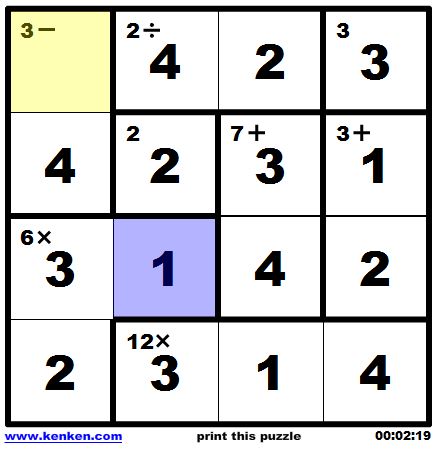 |
The game is played on grids ranging from 4x4 to 9x9, and the rules are as follows:
- Do not repeat a number in any row or column.
- The numbers in each heavily outlined set of squares, called cages, must combine (in any order) to produce the target number in the top corner of the cage using the mathematical operation indicated.
- Cages with just one box should be filled in with the target number in the top corner.
- A number can be repeated within a cage as long as it is not in the same row or column.
Short version: the numbers you place in the bold boxes need to yield the number in the corner by multiplication, division, addition, or subtraction.
Here's a video with Will Shortz (former editor of Games Magazine) explaining how to play.You can find playable puzzles at Kenken.com.
Cribbage in the Field (Minneapolis Event)

The event will feature local artisans and their custom cribbage boards, plenty of boards and cards, open play, and even a 5-foot-tall peg from the man who "carved the world's largest board through the ice of a Minnesota Lake." There will also be prizes and raffles, including a one-of-kind custom cribbage board (shown at the right) that currently resides at the Walker.
Location: Walker Art Center, Open Field / 1750 Hennepin Avenue / Minneapolis, MN
Time: 10am - 2pm
Find more information at Facebook or Cribbageland
Wednesday, July 27, 2011
Battleship: The Trailer of The Movie of The Game
Otherwise known as "What Transformers Hath Wrought". I thought Battleship might have made a decent period war movie, but that approach would have killed any chances for a toy line.
By my count Ridley Scott is ripping off three different Michael Bay movies (Pearl Harbor, Armageddon, and Transformers) in this trailer. Let me say that again: Ridley Scott (the man responsible for Alien, Blade Runner, Gladiator, Black Hawk Down, etc.) is ripping off Michael Bay (the man responsible for the Worst Use of an Animal Cracker in Cinematic History, among other offenses).
There are no battleships left in any Navy in the world, so this movie makes about as much sense as fat-free half-and-half.
By my count Ridley Scott is ripping off three different Michael Bay movies (Pearl Harbor, Armageddon, and Transformers) in this trailer. Let me say that again: Ridley Scott (the man responsible for Alien, Blade Runner, Gladiator, Black Hawk Down, etc.) is ripping off Michael Bay (the man responsible for the Worst Use of an Animal Cracker in Cinematic History, among other offenses).
There are no battleships left in any Navy in the world, so this movie makes about as much sense as fat-free half-and-half.
Consoles Now Only 40% Of the Videogame Market Says ...
... the CEO of Electronic Arts, John Riccitiello. It used to be 80%. In an interview with Industry Gamers, the big boss of the biggest game company on the planet says that iPad is their fastest growing market, the Wii U is just fine, and people need to basically get a grip on the seismic changes in the electronic entertainment industry:
We have a new hardware platform and we’re putting out software every 90 days. Our fastest growing platform is the iPad right now and that didn’t exist 18 months ago. So the idea that we’re categorizing the industry as being [cyclical]... Nintendo is off cycle with what? I mean, the point of reference is gone. And so Nintendo is bringing out a new platform that brings together some of what we’re learning from new media and new platforms like the iPad and then integrating that with a console. It’s the perfect time for that in the industry."
As I've been saying. Somehow videogame analysts got locked into this idea of cyclical hardware updates (PSX, PS2, PS3, etc..., every 6 years) driven by a demand for more processing power. Nintendo blew the second half of that equation out of the water with the under-powered Wii, and they're about to blow the first half out of the water with the "off-cycle" Wii U.
I'll say it again: the old patterns are dying. The next dinosaur to get a comet upside the head is the militaristic FPS genre. If Activision thinks they can spin Call of Duty sequels out to infinity, they're in for a rude awakening. I'm in the process of surveying the entire electronic industry for the Games 100, and I can tell you without hesitation that the only consistently creative and innovative platform is mobile gaming.
Rory’s Story Cubes

There are nine dice in a box a little larger than a deck of cards. These 9 dice offer a total of 54 faces, and each face displays a different icon: apple, fish, lock, rainbow, house, lightening bolt, and so on. Players roll all the dice at once, and then choose a starting image. They begin with “Once upon a time” or some similar opening, and then use that image to begin a story that will weave together all of the face-up images.
Here’s one example from a 10-year-old I found living in my house. She rolled sad face, magic wand, tree, fire, cane, arrow, flashlight, compass points, and magnifying glass, and came up with this (with apologies to JK Rowling).
Here’s one example from a 10-year-old I found living in my house. She rolled sad face, magic wand, tree, fire, cane, arrow, flashlight, compass points, and magnifying glass, and came up with this (with apologies to JK Rowling).
There once was a wizard who was very unhappy. His name was Harry Potter. Harry’s magic wand made of pine tree bark had burned in a wizard duel with Draco Malfoy! He was forced to use a cane and when it broke he had to use an arrow! When he went home it was dark and since he couldn’t cast Lumos, he used a flashlight. (This is very unusual for a wizard.) When he got home he found all of his belongings spread in all directions! He used a magnifying glass and found Draco’s fingerprints! Draco was sent to Azkaban and was never seen again.The genius of the design is its simplicity and flexibility. People can collaborate on stories, select themes, or just play alone. Both kids and adults—solo, or with a family or even in a party setting—can all enjoy it. Home-schoolers in particular might find it a useful tool for jump-starting the brain before a day of a work.
Monday, July 25, 2011
App O' The Mornin': Candy Train

Rating: A
Price: Free
Candy Train is a remake of an old Java title that was still floating around on the internet until recently. (I can't find a current version, so it's probably been removed to keep attention on the mobile port.) It is insanely addictive, perhaps because you always seem so close to getting it juuuust right, moments before you fail completely. This is really just a train pathing game with a tile-switching mechanic, but it’s one of the most appealing free puzzlers to appear on the iOS format this year.
The game is played on an 8x8 grid comprised of tiles representing different track configurations. There are curves, double curves, straightaways, and crossings. Tiles are turned by tapping, thus reorienting the track configuration. In this way, you create a path for the train to follow as it collects points and gathers new cars filled with candy and other treats. If your tracks don’t connect, the train crashes and the game ends.
After all the cars on a map are collected, you attach a caboose and steer the train to the switching point for the next level, where you begin again with more cars. Aside from changing the train speed from slow to fast, there are no other controls.
The normal mode is tough enough, but the expert mode is maddening (in a good way). This is a tricky game to get into, but great fun once you start to master it.
Friday, July 22, 2011
Apples to Oranges: Apples to Apples MOD
I played Apples to Apples MOD (a slim travel edition) during vacation, and the cards were awful: a lot of celebrities and pop culture references that were completely lost on our group. (Hence, "MOD".) So far, the kids edition is the best one we've played, with the most cards for the most people. Obviously, Mattel was aiming for people who'd want cards like "Megan Fox" and ""Neil Patrick Harris", but games like this need to be a bit more timeless, rather than trendy and easily dated.
It reminded me of a Trivia Pursuit 1980s Edition. It may just be the haze of memory, but it seemed like every other answer was either "Michael Dukakis" or "Condoms". It became a running joke. Need a wedge? Just answer "Michael Dukakis" or "Condoms".
There also simply aren't enough cards, so they repeat very quickly. Plus, the cards are a bit too small.
On the positive side, the new dice mechanic for Apples to Apples MOD is pretty decent, as long as people remember they can make up their own adjectives. The system uses a multi-sided die imprinted with 26 letters and an apple icon. There are two cards with an alphabetical selection of words on each side, offering 4 possible adjectives for each letter of the alphabet. The judge rolls the die to select a letter, and then chooses an adjective beginning with that letter. He can use the cards, or make up his own adjective beginning with that letter. This word becomes the "green card" for that game.
It doesn't seem like Amazon even carries it, so it may already be out of print. I picked mine up at Target for $10. It won't be coming out again.
It reminded me of a Trivia Pursuit 1980s Edition. It may just be the haze of memory, but it seemed like every other answer was either "Michael Dukakis" or "Condoms". It became a running joke. Need a wedge? Just answer "Michael Dukakis" or "Condoms".
There also simply aren't enough cards, so they repeat very quickly. Plus, the cards are a bit too small.
On the positive side, the new dice mechanic for Apples to Apples MOD is pretty decent, as long as people remember they can make up their own adjectives. The system uses a multi-sided die imprinted with 26 letters and an apple icon. There are two cards with an alphabetical selection of words on each side, offering 4 possible adjectives for each letter of the alphabet. The judge rolls the die to select a letter, and then chooses an adjective beginning with that letter. He can use the cards, or make up his own adjective beginning with that letter. This word becomes the "green card" for that game.
It doesn't seem like Amazon even carries it, so it may already be out of print. I picked mine up at Target for $10. It won't be coming out again.
DC/Marvel Teaming With Lego
This isn't gaming news, but it touches on two beloved subjects here at Casa McD: superheroes and Lego. Starting January 2012, Lego will begin a multi-year deal to produce sets based on DC and Marvel comics characters.
A line tied to The Avengers feature film will include minifigs of Iron Man, The Hulk, Captain America, Thor, Hawkeye, Loki and Black Widow, while the the X-Men collection includes Wolverine, Magneto, Nick Fury and Deadpool, and the Spider-Man sets offer Spider-Man and Doctor Octopus. On the DC side, we'll be seeing Batman, Robin, Catwoman, The Joker, The Riddler, Two-Face, Poison Ivy, Harley Quinn, Bane, Bruce Wayne, Superman, Lex Luthor, Green Lantern, and Wonder Woman.
In the past, Lego has produced significant lines for both Spider-man and Batman, but this is the first universe-spanning deal to date. They're launching the new endeavor with a Lego Super Heroes Unite contest, which invites people to use their minifigs to create artwork and films highlighting the characters. Expect to start seeing sets in May 2012.
A line tied to The Avengers feature film will include minifigs of Iron Man, The Hulk, Captain America, Thor, Hawkeye, Loki and Black Widow, while the the X-Men collection includes Wolverine, Magneto, Nick Fury and Deadpool, and the Spider-Man sets offer Spider-Man and Doctor Octopus. On the DC side, we'll be seeing Batman, Robin, Catwoman, The Joker, The Riddler, Two-Face, Poison Ivy, Harley Quinn, Bane, Bruce Wayne, Superman, Lex Luthor, Green Lantern, and Wonder Woman.
In the past, Lego has produced significant lines for both Spider-man and Batman, but this is the first universe-spanning deal to date. They're launching the new endeavor with a Lego Super Heroes Unite contest, which invites people to use their minifigs to create artwork and films highlighting the characters. Expect to start seeing sets in May 2012.
Wednesday, July 20, 2011
LostWinds Coming to Mobile Devices
Days of Wonder: Memoir '44 Out of Beta & Small World Underground
 When I loaded up Days of Wonder's new online version of Memoir '44, I could swear my copy said it was still in beta, and mentioned that in my announcement. It has, in fact, been out of beta since late June, and is humming along quite nicely.Thanks to Christine Goutaland for correcting me.
Also, we got a chance over the weekend to play a warm-up game of Small World Underground, and we're liking it a lot. The new races are clever, the powers are dastardly, and the integration of places and relics puts a nice spin on the play. One caveat, however: don't use this one to introduce new players to Small World. The new additions add a little the learning curve and might put off novices.
PUZZLE: Tabling the Question
I haven't done a math puzzle in a while, so here's an old one to strain the average brain. (And by that I mean my brain: in the past, my readers have solved these so fast it's almost embarrassing.)
Mr. Jenkins comes home to find his son Todd reading a comic book rather that working on his quadratic equations. He sets about berating the boy, when Todd interrupts him with a deal. "If I can pose a problem you can't solve, you have to finish my homework, and I can to finish my comic." Mr. Jenkins, considering himself something of a math whiz, takes this bet in a heartbeat.
Todd pushes a large, perfectly round table into a corner, with its edge touching both walls. He places a spot and then turns to his father. "That spot," says Todd, "is exactly 9 inches from one wall and 8 inches from the other. Without measuring the table, tell me its diameter."
My Jenkins puzzled and puzzled 'til his puzzler was sore, and then wound up finishing Todd's homework while the boy returned the adventures of Uncle Scrooge. Would you have done any better?
Mr. Jenkins comes home to find his son Todd reading a comic book rather that working on his quadratic equations. He sets about berating the boy, when Todd interrupts him with a deal. "If I can pose a problem you can't solve, you have to finish my homework, and I can to finish my comic." Mr. Jenkins, considering himself something of a math whiz, takes this bet in a heartbeat.
Todd pushes a large, perfectly round table into a corner, with its edge touching both walls. He places a spot and then turns to his father. "That spot," says Todd, "is exactly 9 inches from one wall and 8 inches from the other. Without measuring the table, tell me its diameter."
My Jenkins puzzled and puzzled 'til his puzzler was sore, and then wound up finishing Todd's homework while the boy returned the adventures of Uncle Scrooge. Would you have done any better?
A Closer Look: French Tarot: Trumps 15 & 16
 |
| Click to enlarge |
 |
| Tarot Trump 15: Detail |
 |
| Click to enlarge |
 |
| Tarot Trump 16: Detail |
Monday, July 18, 2011
App O' The Mornin': Tiny Tower

Price: freemium (extra in-game money can be purchased)
Compulsion loop games are not one of my favorite categories. Any title that requires someone to check in and do something at regular intervals feels less like a game and more like a poor lifestyle choice. Yet the genre remains insanely popular among people who forget just how irritating it was to keep a tamagotchi.
Tiny Tower (NimbleBit) is designed in such a way that it can be played by people who like to check on their game every 30 minutes or so, but it doesn’t have to be played that way. This rather clever balance between compulsion loop design and simple simulation gaming is what makes Tiny Tower work.
The game is like a stripped down, pixilated version of the much-missed SimTower. You build a high-rise, one floor at a time, and designate each floor as either residential or work. Tenants are rated for their work skills in food, service, recreation, retail, or creative businesses. After you build each floor and designate it as a business, you assign tenants to a job, preferably in some area of their ability.
Sometimes these are dream jobs for the tenants, while other jobs make them unhappy. Either way, they work where they’re told to and earn the money needed to continue construction and restock and the stores. The Marxists at Popmatters try to read Deep Meaning into this, with lines like "I have become an exploiter of digital-human capital." (There is no more unintentionally hilarious read on the net than game coverage at Popmatters.) Because we all know that 16-bit dude with a frowny-face is dying inside as he quietly hums "The Internationale".
Tony Tower is free to play, but if you want to play faster you can buy more “bux” online. If you don’t get too obsessed with it, Tiny Tower is great fun and can provide a few minutes of daily play as you manage your little building. If you do get obsessed with it, it ceases to become a fun little game and transmorphs into a time sink.
Your Turn: The Games Magazine Electronic Games 100

So let me know what you think. What have you been playing? What did you love? What did you hate? Do you know something small that deserves more attention? Something big that deserves less attention?
On Twitter, use hashtag #games100 to make your suggestions. I'm also on Google+ and Facebook, or you can use the comboxes. This is the first time I'm doing this "live," so let me know what you think. You can check out the Awards tag on this site for some examples from last year, which saw Super Mario Galaxy II winning as game of the year, just because that's the way we roll.
I can tell you this much: it's going to take a concerted effort to keep mobile games to only 1/4th of the list (25 titles), as I did last year. Given the sorry state of originality in PC and videogaming, and the startling originality and fun found on mobile platforms, that may not be easy. Four words, people: Axe in the Face.
Please note: this is for electronic games only. I don't edit the Traditional Games 100.
Friday, July 15, 2011
Shaun the Sheep: The Hedge Maze
Because I won't ever pass up an opportunity to put Shaun the Sheep on my blog, here's a picture of the giant new Shaun corn maze that's about to open in Staffordshire, England.
 It appears to show Shaun striking a sassy pose while his brain shoots out the top of his head. It seem to be based on this (without the shooting-brain part):


Snapdragon: A Festive Children's Game Played With Flaming Food
Thou art easier swallowed than a flapdragon.
Wm. Shakespeare, Love's Labor's Lost
In Lewis Carroll's Through the Looking Glass, Alice is introduced to various fanciful insects by a gnat the size a chicken. To an American child, these creatures appeared to be little more than whimsical creations, but one insect had special connotations for the British:
 |
| A snap-dragon-fly |
`Look on the branch above your head,' said the Gnat, `and there you'll find a snap-dragon-fly. Its body is made of plum-pudding, its wings of holly-leaves, and its head is a raisin burning in brandy.'
`And what does it live on?'
`Frumenty and mince pie,' the Gnat replied; `and it makes is nest in a Christmas box.'
I'd never really paused over this reference to a "snapdragon fly", but the most recent episode of Masterpiece Mystery, an adaptation of the Inspector Poirot novel Hallowe'en Party, included an alarming scene of kids playing a party game during a Halloween celebration. Children kept reaching into a flaming bowl, grabbing something, and popping it in their mouths while chanting "snip snap dragon." You can find the scene (for as long as it stays up on Youtube), at the 7:00 mark here. I hadn't the faintest idea what they were doing until we looked it up and learned that it's an old game (no one knows just how old) called snapdragon or flapdragon.
 |
| from Poirot: Halowe'en Party (2010) |
Here's how Martin Gardner describes it in The Annotated Alice:
Snapdragon (or flapdragon) is the name of a pastime that delighted Victorian children during the Christmas season. A shallow bowl was filled with brandy, raisins were tossed in, and the brandy set on fire. Players try to snatch the raisins from the flickering blue flames and pop them, still blazing, into their mouths. The burning raisins also were called snapdragons.The chant that accompanies the game goes like this:
Here he comes with flaming bowl / Don't he mean to take his toll!Snapdragon is normally a Christmas tradition, although it's played at Halloween as well. There's no clear indication of the game's origins, but some sources trace it to the ancient Greeks or Druids, which seems rather fanciful. It pops up several times in the works of Shakespeare, where he uses "flapdragon" and "snapdragon" interchangeably to indicate something that's easy to swallow. You know: like flaming fruit. That pushes the game back to the 16th century at least. Like so many indoor amusements, it became traditional during the Victorian era, because nothing says "fun for kids" like sticking your hand in a burning bowl of liquor.
Snip! Snap! Dragon!
Take care you don't take too much / Be not greedy in your clutch!
Snip! Snap! Dragon!
With his blue and lapping tongue / Many of you will be stung!
Snip! Snap! Dragon!
For he snaps at all that comes / Snatching at his feast of plums!
Snip! Snap! Dragon!
But Old Christmas makes him come / Though he looks so fee! fa! fum!
Snip! Snap! Dragon!
Don't 'ee fear him but be bold / Out he goes his flames are cold!
Snip! Snap! Dragon!
I'm annoyed that I even have to add this, but if you try this game at home, please remember that fire is hot and if you're injured it's totally your own fault, not mine.
Wednesday, July 13, 2011
D-Day Dice

If you scroll to the bottom of the Valley Games page, you can download the trial version, print it out, and give it a test run. Based on a read-through of the rules, D-Day Dice appears to have an interesting mechanic, calling to mind a mashup of Roll Through the Ages and Memoir '44, with an added layer of depth. I'm going to print this one out and give it a spin, and I'm looking forward to trying the finished game.

H/T: W. Eric Martin
Memoir '44: Play Online

Right now it's in "open beta," and people who sign up get 50 free "gold ingots." The game uses a pay-to-play model in which you pay ingots to play solo and online games. Ingots can be purchased at a rate of 200 for $8. For $30, you get 1,000 ingots plus the Expert Mode, which allows you to create and upload custom scenarios. For $60, you 2,400 ingots, plus expert mode, plus $30 off any Memoir '44 product. Sessions cost 2-3 ingots each.
It's an interesting model, and I'm not sure how it will work out. It avoids the problems of a subscription-based system, but it's hard, at this point, to determine whether the value-versus-cost balance is quite right. If we calculate about 90 games for 200 ingots, with anywhere from 30-45 minutes for each game, you're looking at maybe 200 hours of gameplay for $8. That doesn't seem unreasonable.

Tuesday, July 12, 2011
EA Buys PopCap For ...
Via TechCrunch.
Subscribe to:
Posts (Atom)