Monday, October 18, 2010

App O' The Mornin': Trainyard Review

The app store has seen some terrific new releases lately, but Trainyard was one I almost missed. I assumed it was another rail switching game like yardmaster. Not even close.

This is a great little puzzler in which you draw tracks in order to get trains to their destinations. That simple description doesn’t even begin to capture the gradual complexity that unfolds in the course of Trainyard’s 100+ puzzles.

When you begin the first level by tracing a straight track path for a red train from its origin to its destination, you have no idea exactly how many variations designer Matt Rix will spin on this simple concept. Trainyard takes it’s time to reveal its inner depth, adding curves, colors, obstacles and crossings before getting the more complex stuff.

Soon enough, you’re faced with destinations that only need one train, even though you have two. So you need to create paths that will make the trains converge and combine. A destination may need 1 purple train, but you have 1 red and 1 blue. Perhaps it needs only 2 orange trains, but you have 2 yellow and 2 red. How do you combine them and path them to the right place?

The increasing complexity and diversity of the puzzles creates an incredibly addictive experience. The controls rarely get in the way of the puzzle solving. Path tracing works well most of the time, with a simple grid system to help with track layout. It’s easy to erase or undo wrong answers, and the game has a built-in sharing featuring that allows you to upload your own solution, or download some else’s.

Really, it’s absurd to see so many good new puzzlers in so sort a period of time. Axe in the Face, Cut the Rope, and Trainyard would make the anyone’s Best App of the Year shortlist, and they all hit in the same week. It’s a good time to be an app gamer.

Saturday, October 16, 2010

PUZZLE: Forecast: Chilly

Find the hidden message. (This one's easy. Try it on the kids.)

Time befriends
For brief space--
Warm days sends;
Clothes in grace

Man and maid.
This I wot:
Looks must fade,
Like or not.

One is not here
Long, my chums;
Cold from hot, here
Winter comes.


by Willard R. Espy

Friday, October 15, 2010

PUZZLE: Words & Music

Using just the notes of the musical scale (A, B, C, D, E, F, G), what is the longest word you can make?

App O' The Mornin': Bejeweled 2 Review

In honor of the 10th anniversary of Bejeweled, the game is selling for $1 until October 20th, which is a 66% discount. Chuzzle, Bookworm, and Peggle are also on sale.

A review of Bejeweled hardly seems necessary. After all, if you’re reading this, you’ve already played it. Everyone has played it. Tribesmen in the remote jungles of Papua-New Guinea have played it. It’s been converted into every conceivable platform known to man, and probably some that are unknown. I suspect that PopCap is, at this very moment, trying to figure out how to get it on the next Mars Rover, so bored aliens can play it and stand in awe of our mighty ability to line up three jewels in a row.

The point is, the game has become so ubiquitous that it doesn’t need any explanation. So I’ll give you one anyway.

In fact, there is a reason to visit Bejeweled this week, other than it being Poptober here at State of Play. Bejeweled actually turned 10 years old on the rather unlikely date of 10/10/10. That means that 10 years ago, the casual gaming revolution was born. It’s not that Bejeweled was the first “casual game” (I’d give that honor to Tetris), but it became so popular and migrated through so many versions and platforms that its success rippled through the entire gaming industry.

The gameplay has been endlessly copied, but never bettered. Just swap two jewels to make rows of 3, 4, 5, or more similar gems in a row. They disappear. More drop down. It continues, forever and ever.

The Bejeweled 2 with Blitz app offers a few variants of this core game, but largely sticks to the plan. There’s Classic (as described), Action (which requires you to swap jewels quickly before a timer bar runs out), and Endless (which is a more “relaxing” version that allows you to just keep making moves forever).

Bejeweled Blitz adds a social networking element to the gameplay. The goal is to make high score in a minute, comparing your score against other friends playing via Facebook. This version adds “boosts” to provide different powers, such as scrambling the gems, increasing time, detonating all special gems, and adding point multipliers.

Bejeweled is just one of those games you need to have on every device. It’s the most successful and influential casual games of all time. And after 10 years, it can still be incredibly addictive.


Exit Trivia Question: What was the original title of Bejeweled? (No Googling, please.)

Thursday, October 14, 2010

REVIEW: Medal of Honor (2010)

PC/360/PS3: $60
Grade: B

This should have been so much better.

I was hoping that the reboot of the Medal of Honor series would knock Call of Duty: Modern Warfare 2 from its perch. The entire drift of the Call of Duty series into nihilistic, over-the-top violence and mindless run-n-gun action has been unpleasant to watch. With the DICE team involved in Medal of Honor, there was hope that some of the qualities of their Battlefield series would find their way to the MoH.

Alas, DICE was only responsible for the multiplayer portion of the game, while Danger Close (a rebranding of the EA Los Angeles studio) did the single player. EA LA has a decent pedigree. They were formed from pieces of Westwood Studios (one of the great development house of all time) and Dreamworks Interactive, and include people who worked on the original Medal of Honor series, as well as the Lord of the Rings: Battle for Middle Earth and Command & Conquer games.

They almost do a great job with the Medal of Honor single player game, but the final product feels rushed, and too many flaws whittle away at the quality of the experience.


The Other Modern Warfare 
Medal of Honor (2010) was designed to be a Call of Duty killer, and as such, it comes close before falling short of the mark. Where MW2 displays nothing but contempt for the American fighting man, Medal of Honor takes the opposite path. Working in close collaboration with military advisors, the developers wanted to create a realistic approximation of combat operations if present-day Afghanistan.

EA’s Greg Goodrich told Incgamers that the US military advisors “have absolutely 100% editorial control, meaning that if we go anywhere or we do anything that cuts too close to home or reveals something that they don't want out there, we'll take it out. Furthermore, we've had things that we've wanted to do that we just naturally assumed we shouldn't do, and they're like, 'No, go ahead.”

This is reflected in the lingo, the mission types, the combined forces approach, and in a hundred other little ways. The focus shifts among 4 different US teams working under Special Operations Command, which is the unified command for the worldwide use of Army, Navy, and Air Force Special Ops. The player alternates among the Naval Special Warfare Development Group, Army Rangers, an Apache helicopter crew, and a team led by the ZZ Top-looking guy on the box, which I think is supposed to be Delta Force. The focus is thus meant to alternate between the “Tier 1” operators (the special forces who work in small teams deep in enemy territory) and the conventional land and air forces.

All of this works well, with each team’s missions nicely dovetailed together so that one narrative ultimately converges with another. The emphasis is on the dangers these men face, the way they interact, and the nature of the ground war in Afghanistan during Operation Enduring Freedom in 2002. The overall design and tone are strong, with a diverse selection of weapons and mission types and a good sense of pacing.

Small problems, however, can easily overwhelm a strong design, and that’s the situation with Medal of Honor.

I’m not sure if there are serious scripting bugs, an environmental bug or quirk that prevents the triggering of certain actions, or what, but there are several places where the game is simply broken. During one sequence, you need to wait for some enemy forces to walk away from a truck, leaving one guy alone. Logically, you should kill that guy and move on, but no. This triggers a counter-response that you were trying to prevent. Perhaps your partner was supposed to give a go-code, but he never does. The mission simply gets stuck.

This happens twice more in the same level. You’re supposed to be able to sneak by the enemy to put some transmitters on a truck, but either you’re never given the go-code, or you’re given the code and the enemy sees you anyway. The only way out of the mission is to kill everyone, which was not the goal.

Enemy AI is either too heavily scripted or brain dead. After awhile, the game simply resembles a shooting gallery, as you pick off endless waves of Taliban. For all the fuss about including real-world enemies in the game, they might as well have included little duckies going around and around on a conveyor belt. Sometimes a shot can strike an enemy in the leg and he won’t even turn around: he just stands there looking at the pretty sunrise.

Visually, the game offers some beautiful and effective scenes and environements, but too often the graphics just don’t make the grade. The single-player game uses the Unreal 3 engine, which was a mistake. Textures are bland and the shadows are sometimes so jaggy they look like saws. Pop-in is prevalent, and any time more than one thing explodes onscreen, the frame-rate drops into the single digits. In 2010, there is simply no excuse for this.

Also: there are multiple quad-bike sequences. Seriously. I don’t care if Delta Force does tool around the Afghan hills on quads. I’m sure they also eat MREs, sleep, and go to the bathroom. That doesn’t mean I want to simulate it.

All of this seems to indicate a game that simply didn’t spend enough time in development. There’s a rushed feeling to it. And though Danger Close gets the big picture right, they suffer the death of a thousand cuts due to the small things they get wrong.

No DICE
I can’t help thinking this whole project would have been better off left in the hands of DICE, but even there, things don’t quite add up. DICE used their own Frostbite engine to create the multiplayer portion of the game, which tries to find a middle ground between the fast pace of Modern Warfare 2 and the more complex, multi-aspect warfare modeled in their own Battlefield series.

The result is … okay. I’m just not quite sure who it’s meant for. No Battlefield player would abandon Bad Company 2 for this scaled back, far-simpler approach to multiplayer. But no Modern Warfare 2 fan is likely to choose the less intense experience of Medal of Honor multiplayer. In trying to find a middle ground between the two, it simply ends up lost.

Don’t get me wrong: the multiplayer is quite good, and proves that the Frostbite engine, rather than Unreal, should have been used for the single player game. Modern military shooters, however, have split into two camps: the fastfastfast action of MW2 and the multi-aspect, goal-driven action of BC2. There really isn’t any place for something in the middle, and that’s what Medal of Honor offers.

I know I’ve been harping on the negatives throughout this post, so let me just step back and restate my opinion: this is a good game with a lot of little flaws. Those flaws stand out all the more because they are set within a game with so much potential. There is a last-stand scenarios where the Rangers hold off wave after wave of Taliban that is as tense as anything I've seen. Even the Apache levels, which are just rail shooters, are a blast.

And the controversy, it turns out, was all much ado about very little. The game twists itself into knots to be respectful of the American military. There’s an amusing moment right at the beginning, where you’re riding in a truck with a driver dressed like mujahedeen. The radio blares that horrible cats-in-heat music common to the region. You assume that you’re beginning the game as the bad guy, and thoughts of Modern Warfare 2’s “No Russian” level come to mind. Then the “Taliban” driver says in an American accent, “Let’s turn that [crap] off,” and you realize that they’re Special Forces in disguise. It’s a good moment, and signals that this is not going to be a retread of MW2’s nasty, anti-American tone.

As for “playing as the Taliban” … big deal. EA has changed the enemy's name to OpFor (Opposing Forces), but they’re still armed and dressed as Taliban. I admit that spawning as a bad guy who’s fighting against US forces may be unappealing to some, but when you play cowboys and Indians or cops and robbers, someone has to be the bad guy. And at no point in the game are the Taliban anything other than the bad guy. There is no moral gray area here, as there was in the murky moral landscape of MW2. This is a game about good men doing hard work to protect people. I just wish they’d taken a little more time to get the small details right.


App O' The Mornin': Super Monkey Ball 2 Review

$6

Holy smokes, has it really been 10 years since Super Monkey Ball debuted on the GameCube? I loved the gameplay of the original, but I haven’t revisited it in years. The idea that I can now carry it around in my pocket still blows my mind.

And Super Monkey Ball 2 does a great job of blowing the mind. This is the entire Monkey Ball experience crammed into an app and given the kind of control system it always demanded. It’s almost absurd that you can buy gameplay this good for a few bucks.

For those who haven’t played Super Monkey Ball before, here are the basics:

The gameboard is essentially a giant, elaborate tilt-maze with a beginning and an end. A monkey is inside a sphere, sort of like a hamster in an exercise ball.

(Why is the monkey inside the sphere? When questions like this arise, I usually just say, “Because it’s Japanese,” and move along. For gamers, that’s about all the explanation you need. It’s best not to question how the Japanese come up with this madness. It’s enough just to be grateful for it.)

Anyway, you don’t ever control the monkey. You control the level itself, which is suspended far above the world below. Tilting the device forward tilts the landscape and makes the monkey roll forward; backwards slows him down. Left and right take care of steering.

The object is to get the monkey from the start of the level to the end while trying to collect bananas along the way. Bananas equal extra lives.

And those extra lives are necessary, because this is not a monkey-friendly environment. It’s all too easy for the little monkey to slide right off the edge of the landscape and plummet to his monkey death. This is actually fairly unnerving, particularly if you have a fear of heights. The result is tense, challenging combination of maze and arcade game. Levels get progressively more complex and elaborate, with rails, hairpin turns, slamming doors, hammers, and other threats.

Super Monkey Ball 2 absolutely nails the control scheme. The first Super Monkey Ball was one of the early releases to the app store, and this improves upon it in every way. The sequel piles on the extra features by including 115 levels, a set of minigames (monkey bowling, monkey golf, and monkey target) and multiplayer support via WiFi. The 3D graphics are exceptional, and controls are more sensitive and responsive than those found in the first Super Monkey Ball. It still takes a good 5-10 minutes to get a grip on the control, but once you do it becomes second nature.

Some people may complain that the price is “high” at $6, but those are the kind of people I tend to ignore. DS games of this quality regularly sell for $30, and if you keep an eye on this one, you can sometimes find it discounted to $2.

Wednesday, October 13, 2010

COLONIAL GAMING: I. Kirk Playing Cards


For the previous entry on Colonial playing cards, see this post on the I. Hardy Great Mogul deck.

In addition to the I. Hardy reproduction playing cards produced for Colonial Williamsburg, there is also a reproduction of the “Aesop’s Fables” deck made by I. Kirk in the 18th century. Or, as the label calls them, “SUPERFINE HARRY THE VIII CARDS.”

As with the I. Hardy deck, this one is wrapped in a reproduction of the royal tax stamp, complete with an embossed seal and threat of Dire Consequences for anyone who sells the deck without the stamp. In this case, the penalty is “X Pounds Duty pr. pack Penalty If Sold Unlabelled.” (Remember: that would have been about 1/3rd of the average middle-class annual salary.)

The card wrapper is even more serious about where and when you use and sell these cards. Under a truly awful portrait of a truly awful man (King Henry VIII) is the warning “For exportation. Fifty pounds penalty is relanded [in an English port], and twenty pounds penalty if sold or used in Great Britain.” 

The cards themselves are excellent examples of the printer's art for the time. Although each card is crowded with text and imagery to the point of distraction, they are quite well made. The actual playing card element is limited to a postage-stamp-sized image crowded, almost as an afterthought, into the upper lefthand corner. The rest of the card is given over to an illustration of one of Aesop’s Fables, along with a little doggerel verse and a two-line moral. As with almost all cards of the period, the backs are blank.

Click to enlarge


App O' The Mornin': Crazy Parachute Review

Price: $1


As high-concepts go, "Bird Strike in reverse" is as simple as you can get. And that's exactly what Colorbox gives us in Crazy Parachute.


Instead of flying up and then plummeting down, Crazy Parachute just has the plummeting part. There are four cute cartoon characters who start at the door of an airplane. After a 3-second countdown, you tap the screen to jump from the plane. 

As your character falls, tilt right or left to avoid certain obstacles while passing over others. Birds, for instance, will slow your descent, while picking up a shield will allow you to smash right through the birds. Along the way, you want to pick up coins and be the first to land safely. This is done by opening your chute at the last safe moment. Open it too late, and you're a pancake.

As you successfully complete levels, you get to drop from higher altitudes, which means more opportunity to gather stuff. There are a few more powerups to be discovered along the way, such as balloons and birds, but the game is a little thin on content. 

This one is probably a good option for kids who find Bird Strike a little too tough. The production is a bit uneven. There are glitches: sometimes the countdown clock doesn't appear, sometimes it doesn't respond to taps. The music is an endless (and endlessly irritating) loop. There are only 4 characters to choose from, but they're fairly cute and add to the over-all kid-friendliness of the title. It's not a winner, but it's a nice little distraction.


Tuesday, October 12, 2010

Gaming on your … Kindle?


I’ve been wondering when Amazon would attempt to integrate gaming into its Kindle ebook devices. Although there were a couple of attempts to make Sudoku for Kindle, it didn't really work. It’s taken a couple of years and hardware upgrades, but we’re finally seeing the first generation of real Kindle games.

How do they look?

Well, no one’s going to mistake them for iPhone apps. Between the black-and-white graphics and the lack of touchscreen input, this is a fairly stripped down gaming experience. But that’s not really the point. 

First, a digression: The daily newspaper is going to die. This is a cold, hard fact of life. I’m not going to make predictions about when, but the death of newsprint is inevitable. (Okay, if pressed, my prediction would be “more than 5 years, less than 10”.) As someone who continues to contribute to newspapers, I’m conflicted about this. Certainly the internet, the 24-hour news cycle, rampant bias, and the death of quality journalism are driving them to extinction, but it’s still hard to see the morning paper simply vanish from the earth.

When the newspapers die, however, they will take a couple of key cultural items with them. No, I’m not talking about the news. In the age of the internet, that’s everywhere. I’m talking about meaningful cultural touchstones: the daily comic strip and the puzzle page. Although comic art is one of my passions, we’re not here to discuss that. 

Puzzles, however, are another matter. The morning crossword is a habit for millions, and the jumbles and Sudoku are solved by even more. Although large compilations of these puzzles are readily available (my publisher, Kappa, puts out about 80 a month), it’s just not the same as sitting down with a fresh paper and a puzzle every day.

This is where Kindle and other e-readers come in. If mainstream news has any hope of surviving, it has to adapt not merely to the internet, but to all forms of e-readers and mobile devices. Those devices will need to offer the complete package: news, editorial, local information, ads, printable coupons, comic strips, and interactive puzzles. 

Color isn’t necessary, but a touchscreen is, so Amazon is going to have to work that one at. Some of the competition, such as the nook, already does. This is not optional. A touchscreen, perhaps with a stylus input, would allow them to create e-ink versions of crosswords and Sudoku, allowing people to simply write right on the screen. This will happen: the only question is who will do it first?

In the meantime, we’re starting to get a sense of what these games will look as Amazon starts to get serious about games, starting with two freebies: Shuffled Row and Every Word

Both are word games that make the most of the Kindle keyboard and interface. Interestingly, both are also  reminiscent of Scrabble Flash.

Shuffled Row slowly adds letter tiles to a row. There are enough space for 9 tiles, and a new tile pops up about every 10 seconds, pushing one of the tiles off the row. The goal is to make the longest words you can out of the tiles available to you. Letters are worth various points, with words longer than 3 letters scoring progressive score multipliers. For instance, a 4 letter word scores x2, while 9 letter words scores x7.

Every Word has a similar setup. There are 6 letter tiles in a row, and a number of blank spaces beneath. The blank spaces indicate just how many words can be made from hese letters, and your goal is to find them all. Longer words score more points. There is both a “Relaxed” mode which allows you all the time you need to solve the puzzle, and a “Timed” mode, which doesn’t.

These are decent games that play to the Kindle’s strengths. They don’t require a lot of in-game navigation, which would be hard to do with the Kindle controls. Instead, they simply use the keyboard for word input. They’re not going to replace anyone’s existing word games, but they provide an easy diversion that people can carry along with their e-reader.

Later this week, I’ll take a look at Scrabble for Kindle after I spend some quality time with it. (I take my Scrabble seriously.)

App O' The Mornin': Red Remover Review

I planned to review Flubby Physics, but as I played it a strange sense of Déjà vu came over me. That’s when I realized I was playing a fairly straight steal of Red Remover, a flash game from Gaz Thomas that’s been floating around for a while. There’s another a rip-off that’s so brazen it called itself Red Block Remover. I’m not quite sure who did the first block remover game, but some of the apps have design and even visual element in common with Red Remover, which has certainly been around for a while. (If I’m wrong about that, feel free to correct me.)

So, rather than reviewing an imitation of a game, I decided to review the game itself, and found that Gaz Thomas had in fact ported Red Remover to the App Store, and done a darn good job of it.

Red Remover is your basic physics game. In this case, you’re removing some boxes from the screen while leaving other behind. Different kinds of boxes follow different rules. Red boxes must be removed by clicking; blue boxes can be removed by clicking, but can also be left behind; and green boxes must be left behind.

The other factor effecting the game are the 4 planes of gravity. Each box has a face, and the face determines which direction a box falls: left, right, up, down. (Obviously, those directions are relative to the way you’re holding the device.)

This creates some very challenging situations very quickly. The goal is to remove some objects while leaving others in place. Box removal games are a staple of the app store and flash gaming for a good reason: they make for entertaining, frequently challenging puzzle play. Some of the puzzles in Red Remover require timing, and some just a logical progression of moves.

The app store is full of games that follow similar patterns, such as Tiki Totems, Tumble Blocks, and Doodle Blocks, not to mention direct rip-offs like Flubby Physics and Red Block Remover. (These last two actually steal some levels straight from Red Remover.) Red Remover does the job very well, and it keeps the elements simple and the puzzles extremely complex. The is just good abstract physics puzzling.

Gaz Thomas tells me that he has a Halloween version of the Red Remover coming out in a week or so. This one will feature new levels and the addition of fireballs.

Monday, October 11, 2010

WIN!: Plants vs. Zombies Limited Edition (Game of the Year Edition PC/Mac)


Thanks to all who participated in the GelaSkin contest.  The winners were Will D., LeeAnn W., and Brett N. They've all been notified by mail.

But don't go away just yet! Next up is this brand-new copy of Plants Vs. Zombies: Game of the Year Edition, generously provided by PopCap.  It includes the Windows/Mac version of the game, along with this little guy:


To enter, all you have to do is:

1. Share a link (even this one) or follow State of Play via:
Please note: if you already follow us on Google, RSS, Twitter, or Facebook, just let me know that you'd like to enter, and please do a retweet or some other kind of link share.

2. Let me know you want to enter. Do this in any of the following ways:
  • Leave a comment.
  • Tweet me @StateOfPlayBlog
  • Post a message on the State of Play Facebook Page
  • Send an email to "games=at=aptopub.com" (replace the =at= with @) to have your name entered.  
  • Please don't forget to do one of these things or I won't know you've entered!
Deadline is Monday, October 18!

I'll choose winners by the scientific process of writing names on little pieces of paper and pulling them out of my Mario hat.

ONLY NORTH AMERICAN ENTRIES PLEASE!

App O' The Mornin': Puzzle Agent UPDATE

Update (10/11/10): This morning's app is a revisit of Puzzle Agent, which I review favorably below. The game had problem with fuzzy textures and weird texture drawing. I'm not seeing any more of the texture pop in in the few scenes I spot-checked, so the update does appear to have fixed this. It also broke the game in the process.

The Puzzle Agent update does the unforgivable: it wipes your saved games. It doesn't do this right away. It begins by making the game utterly unplayable. Attempting to load a game causes the app to hang. You have to delete the app from your device and then load a fresh copy back on. (By the way, the warning about these problems was not included in the original update. It was added later.)

If you've never tried Puzzle Agent, I do still recommend it, even though this is pretty damn irritating. If you have played it, don't update it if you care about your saves.

Original Review

His name is Nelson Tethers, and he’s a Puzzle Agent for the FBI. He solves the tricky puzzles no one else can solve in order to keep America safe.

His latest case? Why has the Scoggins eraser factory in Minnesota stopped producing erasers … the very erasers used by the president? In order to solve the mystery and get eraser production back on line, he needs to explore the snow-bound town of Scoggins, which is filled with the usual roster of Midwestern comic relief.

Puzzle Agent is a typically quirky adventure game from Telltales Games, the people behind the Sam & Max, Wallace & Gromit, and Strongbad episode games. The visual style is based on the work of cartoonist Graham Annabale, best known for his Grickle books. Annabale has a style reminiscent of the cartoonists from the classic days of the New Yorker, particularly Peter Arno. He draws a simple but expressive line that derives its humor from deadpan stares and nervous expressions.

This look is the foundation for the entire game, which uses a simple comic mystery as the pretext for a series of logic puzzles. The adventure gameplay elements are less prominent here than in previous Telltale games, reduced to a minimal amount of scene searching and extensive dialog scenes.

Instead, Puzzle Agent focuses on single screen logic puzzles, placing it firmly in the casual camp. It’s being dismissed by people with short memories as little more than a Professor Layton clone, but in fact this kind of puzzle adventure goes back a couple of decades, to titles like Jewels of the Oracle, Dr. Brain, and 7th Guest.

Considered as a puzzle compilation with a narrative-adventure shell, it delivers the goods. A couple of puzzle formats repeat, but most of them are fresh, many of them are fairly challenging, and some are almost impenetrable. Unfortunately, some of that impenetrability comes from occasionally obscure descriptions, which make the objective of a puzzle hard to determine.

This isn’t a persistent problem, however, and a built in hint system (paid for using pre-chewed gum: don’t ask) means you’ll never be stuck too long. The puzzles range from simple verbal puzzles, such as figuring out a problem from a series of clues, to jigsaws, path-laying, sequencing, and more.

The original PC game was released earlier to this summer to tepid reviews, mostly from people complaining that it wasn’t Professor Layton. The price-point ($10) should have signaled that Telltale was positioning this as a casual game with a few hours of gameplay, a collection of puzzles, and a light, funny story and style.

The app conversion is generally effective, but it has a bug that appears to effect only smaller units (iPhones and Touches) and not iPads. On my Touch, there was a problem with textures and smoothing that caused some image pop-in and occasional fuzziness. Telltale is aware of the problem and is promising a fix. I revisit it when I get a chance to check it out.

As for the controls: they work pretty well on the Touch, but probably will fare better on an iPad. Some of the objects are simply too small to really “grab” with a finger. (They were clearly designed for use with a mouse.) It’s not a universal problem, but it crops up often enough to slow things down.Those reservations aside, I’d recommend this one for people who just like single-screen logic puzzles. For $5, you get an appealing visual style, clever puzzles, and a few laughs along the way.

Saturday, October 9, 2010

What's wrong with this picture?

This is a screen capture from UGH Find It Lite, which is a "spot the difference" app that I downloaded for my daughter. I decided to take a look at it in case it was worth an App O' The Mornin', and found something ... odd.

Here's the picture, with the answer and some more pictures after the jump. Can you spot the difference?

Friday, October 8, 2010

Friday Linkaround

Plants vs. Zynga: The CEO of PopCap, Dave Roberts, recently took some time to smack around Zynga. Activity for the afternoon: compare/contrast the comments of Roberts (a man whose company makes actual games) with those of noted Force For Evil Mark Pincus. Remember to show your work.

It's the Catan App ... But Bigger: Catan HD is in the app store. This version for iPad appears to to spread out the screen a bit and allow users to move information boxes around. I say "appears" because I don't have an iPad, although I am willing to accept donations.

Incoming!: Be not afraid of the catapult in your mailbox. Due to a production error, the coveted catapult token for the Be Not Afraid expansion for Small World was left out of the package. Days of Wonder is fixing the error and adding 5 leader tokens in the leftover space on the punchboards. I'm already playing with this expansion, and I like it a lot.

SimTV?: IGN is reporting on a proposal for a TV show from Will Wright. The working title is The Creation Project, and the documents describe the creation of a TV showed derived from audience suggestions via online and mobile phone messages. Not only does that sound like a spectacularly bad idea for a show, but the participation of Will Wright raises the horrible prospect that Simlish might be involved at some point. Wright is one of the true geniuses of game design, but the entire The Sims line just a canker.

Taliban Removed From Medal of Honor, Military Ban Holds: EA announced that the opposing force in Medal of Honor will be called "Opposing Force," not the Taliban. This is a classy move on their part, but it doesn't change the fact that the game takes place in an current theater of war, which remains a sticking point for the Army & Air Force Exchange Service's commander. For this reason, the ban on on-base sales will remain in place. In any case, the game will probably be very popular among servicemen, many of whom are huge fans of military shooters.

Life Imitates Fallout: Kotaku has discovered that, mere miles from my home in South Jersey, the Army is testing wrist-mounted displays. As they note, these are essentially PIPBoys: "The organic light emitting diode display is mounted on thin, flexible metal foil, which in turn is mounted on a wrist-wrapping housing to create a fully functional display and communication device."

Enough With the Damn Zombies Already!: Now Red Dead Redemption, a truly excellent game, is adding a zombie mode. Look, folks: it's done already. The zombie thing is over. Let them die peacefully, and if they won't, then shoot 'em in the head. That's a sure way to kill 'em. If you don't, get yourself a club or a torch. Beat 'em or burn 'em, they go up pretty easy.

Twitterstream Digest: Board game news, courtesy of Seize Your Turn.

Chess: News from around the world.

App O' The Mornin': Axe in The Face Review

If you want to get me to buy your game, just go ahead and name it Axe in the Face. Works every time.

If you want to be doubly sure I'll buy it, make sure your main character looks like a tiny Viking Yosemite Sam, and have him in a perpetual state of axe-slinging rage as he tries to protect his well-tended bed of flowers.

Yes, that's what Axe in the Face is all about: a red-bearded, highly irritated little cartoon Viking determined to kill as many marauders as it takes to protect his daffodils. All he has is his axe, some fire, a couple of powers bestowed by the gods, and a heart filled with rage as he faces wave upon wave of foes. If any enemy gets past him and begins to trample the flower bed, the level is lost.

The control is based upon an effective line-drawing system to determine the throwing path of the axe. Just trace a line (however convoluted) and then remove your finger to unleash the axe. It follows its path and then returns. The blade cuts through enemies like butter, hewing head from torso. If the path passes through a fire, then you have a flaming axe, which is just the ticket for taking out enemies hiding behind trees.

Enemies move at different speeds, and some have different defenses, which makes timing each strike a tricky business. It also makes setting up and executing elaborate strikes quite satisfying when they mow down multiple enemies at once. The two god powers are lightning, which fries 3 foes at once, and ice, which slows the enemies.

Blue Carrot games has put out a first rate little app, with a good sense of humor and colorful art. There are 32 levels total, and they get challenging rather quickly. This is a fun game, but it's also a hard one.

Thursday, October 7, 2010

In the mail: Betrayal at House on the Hill & more

It's been kind of a slow week for games, but a couple of interesting items have arrived, including...


Betrayal at House on the Hill
Avalon Hill (aka Wizards of the Coast, aka Hasbro) has republished the classic 2004 haunted house game with some new features.  Just having it back in print is a fairly big deal, since I've seen copies of the original going for as much $150. The game appears to be largely the same, with new haunts and items, as well as some redesigned tokens.

Out of the the box, this one looks good. There are clear similarities to the Castle Ravenloft Board Game, with players "building" the house by laying down tiles as they explore. Once someone triggers a "haunt," one player becomes the traitor and the game turns into a fight against a diverse array of creatures. There's even a werewolf haunt that has the traitor infecting the others.

I have a giant stack of games waiting for their turn at the table, so a full review will have to wait, but after a read-through of the rules and a general fondling of the components, it looks promising.

Scooby-Doo! and the Spooky Swamp
Go ahead, laugh, but this looks like a great one for the kids. Good games for young kids aren't all that common, so it's nice to see a branded product with this level of quality. This follow-up to Scooby Doo: First Frights it pretty simple, and has a bit too much traveling back-and-forth, but it's well animated, has excellent sound (except for a regrettable decision to include a laugh track) and good content thus far.

My daughter is the World's Biggest Scooby Fan (seriously: we've even watched all of 13 Ghosts of Scooby-Doo, which no man would do but for love) and she's playing it right now. Her early verdict: "great!" That's usually about all I get out of her. I'll probably do this one for GAMES, so I'll be logging my own play time. (Although the thought of outsourcing some of my game playing to unpaid minors is tempting ... very tempting. "Please daddy, no more Ben 10: Alien Force! It burnses!")

Kindle 3 Games
A new Kindle is supposedly on its way, and I'm planning to see how well the new games work on it. I've gotten a look at a couple of free games, Every Word and Shuffled Row, and I'm kind of impressed they could pull it off. I'm a huge fan of Kindle, but I don't think "game platform" when I see one.

App O' The Mornin': Cut the Rope Review

Cut the Rope is one of the best puzzlers to hit the App Store in a long time. If any game has the potential to knock those Angry Birds off their perch, it's this one.

The gameplay is based on an old physics-puzzle standby. Hanging objects function like pendulums, and you need to cut the ropes at precisely the right time and in exactly the right sequence to get the object where it needs to go.

In this case, the problem is how to get a piece of candy into the mouth of a voracious (yet adorable) little monster. The puzzles start out with a single element: a piece of candy dangling from a rope. It's directly over the monster, and a line of 3 stars are right below it. Cut the rope with a finger swipe, and the candy collects the stars as it drops into the monster's mouth.

The puzzles quickly add both complexity and new variables. Stars are spread around, multiple ropes are attached, and solutions become part logic and part dexterity. Bubbles lift the candy up, whoopee cushions push it around, new ropes pop up, and movable pivots allow you to shift the rope. Meanwhile, spikes, electrodes, and spiders appear as hazards. Every time you think you've got the game figured out, it adds some new and inventive element.

There are 4 sets of 25 puzzles each, with more to come. Each puzzle has one basic requirement for victory: get the candy in the monster's mouth. The tricky part, however, is to do so while collecting all 3 stars on every screen. Merely getting the candy where it needs to go isn't that hard, but you'll want to keep trying until you figure out how to pull it off while getting all 3 stars.

Like Angry Birds, Cut the Rope is from Chillingo. They obviously have a knack for combining excellent character and art design with horribly addictive gameplay. Get used to the sight of that little bug-eyed monster, folks: he's going to be sitting on the top-10 list for a long time.

Wednesday, October 6, 2010

WIN! Plants vs. Zombies GelaSkins

I'm giving away a few Plants Vs. Zombies GelaSkins, generously provided by PopCap. They fit either iPhone 4 or 3GS/3G/original. They do not fit on an iPod Touch.

GelaSkins are protective coverings for you device. They cling to the surface to prevent damage. They sell for about $15 each.

To enter, all you have to do is:

1. Share a link (even this one) or follow State of Play via:
Please note: if you already follow us on Google, RSS, Twitter, or Facebook, just let me know that you'd like to enter, and please do a retweet or some other kind of link share.

2. Let me know you want to enter. Do this in any of the following ways:
  • Leave a comment.
  • Tweet me @StateOfPlayBlog
  • Post a message on the State of Play Facebook Page
  • Send an email to "games=at=aptopub.com" (replace the =at= with @) to have your name entered.  
  • Please don't forget to do one of these things or I won't know you've entered!
The deadline is Friday, October 8, 2010. Deadline extended to Monday, October 11!

I'll choose winners by the scientific process of writing names on little pieces of paper and pulling them out of my Mario hat.

ONLY NORTH AMERICAN ENTRIES PLEASE!

PUZZLE: Next-Door Neighbors

Here's a poser from Henry Dudeney:

"There were two families living next door to one another at Tooting Bec—the Jupps and the Simkins. The united ages of the four Jupps amounted to one hundred years, and the united ages of the Simkins also amounted to the same. It was found in the case of each family that the sum obtained by adding the squares of each of the children's ages to the square of the mother's age equalled the square of the father's age. In the case of the Jupps, however, Julia was one year older than her brother Joe, whereas Sophy Simkin was two years older than her brother Sammy. What was the age of each of the eight individuals?"

Puzzlewood: A Maze In Nature

If you don't yet have Atlas Obscura--"A Compendium of the World's Wonders, Curiosities, and Esoterica"--in your RSS feed, you should. Today they did an interesting writeup on Puzzlewood, a 14-acre stretch of the Forest of Dean near Coleford, Gloucestershire, England.

Puzzlewood is a mysterious and bizarre tangle of paths, caves, strange rock formations, and trees. The Forest of Dean was a frequent haunt of J.R.R. Tolkien, and some have suggested that the mysterious landscape of Puzzlewood was the inspiration for Middle Earth. There's no solid evidence for this, but it's a good story.

The strange combination of limestone caves, uplift, erosion, and pre-Roman open-cast mining have created a natural labyrinth. The effect was made more pronounced in the 19th century when the owner of the land laid down a mile of twisting paths. The proprietors have added a willow maze and an indoor "wood puzzle," which they describe as "a maze of secret doors, dead ends, ups and downs and rounds and rounds."

Puzzlewood is such a complete labyrinthine package that it even came with a treasure for those who braved its mysteries. Workers in 1848 found 3 jars hidden in the rocks. Inside were 3,000 Roman coins. No one has a clue why they were hidden there.

App O' The Mornin': BookWorm Review

PopCap smashed together Boggle and Bejeweled to create this obscenely addictive games about 7 years ago. Since then, it has been reinvented as BookWorm Adventures, and remains a popular fixture on mobile device, computers, and even the Nintendo DS.

The version PopCap brought to the App Store is the original BookWorm, rather than BookWorm Adventures. That’s a little disappointing, since Adventures added some great twists to the gameplay, and I hope it find its way to Apple devices soon.

That said, BookWorm for iPhone isn’t one you’re likely to pass up for a buck. This is one of the best casual word games of the past 10 years. Letter tiles are laid out on a grid, with each letter touching at least touching at least 3, and as many as 6, other letters. The board is cleared by linking letters to form words. When a letter is used, it disappears and all the tiles drop down to fill the space.

Naturally, longer words earn more points, while words that are too short generate burning tiles. These tiles must be eliminated before they reaching the bottom of the frame, or the game is over.

There are other scoring opportunities, such as special tiles and bonus words. Various “books” include particular word lists, such as colors or insects, and bonus points are awarding for spelling these words and completing entire books.

Gameplay breaks down into the classic game, which progresses through levels, and a timed games, which requires some speed spelling.

BookWorm is one of the classic casual games, and the App versions does a fine job of making it portable.

Tuesday, October 5, 2010

Review: Memoir '44


In preparation for reviewing the new Memoir 44 add-on, Winter Wars, I decided to do a full review of the original game. As I’ve said, age is irrelevant in determining what I’ll write about. Any game you haven’t played is new to you, and my goal is to get more people thinking of good games. Only time can reveal just what games have lasting qualities.

When Memoir ’44 came on the scene about 6 years ago, I gave it a pass. I’m an old grognard, which means a hardcore wargamer with a bookcase stuffed with high-complexity wargames from Avalon Hill, TSR, SSG, GMT, and The Gamers. A low-complexity historical wargame wasn’t to my taste.

Well, that was then. As I tried to nudge my son into historical wargaming, I used some standard introductory games, such as Gettysburg and Across Five Aprils, to introduce the concepts, but they failed to grip. He’d had a taste of Axis & Allies and various miniatures systems, and, being ten years old, he liked his bits and pieces.

So, I finally took a plunge into the wonderful world of Richard Borg, who has been refining an approachable system for wargaming for the past decade. What began with Battle Cry (Avalon Hill, 2000) has since grown into Memoir ’44 (Days of Wonder, 2004), Commands & Colors (GMT, 2006), and BattleLore (Fantasy Flight, 2006), offering combat gaming in, respectively, the Civil War, World War II, the ancient world, and a fantasy setting.

Memoir ’44 would prove to be the perfect gateway for historical gaming. It’s not a design that purists would recognize as a true “wargame,” because it doesn’t simulate combat with depth and accuracy, and it doesn’t always reward real-world tactics. That wasn't Borg's goal. It is, instead, a strategy game that uses the elements of wargames and history to provide a unique, completely entertaining, and very appealing experience.


The Elements

Memoir ’44 (Days of Wonder, about $40) stands out for its high level of production design, which is what you’d expect of a product from Days of Wonder. This is just a game you want to open, fiddle with, play, and collect.

The components break down into a few elements that provide a foundation for an incredible range of gameplay. The board depicts a grassy expanse on one side, and a beachhead on the other. Both side are marked with a hexagonal grid. The gameplay surface is created by placing tiles on this board to create a unique battlefield. Tiles may depict towns, roads, forests, water, bridges, and obstacles, thus allowing you to build any kind of battlefield you like. (Other surfaces and tiles, featuring desert and snow terrains, are available separately.)

The most striking element of the Memoir series is its miniatures, which make the experience akin to playing a wargame with little plastic army guys. There’s infantry, artillery, and armor, as well as hedgehogs, barbed wire, and sandbags to use as obstacles and defenses.

Players activate and move these figures by using command cards, which allow them to maneuver within certain limitations, and provide different bonuses.

The Play
The rules provide 16 scenarios, complete with unit setups, victory conditions, and historical background for 2 players. The focus is on D-Day and the battles that followed, with Axis and Allies forces clashing across a variety of terrain configurations. If you have two sets of the game, or 1 set of the game plus the Operation Overlord add-on, you can play gigantic battles with two teams of multiple gamers controlling various portions of the battlefield.

The gameplay is simplicity itself. Each player gets a certain number of cards (usually 5) based on the scenario. Most of these effect unit activation, allowing a player to move and fight with the units in a certain area of the board (left, center, or right). Units are placed on the board in groups: 4 pieces to represent an infantry unit, 3 for armor, and 2 for artillery.

Combat results are determined with a simple roll of the dice based on the kind of unit that’s attacking and its range from the target. For instance, artillery can attack up to 6 spaces away. For the 2 closest spaces, it rolls 3 dice; 2 dice for the next two spaces, and 1 die for the spaces furthest away. If any of the dice are a hit, the unit being attacking removes 1 figure per hit. When all the figures are removed, that unit is considered destroyed. Modifiers, such as terrain, obstacles, and cards, can effect the outcome in various ways.

The Verdict
Using these simple rules, Richard Borg has created an immensely satisfying gameplay experience. Much of this has to do with the tactile element: it’s just a fun game to set up and play.

But the gameplay itself is also appealing. It’s fast, flexible, and provides plenty of opportunity for smart tactics and decision making.

No, it is not a “real” wargame. There's too much luck involved, the combat results are too generic and the mechanics too abstract for any Memoir scenario to function as a historical simulation.

And so what? I was a wargaming snob to bypass this one when it first came out. It took playing it with my son and viewing it through fresh eyes to see its merits. My rules for what make a good game have grown simpler as I get more experienced. (“Experienced” is a euphemism for “old” in case you’re wondering). My basic rule for determining a good game is this: a good game is one you play. Faced with a choice between setting up Terrible Swift Sword and banging out a couple of Memoir scenarios, I’ll choose Memoir every time. When you continually return to a game, that’s a pretty good indication of its quality.

Memoir is fun, and as I’ve refined my reviewing criteria over the years, that’s become one of my baseline quantifiers. I know that "Fun" should seem obvious obvious element in a game, but “Good” and “Fun” aren’t always found in the same package. There are plenty of games with rock-solid design that I find about as much fun as gargling ground glass. On the other hand, some games have obvious flaws that I’m willing to overlook because the net experience is entertaining. Maybe my brain is getting softer or my time is just getting shorter, but I find myself liking simpler things.

I don't have to make such allowances with Memoir '44: the design is rock solid. This is a keeper, and it’s great from both adults and kids as young as 10. If you have a son and you want to introduce him to tabletop World War II gaming, this is the place to start. Forget Axis & Allies. It’s a good game, but it focuses on sprawling, high-level strategies. (It’s really just a jumped-up version of Risk.) Memoir is closer to the action, and has a more immediate feel to it. It also plays faster, has more flexibility and better components, and is easier to set up.

Thanks to the continued success of the Memoir system, Days of Wonder has been able to keep up a steady stream of products, with new maps, scenarios, units, and add-ons. They even make a campaign bag to store everything. (I gotta get me one of them.)
I plan take a look at the new Winter Wars add-on as soon as I get some table-time with it.



App O' The Mornin': Urban Ninja Review

Urban Ninja is a mixed bag. It offers some good platforming action, but includes a few niggling design flaws that diminish the effect.

The titular ninja is a pudgy little man in black, hopping from rooftop to rooftop on his way to grab a rope dangling from a helicopter. This is his exit point, but it’s not his only goal. Along the way he has to collect enough stars to make his exit, while avoiding various hazards and pitfalls.

When the ninja is on a flat surface, he can walk left or right. From any location, he can also leap with a simple touch-and-drag control. This allows him to jump over threats or onto nearby roofs, as well as grab onto walls and low-hanging objects. If he makes too many jumps, however, he’ll expend all his energy before he reaches the end of a level.

With these simple controls, the ninja can reach stars in out-of-the-way places, which is the whole point. The problem is with too many levels that have inconsistent design rules. Sometimes, you need to drop off the bottom of a screen to reach a place that hides essential stars, while other times dropping off the bottom of a screen simply results in death. There’s no clear distinction between the two situations.

Urban Ninja also doesn’t make the most of the situations it creates. There are some fine touches, like a bubble that allows you to float to higher levels; but just as many places where more could have been done. This is particularly clear with the rather random selection of monsters and threats, which don’t really add anything interesting except obstacles to be avoided. They’re just kind of there.

Across its 40 levels, Urban Ninja offers some diverting platforming action. For 99 cents, it’s passable buy. There are some good elements here, but also a few places where it just could have been better.

Monday, October 4, 2010

In the mail...


Small World: Be Not Afraid: An add-on from Days of Wonder Games Magazine's Game of the Year, 2010. Be Not Afraid adds 5 new races (Barbarians, Homonculi, Leprechauns, Pixies, and Pygmies ... hmmm, one of these things is not like the other) and 5 new powers (Barricade, Catapult, Corrupt, Imperial, and Mercenary).  

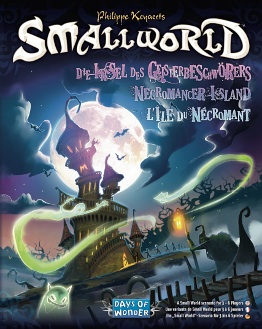
Small World: Necromancer's Island: This a free, limited-edition scenario available to people who buy the base game from various retailers or the Days of Wonder web store during November and December 2010, while supplies last. One player becomes the Necromancer, who turns dead units into an army of Ghosts. This is sure to become a collectible, so keep an out for it.

Memoir 44: Winter Wars--The Ardennes Offensive: I already discussed it here. I'm planning to do a review of the base game, and then follow-up with a review of this add-on.

Halo: Reach: I didn't have any time to spend with it until this weekend. (I'm long past being excited about a new Halo game. A new Arkham Asylum or Bioshock or Civilization? Yes. A new Halo or Call of Duty? Eh, no. Been there, done that, passed the t-shirt on to my son.) It's exactly what we expected: a very polished, very good continuation without a whole lot of surprises. Multiplayer has gotten almost absurdly over-stuffed with modes and variations: there's about 4 or 5 games worth of content in there.The differences between this and previous Halo games are merely of degree, not of kind. It's an excellent game, and like StarCraft II, it sticks to the formula that made it huge.

MySims SkyHeroes: The most I could get out of Daughter was "It's fun and cool," which means nothing considering that 2 years ago Winnie the Pooh's Rumbly Tumbly Adventure was described that same way. I'll have to put some actual time in if I plan on covering it.  (IF....)

I'll write some more about the new Days of Wonder stuff as I get them to the game table this week.

... And Poptober Begins

You know you want this.
And so we begin to pass out the PopCap swag throughout October.  Here's what we have on hand:
  • A rare, 10th Anniversary metal Bejeweled Photo frame
  • Plants vs. Zombies Gelaskins for your iPhone
  • A Peggle t-shirt
  • Plants vs. Zombies Game of the Year Edition, with a special zombie figurine.

I also have a variety of stuffed Chuzzles and strongbands, so I'll probably spread those around to various packages as I send out stuff.

First contest begins today.

Bicycle September Ends ...

I want to thank the United States Playing Card Company for sponsoring prizes for the month of September, particularly Jorie Livingston for making it all happen. Their sponsorship gave me a chance to look at a lot of brands I hadn't seen before, and even changed my mind on plastic playing cards.

I also want to congratulate our prize winners: Hillary, Gary, M&M, MJ, and Simon. Thanks for participating!


Playing Card Design Series
Bee Club Special
KEM Playing Cards
Hoyle Maverick
Hoyle Playing Cards
Aviator Cards
Bicycle Prestige
Bicycle Rider Backs

App O' The Mornin': Color Fill Review

My first impression of Color Fill was that it might break some kind of land-speed record for rapid deletion. The only thing that prevented that fate was my young daughter, who likes doodling and painting on the iPod Touch. It was kicking around there for a little while before I finally took a look at it, and was surprised to find an interesting take on the standard touch-coloring program.

This is really just a cubist coloring book with a puzzle element. You choose from a palette of 4 colors, and fill in all the shapes so that no two blocks of color touch each other. That’s it, but with variations and elaborations, it becomes pretty entertaining.

The puzzles get slightly more difficult as you go along, but none are particularly challenging for someone with any puzzle experience. Even the inclusion of a time-limit doesn't really add much to the difficulty level. More interesting are the way the solutions create interesting art as you go. Adults might not get a lot out of this one, but kids may find it more interesting.

Sunday, October 3, 2010

This Week in Review


And this week started out so well....

I've spent the past few days on my keister with my leg propped up thanks to what the hospital discharge papers dryly call a "crush injury with lacerations." It's what happens when a really heavy stack of shelves falls on your foot from a height of about 6 feet. I haven't seen that much blood since Evil Dead II. I've managed to tear through a couple of stitches since then, so the fun never ends. This is what I get for trying to install a new closet system.

Also, Vicodin didn't do a thing for me. It didn't even cut through the pain. Useless. It always seems to work so well for Dr. House. TV lied to me again! (Watching War of the Gargantuas, however, had a wonderfully numbing effect.)

Anyway, I'll be a little slow getting back to work this week, so please bear with me.

Apps
Splode
Tafl
Undercroft
Froggy Launcher
Mr. Runner

Posts
COLONIAL GAMING: Fox &  Geese
REVIEW: Sorry Revenge
A CLOSER LOOK: Bee Club Special and KEM Playing Cards
GAMES WITHOUT PIECES: Ghosts and Superghosts
New contest sponsor: PopCap
Memoir 44: Winter Wars

Puzzles
Got a Problem?, Follow-Up, Answer
Sporting Chance
Big Cross-Out Swindle
The Blue-Eyed Sisters