
Tuesday, September 20, 2011


Friday, September 16, 2011
The Road to Canterbury Arrives

The gameplay, as my daughter remarked, is "EEEEEVIL." We did one full trial playthrough and enjoyed the mechanics, even though we made a rules mistake that we didn't catch till half-way through.
The game has you playing as The Pardoner, the cynical and corrupt churchman from The Canterbury Tales. The Pardoner peddles forged indulgences and counterfeit relics in order to fleece the pilgrims. In this role, you draw a combination of Sin, Pardon, and Relic cards, which are played to various pilgrims from the tales. Sins are pardoned in sets, earning influence (known in the game as "corruption") as well as coin for the Pardoner. It's a pretty unique mechanic, and we need to run it through a few more test plays to see what we think, but first impressions are positive. As the daughter said at the end of the first test game, "It's still evil, but fun."
Monday, September 12, 2011
Settlers of Catan: The Novel

Wind howls through the village. Swords clash. Voices call desperately for help. It's the year 850, and the people of the small coastal village Elasund are feeling bitter. Hostile nations are attacking, taking everything and even murdering women and children and cattle. The village Council consults the runes and determines the clan's future: Candamir and his followers will build ships and head west to find a new home, leaving Osmund and his loyal ones in the north. After much effort, the settlers arrive in legendary Catan. But instead of their dream of island tranquility, fraternal strife threatens the entire community from the beginning... In this vivid depiction inspired by the wildly popular Settlers of Catan role playing game, Rebecca Gable takes readers on a journey that will feel at once familiar and fascinating to Catan’s many fans.
App O' The Mornin': Gesundheit!

Grade: A
Price: $1
I imagine there are quite a few people who won't be able to muscle past the premise of Gesundheit! in order to enjoy the treasures of the gameplay itself. Their loss. Sure, it's a game about a little green pig whose allergies are so horrible that he sneezes giant globs of snot across the landscape. And, yes, said landscape is populated by monsters who find these globular goodies so unbelievable tasty that they'll ignore that temptation to eat fresh green pork, at least for a few seconds. But once you get past all the booger blasting and snot snacking, you'll find a game that's not only fun and clever, but even charming.
Much of this charm comes the visual style of Gesundheit!, which is striking, colorful combination of storybook backgrounds and and child-like drawings. The music, animation, and art are all the work of Matt Hammill, while the game itself is made by Revolutionary Concepts. Thanks to the graphics, none of the mucous mechanics ever come off as all that gross. Believe me, I've seen apps that go for the gross-out just because that's the only arrow they have in their quiver, but Hammill isn't working that side of the street. His sneezing piglet is just a cute little outcast who turns his problems (horrible allergies) into an asset, making him a kind of superhero of snot.
The game is comprised of 40 single-screen levels, with gameplay that combines puzzle solving with some stealth-strategy elements. Each level has a monster (or monsters), and the now-ubiquitous triple-star challenge. The goal is to collect as many of he stars as possible before trapping all the monsters inside monster-eating traps. This is done by luring the monsters into different areas of the maze-like map with your gourmet nose nachos. Simply tap the pig, draw back to choose force and aim, and fire away. If your loogie lands where a monster can see it, he'll ignore you and run straight to his favorite snack, even if it's inside a trap.
Lacking a snack, the monster will run straight for you, and you need to shake him by sneezing, or try to just lose him in a maze. The trick is luring monsters away from the stars without letting them walk over the stars, which they'll crush. And then luring them to the traps. And then not gettin' et.
As triggered obstacles, multiple monsters, superpowered mucous, teleporters, and other challenges are added, things start to get pretty tricky. Not long into the game you develop the ability to create a snot-slingshot (snotshot?) that catapults you from one location to another. It's kind of like Tarzan swinging on horizontal ropes of phlegm
Although there are puzzles I still haven't been able to solve at the 3-star level, basic level-completion is only moderately difficult, making this a good choice for both kids and adults. There's a timed element to the game, and you'll need to think pretty fast on your feet in order to escape certain monsters.
This is a wonderfully weird and appealing little puzzler with some genuine challenges. Don't be put off by the theme. Within a few minutes, you'll forget you're defeating evil by wielding the mighty power of boogers and just lose yourself in the clever puzzles and wonderful graphics.
Friday, September 9, 2011
Three Quick Takes: Bastion, Toy Soldiers, Deus Ex

Some here are a few quick takes on what I've been playing this week:
Deus Ex: Human Revolution
Spectacular. And maddening. Everything about it is so good, and then you get to the boss battles and have this overwhelming urge to fly to Montreal and punch someone. Penny Arcade even did a comic about it. I'm merrily rolling along, doing the whole stealthy-hacky-persuader thing, and then every few hours I'm popped out of my bubble to fight some modified boss from hell in a level of spectacularly bad design. This is the kind of thing that shaves 10 points right off the top of a final score.
I'm not just complaining because I find these moments difficult. I'm complaining because these moments are a like a musician suddenly playing off key in the midst of a spectacular performance. Every element of the design has encouraged me to make choices, and those choices are chucked back in my face at random, arbitrary moment as the designers say, "You know, you really should have invested in that Typhoon."
Aside from that, everything else is wonderful. It just shows how we're starved for good, deep content. There aren't enough Mass Effects and Bioshocks out there to feed the need. This is a game with something on its mind, and it will be my debut review for the new Catholic News Service game review department, just to show how powerful games can be as a narrative medium.
Bastion

Bation is just something you need to play to really understand its charm. It’s a solid action/RPG hybrid with an old-school vibe: you bash stuff, collect things, upgrade, and move along. What sets it apart is a wonderful design and sense of style, featuring a floating world that constructs itself as you explore. The landscape is a colorful, richly-imaged fantasy realm that draws you in and demands to be explored. It’s almost impossible to stop playing. I'm picking this one up for about a half hour every day. It doesn't make too many demands, but it rewards you with loads of fun and a surprising bit of depth for its genre. I even used it at the backdrop for a new headshot that publisher requested, just because it looks so sweet.
Toy Soldiers: Cold War
This sequel to last year’s insanely entertaining Toy Soldiers updates the series from little iron soldiers fighting in the trenches of WWI to GI Joe-style action figures fighting those pesky Reds. The novelty of the design was in the way it takes elements of tower defense games—such as placing weapons—and mixes them with action elements. You can actually take over and fire certain weapons and aircraft, which is a whole lot of fun. The entire game is steeped in 1980s nostalgia, complete with a Stallone action figure, lots of Cold War settings, and a complete 1980s action-movie vibe and cheesy synth soundtrack. If you have fond memories of either GI Joe or movies like Red Dawn or Rambo, this game is for you. We're mostly down to multiplayer on this one, and it's still great fun in 1 hour bursts of split screen. More maps are needed, however.
Gesundheit!
This is just a real charmer, thanks in no small part to the wonderful children's-book aesthetic. Beneath the cute visuals, however, is a game of surprising depth. You need to use a little green pig's (green pigs again!) prodigious mucus output to lead monsters into traps in order to survive a level. I'll get a full review of this one up soon.
Wednesday, September 7, 2011
Still Alive

I'll be slow getting back to blogging, because the financial crunch at Casa McD is at critical mass. If you are so inclined, using my Amazon or donation link in the sidebar will be a huge help. Donations help me do extravagant things like keeping the bank from foreclosing on my house and buying food.
I've managed to get a fair deal of gaming in, and I've been spending a great deal of time with Deus Ex: Human Revolution for a review. One word: awesome.
Wednesday, August 24, 2011
The Electronic Games 100: Done
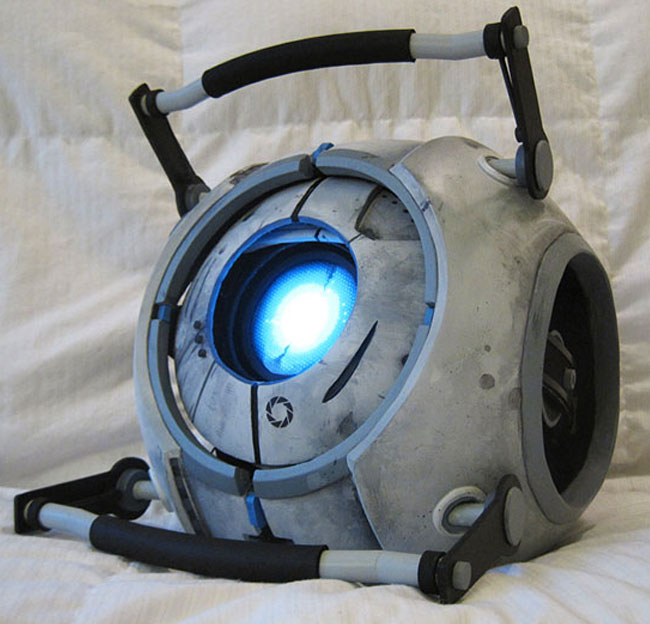 |
| Wheatley, by TRP-Chan |
You'll have to wait for the December issue to find out what we picked, but I can talk a bit about the general contours of the game industry as it stands in 2010-2011.
The game industry continues to grow, but in strange and unpredictable ways. Here are some quick observations:
- 72% of American households have a videogame machine.
- Consumers spent $25.1 billion on games in 2010, with those numbers projected to hit $48 billion for 2011 and $70 billion by 2012. By comparison, worldwide motion picture ticket sales for 2010 were approximately $31 billion.
- In studies of children 12 to 17 years old, 99% of boys (and 94% of girls) play video or computer games, with no variables for race or ethnicity.
- The average game player is 37 years old, with 29% of them over the age of 50.
- Video games had skewed heavily male for most of their existence, but by 2010 48% of the gamer audience was female.
- Approximately 13% of the gaming audience is made up of males under 17, while 37% are adult women.
- Electronic Arts CEO John Riccitiello revealed that since the year 2000, console games have dropped from 80% of EA’s total sales down to only 40%. What filled that vacuum? It was mobile devices, which are becoming the dominant platform in electronic entertainment.
- The 3DS was a dramatic flop. A lack of quality 3DS games and the explosion of the mobile market lay at the root of Nintendo’s woes. The company made deep price cuts in the hardware, but it may not be enough. For the first time in gaming history, Nintendo may lose its complete dominance of the handheld market.
- Mobile gaming has emerged the dominant force in interactive entertainment. This is not merely driven by technology, or convenience, or price point, although all of these are factors. It is driven by the wild creativity that is being unleashed in mobile gaming design. Apps are cheaper to develop, which means more people can make quirky and original games and get them directly to players without involving a publisher or retailers. As a result, a rich and previously inaccessible vein of innovation is tapped, radically changing the gaming landscape. The shocker in preparing for this year’s Games 100 was how many of these little games eclipsed an increasingly-derivative mainstream gaming market. While consoles are dominated by endless sequels, mobile gaming seems to offer a fresh new surprise every day.
Wednesday, August 17, 2011
Couple Sells Children to Play Online Games
Sadly, this comes as no surprise in a society that values human life so little, but it's still disturbing:
A young Chinese couple has sold all three of their children in exchange for money to play online games at Internet cafes, reports a southern Chinese newspaper.
According to Sanxiang City News, the couple met in an Internet cafe back in 2007 and bonded over their obsession with online video games. A year later, the parents -- who are both under 21 -- welcomed their first child, a son. Days after his birth, they left him home alone while they went to play online games at an Internet cafe 30 km away.
Tuesday, August 16, 2011
Life Imitates Bioshock

Peter Thiel, founder of PayPal "has been a big backer of the Seasteading Institute, which seeks to build sovereign nations on oil rig-like platforms to occupy waters beyond the reach of law-of-the-sea treaties. The idea is for these countries to start from scratch--free from the laws, regulations, and moral codes of any existing place."
What could possibly go wrong?
Yesterday's outrageous plot for Bioshock is tomorrow's reality. I wonder if they'll call it "Rapture."
H/T Sean Dailey (check out his awesome magazine, Gilbert)
Friday, August 12, 2011
Jonathan Stark's Social Experiment
This isn't about games, but it's a good story that's certainly going viral. App developer and author Jonathan Stark has made his Starbuck's card publicly available. Here it is:


Just save the picture to your phone, run it under the barcode scanner, and if there's any money in the account, then someone else has just bought you a cup of really bad coffee. (I detest the flavor of Starbucks.)
You can check the card's current account balance via Twitter.
Stark also posts directions on how to place money back on the card, for people who want to buy someone else a cup of coffee.
As social experiments go, it's kind of fascinating. A glance at the Twitter feed shows the card running out and then filling up again. In the midst of complete economic collapse, it's heartening to know that someone is willing to buy a stranger a cup of coffee.
Historically, America has always been an absurdly generous nation. I like to imagine that this quality will save us when our governing and financial systems finally break down; that we will band together in charity and support rather than turning on each other in fear and anger.
"When the chips are down," the Joker says in The Dark Knight, "these 'civilized' people will eat each other." That certainly seems to be what's happening in England right now. Are we any better? I like to think so. Maybe Stark's small experiment is a little glimmer of light.
1979: A Game About the Iranian Revolution
Before leaving to found his own company, Navid Khonsari was one of the people who gave Rockstar's games, such as Grand Theft Auto and Red Dead Revolver, their cinematic feel. After producing critically acclaimed titles like Alan Wake and Homefront, the Iranian-born director and producer is turning his attention to the Islamic revolution that drove his family from their homeland.
In 1979, Khonsari is tackling the events surrounding he deposing of the Shah, the rise of the Ayatollah Khomeini, and the hostage crisis. He's well aware of the controversial nature of the project:
Read the whole thing.
In 1979, Khonsari is tackling the events surrounding he deposing of the Shah, the rise of the Ayatollah Khomeini, and the hostage crisis. He's well aware of the controversial nature of the project:
Iranians are going to criticize me because I'm making a game that 'promotes American imperialists going in and shooting Iranians'. Americans are going to criticize me because I'm making a game that 'glorifies Islamic fundamentalism,' or something. I'm not going to please everyone, and the point of the game isn't to do that.
I think that being able to base a game in contemporary historical truths is significant, besides being educational. It opens people's eyes to look beyond what they're reading in the paper and realize that there's a definite relationship between history and the headlines.
Read the whole thing.
A Psychiatrist Tries to Understand Angry Birds
Okay, this is my absolutely last Angry Birds post for this week. Dr. Dinah Miller is trying to figure out why people are hooked on this game. Help her out. While you're at it, maybe you could give me a clue. I liked Angry Birds fine when it was called Crush the Castle, and I like the art, but I've just never spent all that much time with it.
Wednesday, August 10, 2011
London Riots Blamed On...

Kotaku spotted this quote from a constable, buried in a story in the London Evening Standard:
These are bad people who did this. Kids out of control. When I was young it was all Pacman and board games. Now they're playing Grand Theft Auto and want to live it for themselves.Ah ... no. Look, I detest the content of Grand Theft Auto, but this is just absurd. Generations of class warfare rhetoric, a culture of entitlement and dependency, and the erosion of a distinct British character in favor of the vague promises of "multiculturalism" is at the root of these problems, not some game. When you listen to these two stupid girls brag about their crimes, you have all the explanation you need for the nightmare engulfing England. The British made it through the Blitz because they believed in their nation and the importance of sacrifice and honor, and then raised a generation that derided these things.
On the other hand: yay, boardgames and Pac-Man! You both get the English Police Constable Vote.
These Birds Aren't Angry, Just Mad
Sorry for the light posting, folks, but my publisher moved up the print date for the Games 100, and there hasn't been much time left over for the blog.
In the meantime, I leave you with the surest sign that Angry Birds have entered the pop culture pantheon: a MAD magazine cover.

The full cover is here (mild language warning).
In the meantime, I leave you with the surest sign that Angry Birds have entered the pop culture pantheon: a MAD magazine cover.

The full cover is here (mild language warning).
Monday, August 8, 2011
App O' The Mornin': Cut the Rope: Experiments
Grade: A


Price: $1
Cut the Rope is one of the few games to challenge the dominance of Angry Birds in the hearts and devices of app gamers. Cute, clever, and insanely addictive, it combines a wonderful puzzle mechanic with an appealing visual style to make a knock-out game.
Cut the Rope is one of those rare games where the title is also the instruction manual. In a series of single-screen puzzles, hanging objects function like pendulums. You need to cut the ropes at precisely the right time and in exactly the right sequence to get the object where it needs to go.
In this case, the problem is how to get a piece of candy into the mouth of a voracious (yet adorable) little monster named Om Nom. Each puzzle has three stars and a piece of candy. Cut the rope with a finger swipe, and the candy collects the stars as it drops into Om Nom's mouth. It's fairly easy to get the candy into the monster's mouth, but to get it there while collecting all three stars can be incredibly challenging.
The original game came with 4 sets of 25 puzzles each, and more sets were released with updates and holiday packs. In the first full-blown sequel--Cut the Rope: Experiments--the initial set of puzzles functions as a recap of the entire first game. All of the many puzzle elements are re-introduced: balloons, whoopee cushions, spiders, rubber bands, ropes, and so on.
There are only two other puzzle sets: "Shooting the Candy" and "Sticky Steps"--for a total of 75 puzzles. This is fewer than the original, but updates are promised.
The new gameplay elements are certain to appeal to CtR Fans. The targeting button shoots a rope to the candy as it swings. This rope can be of various lengths depending upon how far away the candy is when you fire. If the candy is swinging close to the rope shooter, the rope is short; if it's further away, the rope is longer.
The other new element is the suction cup. Tap this cup, and it comes loose from the "wall" of the puzzle and begins to drop. This allows you to reposition ropes, creating far more variables on each screen.
These new features are run through their paces in two sets of twenty-five puzzles each, creating complex variations of the familiar CtR gameplay. Lvels are of consistently high quality. The basic solution usually isn't all that hard, but earning 1, 2, and 3 stars can be brain-bendingly difficult. There are some I simply couldn't solve at the 3-star level no matter how many times I tried. That's a good thing: it means the game is still challenging, which keeps it interesting.
It is a bit disappointing to have only 75 puzzles and 2 new elements, but there's more than enough here to keep things fun and fresh, and the updates give you something to look forward to. Cut the Rope is one of the best puzzlers in mobile gaming, and Experiments only further cements its reputation.
Wednesday, August 3, 2011


Malfoy v. Potter in Scrabble Throwdown
Harry Potter actors Tom Felton (Draco Malfoy) and Daniel Radcliffe (Harry) ended their decade-long on-screen rivalry with a cut-throat game of Scrabble. As Felton tells it, after the big wrap party for the final film,
There was an after, after party, if you will, and we had a few of the cast members there. Everyone was expecting us to be popping Cristal and all the rest of it but we actually played Scrabble until about two in the morning; Daniel [Radcliffe] and I got very heated at a game of Scrabble!H/T Kim Vandenboucke at The Game Aisle
The New Cut the Rope is Due ...

What on earth is Om Nom?! That’s what millions of fans of the widely acclaimed game, Cut the Rope, have been asking about the cute little monster who eats candy like its his job! That same question has a mad (but not bad) scientist studying the little creature that mysteriously arrived outside his house.
There's a teaser trailer up at TechCrunch, but it doesn't have any in-game footage. I think Cut the Rope's gameplay kicks Angry Birds in its feathery butt, so you better believe I'll be checking the app store around midnight.
A Few Words About Cards and Cribbage
Jordan Wiklund did an interview with me at his site, Cribbageland. Don't forget to check out his event, Cribbage in the Field, if you're in the Minneapolis area.
Monday, August 1, 2011
Deepak Chopra Makes Boring Game
Actually, I've only seen the trailer, but I believe it is metaphysically certain that a forthcoming game from contemptible New Age quack Deepak Chopra will be blindingly boring and spiritually nugatory. THQ spent a bundle last year to nail down the rights to the Chopra ouvre, and the first fruit of that deal is named Leela. (I thought she was still working for Planet Express.)
The game includes things like "Chakra-based meditations." These "task players with moving their bodies to control graphics onscreen set to a soothing soundtrack ... the root chakra exercise, for example, directs players to tilt their hips to seed a virtual planet." It seems to be a motion control thing aimed at the Wii and Xbox Kinect markets. I shall be waiting by my mailbox every day until it arrives.
Here's my favorite D-Pak moment:
Exit quote from Deepak: "Hope is a sign of despair." And people have made this fool a multi-millionaire for peddling this tripe.
Diablo 3 To Include In-Game Auctions With Real Money

This is a whole new concept in monetizing gaming that could have fascinating ramifications. There have always been gold farmers in online games. Some estimates claim there are already 100,000 to 200,000 people who do this for a living, most of them living in China. By integrating this process, Blizzard a) increases the reliability of the exchanges, and b) increases their own profits. Win-win! With the real-world economy in a shambles, will it be possible for even more people to supplement their income by collecting and trading items within games?
App O' The Mornin': Ascension: Chronicle of the Godslayer

Grade: B
Price: $5
Although burdened with a cumbersome title, Ascension: Chronicle of the Godslayer scratches an itch many gamers didn’t even know they had, at least prior to the release of Dominion.
Ascension is a deck-building game created by a team of Magic: The Gathering tournament players. Originally publishes as a conventional tabletop game, it feels a bit like a mashup of Magic and Dominion. Players take turns building a deck by buying various cards. Most cards either generate Runes or Power. Runes allow you to buy more cards to add to your growing deck, while Power allows you to defeat monsters. Players earn honor points by defeating monsters, and the player with the most honor, wins.
Each turn, a player can draw five cards. At the center of the table is a line of cards which can either be purchased for your deck, or “banished” in order to keep another player from purchasing them. As your deck grows, you begin to search for cards in specific classes—Enlightened, Lifebound, Mechanic, or Void—since these work well together. By careful deck building and management, you can create a hand that allows you to buy and fight effectively, thus earning more honor and winning the game. There is a modest strategic element to the deck building, and the game has a quirky, appealing feel.
There is a load of data on the screen, which makes the layout a bit cramped on an iPhone/Touch screen. It functions well, however, and there are no accidental moves that can ruin a game. Gameplay is addictive, with clever card design and a diverse range of powers to draw upon. The AI didn’t impress me much, but fortunately the game has a multiplayer component with a matching service. The result is quite entertaining.
Friday, July 29, 2011
Struggle for Catan: Tutorial

Kenken: Sudoku With Math
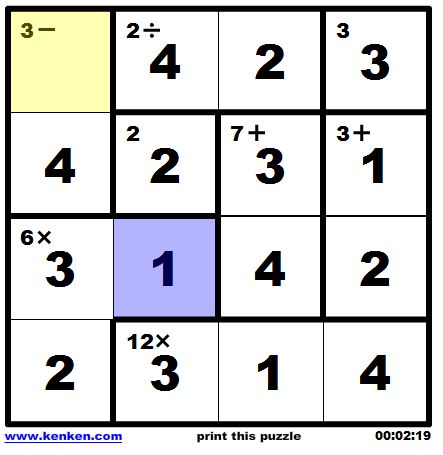 |
The game is played on grids ranging from 4x4 to 9x9, and the rules are as follows:
- Do not repeat a number in any row or column.
- The numbers in each heavily outlined set of squares, called cages, must combine (in any order) to produce the target number in the top corner of the cage using the mathematical operation indicated.
- Cages with just one box should be filled in with the target number in the top corner.
- A number can be repeated within a cage as long as it is not in the same row or column.
Short version: the numbers you place in the bold boxes need to yield the number in the corner by multiplication, division, addition, or subtraction.
Here's a video with Will Shortz (former editor of Games Magazine) explaining how to play.You can find playable puzzles at Kenken.com.
Cribbage in the Field (Minneapolis Event)

The event will feature local artisans and their custom cribbage boards, plenty of boards and cards, open play, and even a 5-foot-tall peg from the man who "carved the world's largest board through the ice of a Minnesota Lake." There will also be prizes and raffles, including a one-of-kind custom cribbage board (shown at the right) that currently resides at the Walker.
Location: Walker Art Center, Open Field / 1750 Hennepin Avenue / Minneapolis, MN
Time: 10am - 2pm
Find more information at Facebook or Cribbageland
Wednesday, July 27, 2011
Battleship: The Trailer of The Movie of The Game
Otherwise known as "What Transformers Hath Wrought". I thought Battleship might have made a decent period war movie, but that approach would have killed any chances for a toy line.
By my count Ridley Scott is ripping off three different Michael Bay movies (Pearl Harbor, Armageddon, and Transformers) in this trailer. Let me say that again: Ridley Scott (the man responsible for Alien, Blade Runner, Gladiator, Black Hawk Down, etc.) is ripping off Michael Bay (the man responsible for the Worst Use of an Animal Cracker in Cinematic History, among other offenses).
There are no battleships left in any Navy in the world, so this movie makes about as much sense as fat-free half-and-half.
Consoles Now Only 40% Of the Videogame Market Says ...
... the CEO of Electronic Arts, John Riccitiello. It used to be 80%. In an interview with Industry Gamers, the big boss of the biggest game company on the planet says that iPad is their fastest growing market, the Wii U is just fine, and people need to basically get a grip on the seismic changes in the electronic entertainment industry:
We have a new hardware platform and we’re putting out software every 90 days. Our fastest growing platform is the iPad right now and that didn’t exist 18 months ago. So the idea that we’re categorizing the industry as being [cyclical]... Nintendo is off cycle with what? I mean, the point of reference is gone. And so Nintendo is bringing out a new platform that brings together some of what we’re learning from new media and new platforms like the iPad and then integrating that with a console. It’s the perfect time for that in the industry."
As I've been saying. Somehow videogame analysts got locked into this idea of cyclical hardware updates (PSX, PS2, PS3, etc..., every 6 years) driven by a demand for more processing power. Nintendo blew the second half of that equation out of the water with the under-powered Wii, and they're about to blow the first half out of the water with the "off-cycle" Wii U.
I'll say it again: the old patterns are dying. The next dinosaur to get a comet upside the head is the militaristic FPS genre. If Activision thinks they can spin Call of Duty sequels out to infinity, they're in for a rude awakening. I'm in the process of surveying the entire electronic industry for the Games 100, and I can tell you without hesitation that the only consistently creative and innovative platform is mobile gaming.
Rory’s Story Cubes

There are nine dice in a box a little larger than a deck of cards. These 9 dice offer a total of 54 faces, and each face displays a different icon: apple, fish, lock, rainbow, house, lightening bolt, and so on. Players roll all the dice at once, and then choose a starting image. They begin with “Once upon a time” or some similar opening, and then use that image to begin a story that will weave together all of the face-up images.
Here’s one example from a 10-year-old I found living in my house. She rolled sad face, magic wand, tree, fire, cane, arrow, flashlight, compass points, and magnifying glass, and came up with this (with apologies to JK Rowling).
Here’s one example from a 10-year-old I found living in my house. She rolled sad face, magic wand, tree, fire, cane, arrow, flashlight, compass points, and magnifying glass, and came up with this (with apologies to JK Rowling).
There once was a wizard who was very unhappy. His name was Harry Potter. Harry’s magic wand made of pine tree bark had burned in a wizard duel with Draco Malfoy! He was forced to use a cane and when it broke he had to use an arrow! When he went home it was dark and since he couldn’t cast Lumos, he used a flashlight. (This is very unusual for a wizard.) When he got home he found all of his belongings spread in all directions! He used a magnifying glass and found Draco’s fingerprints! Draco was sent to Azkaban and was never seen again.The genius of the design is its simplicity and flexibility. People can collaborate on stories, select themes, or just play alone. Both kids and adults—solo, or with a family or even in a party setting—can all enjoy it. Home-schoolers in particular might find it a useful tool for jump-starting the brain before a day of a work.
Monday, July 25, 2011
App O' The Mornin': Candy Train

Rating: A
Price: Free
Candy Train is a remake of an old Java title that was still floating around on the internet until recently. (I can't find a current version, so it's probably been removed to keep attention on the mobile port.) It is insanely addictive, perhaps because you always seem so close to getting it juuuust right, moments before you fail completely. This is really just a train pathing game with a tile-switching mechanic, but it’s one of the most appealing free puzzlers to appear on the iOS format this year.
The game is played on an 8x8 grid comprised of tiles representing different track configurations. There are curves, double curves, straightaways, and crossings. Tiles are turned by tapping, thus reorienting the track configuration. In this way, you create a path for the train to follow as it collects points and gathers new cars filled with candy and other treats. If your tracks don’t connect, the train crashes and the game ends.
After all the cars on a map are collected, you attach a caboose and steer the train to the switching point for the next level, where you begin again with more cars. Aside from changing the train speed from slow to fast, there are no other controls.
The normal mode is tough enough, but the expert mode is maddening (in a good way). This is a tricky game to get into, but great fun once you start to master it.
Friday, July 22, 2011
Apples to Oranges: Apples to Apples MOD
I played Apples to Apples MOD (a slim travel edition) during vacation, and the cards were awful: a lot of celebrities and pop culture references that were completely lost on our group. (Hence, "MOD".) So far, the kids edition is the best one we've played, with the most cards for the most people. Obviously, Mattel was aiming for people who'd want cards like "Megan Fox" and ""Neil Patrick Harris", but games like this need to be a bit more timeless, rather than trendy and easily dated.
It reminded me of a Trivia Pursuit 1980s Edition. It may just be the haze of memory, but it seemed like every other answer was either "Michael Dukakis" or "Condoms". It became a running joke. Need a wedge? Just answer "Michael Dukakis" or "Condoms".
There also simply aren't enough cards, so they repeat very quickly. Plus, the cards are a bit too small.
On the positive side, the new dice mechanic for Apples to Apples MOD is pretty decent, as long as people remember they can make up their own adjectives. The system uses a multi-sided die imprinted with 26 letters and an apple icon. There are two cards with an alphabetical selection of words on each side, offering 4 possible adjectives for each letter of the alphabet. The judge rolls the die to select a letter, and then chooses an adjective beginning with that letter. He can use the cards, or make up his own adjective beginning with that letter. This word becomes the "green card" for that game.
It doesn't seem like Amazon even carries it, so it may already be out of print. I picked mine up at Target for $10. It won't be coming out again.
DC/Marvel Teaming With Lego
This isn't gaming news, but it touches on two beloved subjects here at Casa McD: superheroes and Lego. Starting January 2012, Lego will begin a multi-year deal to produce sets based on DC and Marvel comics characters.
A line tied to The Avengers feature film will include minifigs of Iron Man, The Hulk, Captain America, Thor, Hawkeye, Loki and Black Widow, while the the X-Men collection includes Wolverine, Magneto, Nick Fury and Deadpool, and the Spider-Man sets offer Spider-Man and Doctor Octopus. On the DC side, we'll be seeing Batman, Robin, Catwoman, The Joker, The Riddler, Two-Face, Poison Ivy, Harley Quinn, Bane, Bruce Wayne, Superman, Lex Luthor, Green Lantern, and Wonder Woman.
In the past, Lego has produced significant lines for both Spider-man and Batman, but this is the first universe-spanning deal to date. They're launching the new endeavor with a Lego Super Heroes Unite contest, which invites people to use their minifigs to create artwork and films highlighting the characters. Expect to start seeing sets in May 2012.
Wednesday, July 20, 2011
LostWinds Coming to Mobile Devices
Days of Wonder: Memoir '44 Out of Beta & Small World Underground
 When I loaded up Days of Wonder's new online version of Memoir '44, I could swear my copy said it was still in beta, and mentioned that in my announcement. It has, in fact, been out of beta since late June, and is humming along quite nicely.Thanks to Christine Goutaland for correcting me.
Also, we got a chance over the weekend to play a warm-up game of Small World Underground, and we're liking it a lot. The new races are clever, the powers are dastardly, and the integration of places and relics puts a nice spin on the play. One caveat, however: don't use this one to introduce new players to Small World. The new additions add a little the learning curve and might put off novices.
PUZZLE: Tabling the Question
I haven't done a math puzzle in a while, so here's an old one to strain the average brain. (And by that I mean my brain: in the past, my readers have solved these so fast it's almost embarrassing.)
Mr. Jenkins comes home to find his son Todd reading a comic book rather that working on his quadratic equations. He sets about berating the boy, when Todd interrupts him with a deal. "If I can pose a problem you can't solve, you have to finish my homework, and I can to finish my comic." Mr. Jenkins, considering himself something of a math whiz, takes this bet in a heartbeat.
Todd pushes a large, perfectly round table into a corner, with its edge touching both walls. He places a spot and then turns to his father. "That spot," says Todd, "is exactly 9 inches from one wall and 8 inches from the other. Without measuring the table, tell me its diameter."
My Jenkins puzzled and puzzled 'til his puzzler was sore, and then wound up finishing Todd's homework while the boy returned the adventures of Uncle Scrooge. Would you have done any better?
A Closer Look: French Tarot: Trumps 15 & 16
 |
| Click to enlarge |
 |
| Tarot Trump 15: Detail |
 |
| Click to enlarge |
 |
| Tarot Trump 16: Detail |
Monday, July 18, 2011
App O' The Mornin': Tiny Tower

Price: freemium (extra in-game money can be purchased)
Compulsion loop games are not one of my favorite categories. Any title that requires someone to check in and do something at regular intervals feels less like a game and more like a poor lifestyle choice. Yet the genre remains insanely popular among people who forget just how irritating it was to keep a tamagotchi.
Tiny Tower (NimbleBit) is designed in such a way that it can be played by people who like to check on their game every 30 minutes or so, but it doesn’t have to be played that way. This rather clever balance between compulsion loop design and simple simulation gaming is what makes Tiny Tower work.
The game is like a stripped down, pixilated version of the much-missed SimTower. You build a high-rise, one floor at a time, and designate each floor as either residential or work. Tenants are rated for their work skills in food, service, recreation, retail, or creative businesses. After you build each floor and designate it as a business, you assign tenants to a job, preferably in some area of their ability.
Sometimes these are dream jobs for the tenants, while other jobs make them unhappy. Either way, they work where they’re told to and earn the money needed to continue construction and restock and the stores. The Marxists at Popmatters try to read Deep Meaning into this, with lines like "I have become an exploiter of digital-human capital." (There is no more unintentionally hilarious read on the net than game coverage at Popmatters.) Because we all know that 16-bit dude with a frowny-face is dying inside as he quietly hums "The Internationale".
Tony Tower is free to play, but if you want to play faster you can buy more “bux” online. If you don’t get too obsessed with it, Tiny Tower is great fun and can provide a few minutes of daily play as you manage your little building. If you do get obsessed with it, it ceases to become a fun little game and transmorphs into a time sink.
Your Turn: The Games Magazine Electronic Games 100

So let me know what you think. What have you been playing? What did you love? What did you hate? Do you know something small that deserves more attention? Something big that deserves less attention?
On Twitter, use hashtag #games100 to make your suggestions. I'm also on Google+ and Facebook, or you can use the comboxes. This is the first time I'm doing this "live," so let me know what you think. You can check out the Awards tag on this site for some examples from last year, which saw Super Mario Galaxy II winning as game of the year, just because that's the way we roll.
I can tell you this much: it's going to take a concerted effort to keep mobile games to only 1/4th of the list (25 titles), as I did last year. Given the sorry state of originality in PC and videogaming, and the startling originality and fun found on mobile platforms, that may not be easy. Four words, people: Axe in the Face.
Please note: this is for electronic games only. I don't edit the Traditional Games 100.
Friday, July 15, 2011
Shaun the Sheep: The Hedge Maze
Because I won't ever pass up an opportunity to put Shaun the Sheep on my blog, here's a picture of the giant new Shaun corn maze that's about to open in Staffordshire, England.
 It appears to show Shaun striking a sassy pose while his brain shoots out the top of his head. It seem to be based on this (without the shooting-brain part):


Snapdragon: A Festive Children's Game Played With Flaming Food
Thou art easier swallowed than a flapdragon.
Wm. Shakespeare, Love's Labor's Lost
In Lewis Carroll's Through the Looking Glass, Alice is introduced to various fanciful insects by a gnat the size a chicken. To an American child, these creatures appeared to be little more than whimsical creations, but one insect had special connotations for the British:
 |
| A snap-dragon-fly |
`Look on the branch above your head,' said the Gnat, `and there you'll find a snap-dragon-fly. Its body is made of plum-pudding, its wings of holly-leaves, and its head is a raisin burning in brandy.'
`And what does it live on?'
`Frumenty and mince pie,' the Gnat replied; `and it makes is nest in a Christmas box.'
I'd never really paused over this reference to a "snapdragon fly", but the most recent episode of Masterpiece Mystery, an adaptation of the Inspector Poirot novel Hallowe'en Party, included an alarming scene of kids playing a party game during a Halloween celebration. Children kept reaching into a flaming bowl, grabbing something, and popping it in their mouths while chanting "snip snap dragon." You can find the scene (for as long as it stays up on Youtube), at the 7:00 mark here. I hadn't the faintest idea what they were doing until we looked it up and learned that it's an old game (no one knows just how old) called snapdragon or flapdragon.
 |
| from Poirot: Halowe'en Party (2010) |
Here's how Martin Gardner describes it in The Annotated Alice:
Snapdragon (or flapdragon) is the name of a pastime that delighted Victorian children during the Christmas season. A shallow bowl was filled with brandy, raisins were tossed in, and the brandy set on fire. Players try to snatch the raisins from the flickering blue flames and pop them, still blazing, into their mouths. The burning raisins also were called snapdragons.The chant that accompanies the game goes like this:
Here he comes with flaming bowl / Don't he mean to take his toll!Snapdragon is normally a Christmas tradition, although it's played at Halloween as well. There's no clear indication of the game's origins, but some sources trace it to the ancient Greeks or Druids, which seems rather fanciful. It pops up several times in the works of Shakespeare, where he uses "flapdragon" and "snapdragon" interchangeably to indicate something that's easy to swallow. You know: like flaming fruit. That pushes the game back to the 16th century at least. Like so many indoor amusements, it became traditional during the Victorian era, because nothing says "fun for kids" like sticking your hand in a burning bowl of liquor.
Snip! Snap! Dragon!
Take care you don't take too much / Be not greedy in your clutch!
Snip! Snap! Dragon!
With his blue and lapping tongue / Many of you will be stung!
Snip! Snap! Dragon!
For he snaps at all that comes / Snatching at his feast of plums!
Snip! Snap! Dragon!
But Old Christmas makes him come / Though he looks so fee! fa! fum!
Snip! Snap! Dragon!
Don't 'ee fear him but be bold / Out he goes his flames are cold!
Snip! Snap! Dragon!
I'm annoyed that I even have to add this, but if you try this game at home, please remember that fire is hot and if you're injured it's totally your own fault, not mine.
Wednesday, July 13, 2011
D-Day Dice

If you scroll to the bottom of the Valley Games page, you can download the trial version, print it out, and give it a test run. Based on a read-through of the rules, D-Day Dice appears to have an interesting mechanic, calling to mind a mashup of Roll Through the Ages and Memoir '44, with an added layer of depth. I'm going to print this one out and give it a spin, and I'm looking forward to trying the finished game.

H/T: W. Eric Martin
Memoir '44: Play Online

Right now it's in "open beta," and people who sign up get 50 free "gold ingots." The game uses a pay-to-play model in which you pay ingots to play solo and online games. Ingots can be purchased at a rate of 200 for $8. For $30, you get 1,000 ingots plus the Expert Mode, which allows you to create and upload custom scenarios. For $60, you 2,400 ingots, plus expert mode, plus $30 off any Memoir '44 product. Sessions cost 2-3 ingots each.
It's an interesting model, and I'm not sure how it will work out. It avoids the problems of a subscription-based system, but it's hard, at this point, to determine whether the value-versus-cost balance is quite right. If we calculate about 90 games for 200 ingots, with anywhere from 30-45 minutes for each game, you're looking at maybe 200 hours of gameplay for $8. That doesn't seem unreasonable.

Tuesday, July 12, 2011
EA Buys PopCap For ...
Via TechCrunch.
Monday, July 11, 2011
App O' The Mornin': Bumpy Road

Price: $3
This sophomore effort from the creators of Kosmo Spin has a delightful aesthetic, with a muted but eye-catching color palette and charming art. It’s a look that works perfectly for game about an older couple out for a Sunday drive on a corduroy road past windmills and impossibly narrow houses.
The gameplay is just as interesting as the visual element. Bumpy Road uses a novel mechanic to create a twist on the 2D platforming, move-to-the-right genre that has thrived on mobile touch devices. In this case, you don’t control the car, which moves at a steady pace, but the road itself, which is comprised of a series of little bumps. Touching the road raises it a little bit. Touch behind the car to create a hill that makes the car go faster. Touch in front of it to create a hill that slows the car down. Touch beneath it to make the car hop.
It’s as simple as that. The levels consist of multiple platforms and occasional water hazards, with minor variations for the two gameplay modes. In Evergreen Ride, you need to go as far as possible without falling into one of the water hazards. The trip is endless, with little powerups found along the way to close traps and allow you to focus on gathering items to improve your final time. There are no traps in Sunday Trip mode, so the goal is to get to a finish line as fast as possible by grabbing the accelerator powerups and avoiding the brake powerups. The result is a great little app, with a novel mechanic and engaging gameplay.
Site Update: Changes and Other News
I got off to a pretty serious start with an average of 20 posts a week in the beginning. That gradually tapered off, and then posts started getting a bit more irregular back in April. Part of this was because I had a lot of work to do in order to go on vacation, and part of this was the beginning of graduate school. I've been trying to find a good way to balance the blog with work and school, and might have finally found a pattern that works. So, here are the changes:
- Posts will be 3 times a week: Monday, Wednesday, and Friday. This gives me a target to shoot for that shouldn't be too hard to hit, while also providing regular visitors with a better sense of when to expect new content.
- The App O' the Mornin' will return in a reduced form. I wrote about 100 app reviews for the site, and another 50 or so for various print venues, and then my brain when pfffft. This was around the time that Axe in the Face was released, and I don't recall a lot of apps grabbing my attention after that. Maybe it was app burnout on my part, but there seemed to be a bit of a lull in quality appage. In the intervening time, the well of good apps has gradually refilled, giving me something to write about again. Thus, each Monday, starting today, I'll do an App Review.
- I also have a stack of board games to review, but I take these very slowly. I hate reviews that are done on one or two playthroughs. I tend to take a couple of months to test things and gradually build some kind of opinion. Yes, I can form a pretty fast snap judgment like any other experienced gamer, and it will usually turn out correct, but without a number of plays under my belt, I just don't feel like I have much to say. For instance, I've been testing Rivals for Catan, in its many different play modes, for over a month, and I still want to play a couple more times before I write about it.
Also, I'd ask you to please remember to use the Amazon links from the sidebar when you shop at Amazon. The Amazon Affiliates program is the only way I make anything for my work here (Google Ads are a joke). Using my link anytime you access Amazon costs nothing, but gives me a 4-6% commission for anything you buy. The depression has ruined us here at Casa McD, so every little bit helps.
Thanks for your continued support.
Subscribe to:
Posts (Atom)