O T T F F S S . . .

Tuesday, August 10, 2010


Monday Puzzle SOLUTION: The Bicycle Thief
The only money that matters is the money lost to the thief. Here's Dudeney's solution:
"People give all sorts of absurd answers to this question, and yet it is perfectly simple if one just considers that the salesman cannot possibly have lost more than the cyclist actually stole. The latter rode away with a bicycle which cost the salesman eleven pounds, and the ten pounds "change;" he thus made off with twenty-one pounds, in exchange for a worthless bit of paper. This is the exact amount of the salesman's loss, and the other operations of changing the cheque and borrowing from a friend do not affect the question in the slightest. The loss of prospective profit on the sale of the bicycle is, of course, not direct loss of money out of pocket."
Some may think this is a cheat because of the misdirection of the salesman having to borrow the £25. Since he already had the £15 change from the cashed check, why would he need to borrow £25?
You need to forget that kind of distraction and just focus on the numbers. Why he borrowed the £25 is not important. All that's important is 1) money lost to the thief, and 2) money actually in hand. Keep the focus on the data.
App O' The Mornin': Fruit Ninja
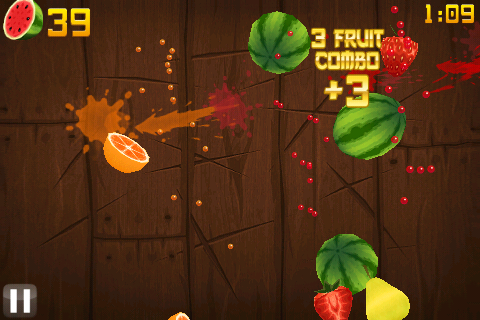
And well you should. I resisted the Fruit Ninja temptation at first, since it looked like a piece of one-note twitchware that does very little.
After I finally spent some time with it, I realized that is was a piece of one-note twitchware that does very little, but I didn’t care. I loved it anyway, and have logged a fair amount of time trying to my nudge my top score ever higher.
Fruit Ninja is based on the simple premise that “Ninjas hate fruit.” I don’t want to know why they hate fruit, and I sure hope the developer isn’t planning on spinning this into some revenge-driven storyline based upon the fruit-related deaths of ninja loved ones.
(On second thought, I would like to see that.)
Fruit is tossed in the air, and you use your finger to “slice” it before it drops offscreen. Avoid the bombs and strike multiple fruits for bonus points. You can do it timed, or not-timed, and you can change the color of your blade. Sometimes new fruit appears, and this is more exciting than I’d like to admit. The game is also a bottomless treasure trove of fruit lore and trivia.
This is one of the great dexterity games in the App store. It’s small, simple, and cheap. That’s the point of Apps: they can do one little thing, and because they’re inexpensive and portable, that’s all they need to do. It really is a new kind of gaming.
Monday, August 9, 2010
The King of Kong is King Again
As part of the weekend festivities, Mitchell regained the Donkey Kong crown from current champion Hank Chien, scoring 1,062,000. Mitchell also regained the Donkey Kong Jr. crown.
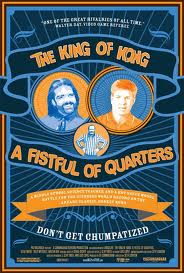
In the meantime, I thought I'd share what I wrote about The King of Kong when it first came out. It's an important example of why you shouldn't accept documentaries (or even news) at face value.
The King of Kong
The passionate core of any hobby—be it model trails, sci-fi, or coin-op gaming—is usually comprised of quirky misfits and fringe personalities. People who dedicate all their spare time and disposable income to a single pursuit are rarely the most well-adjusted, mainstream members of society, but they can be the most interesting. Ten years ago, director Roger Nygard’s film Trekkies showed us some of the oddball personalities forming the hard core of Star Trek fandom. Now, first-time feature director Seth Gordon’s The King of Kong does something similar for the classic or coin-op gaming community.
Gordon’s film is the latest in series of classic gaming documentaries, including High Score (chronicling Bill Carlton’s quest to break the Missile Command record) and Chasing Ghosts: Beyond the Arcade (which catches up with top score-holders featured in a seminal 1982 Life Magazine spread). King of Kong enters this world through one very specific rivalry for one coveted world record.
Top score in Donkey Kong is no easy feat. Shigeru Miyamoto’s first masterpiece can be ridiculously difficult to beat, thanks to its tricky timing and the high number of obstacles (barrels, fireballs, springs). The film casts Billy Mitchell as the record-holding goliath in the contest, depicting him as an arrogant jerk willing to do anything to hold onto his record. Mitchell is the top celebrity of the coin-op gaming circuit: a charismatic, mullet-haired entrepreneur who functions as the hobby’s unofficial mascot and spokesman. Though he held numerous records throughout the 80s and 90s, by the time the film was made all but Donkey Kong had fallen, leaving him as more of a figurehead. King of Kong depicts him as little more than a Machiavellian schemer who’s afraid to defend his own record in public.
Pitted against him is the quiet, likable family man Steve Wiebe, a talented obsessive-compulsive high-school science teacher who always seems to fumble just when he seems on the brink of success. Wiebe looks at the Donkey Kong record, says “I can beat that,” wheels a DK machine into his garage, and begins to work on creating a new World Record in Donkey Kong. After he succeeds, he sends the tape of his achievement to Twin Galaxies, the semi-official leaderboard and sanctioning agency for competitive gaming, and waits for his record to be acknowledged.
It’s not to be. As Gordon and his cameras document the process, we get an inside look at the strange personalities that orbit around Mitchell and the coin-op gaming scene. Twin Cities founder Walter Day, judge Robert Mruczek, Mitchell pals Brian Kuh and Steve Sanders, Doris Self (a 79-year-old grandma who has the top Qbert score), and Wiebe’s shady benefactor, a bizarre cartoon of a man named Roy “Mr. Awesome” Shildt, all figure into the story as Twin Cities rejects Wiebe’s high score, and insists he reproduce it in a live venue. At the moment of Steve’s victory, Doris Self delivers a dodgy videotape appearing to show a new record breaking high score by Mitchell.
There is no question that all of this makes for an entertaining film full of interesting characters with mixed motives, many of them appearing to conspire against a likable guy to keep him from getting his due. As a documentary, however, the film is troubling and fundamentally dishonest. Through clever editing and selective omissions, it paints Mitchell as a puffed up has-been who is afraid to play in public, a coward who avoids meeting his competitor, and an obnoxious braggart who uses his influence to steal the record back from an underdog.
In fact, Wiebe and Mitchell had already met and competed in public in 2004, before the events of the documentary: a point never mentioned in the film. More serious is the fact that Mitchell didn’t even hold the record Wiebe was competing against. Mitchell’s original score was broken by Tim Sczerby in 2001. Thus, the entire premise of King of Kong simply collapses, and it becomes clear that Seth Gordon merely wanted the colorful contrast of braggart Mitchell (and even his most obnoxious quotes are little more than the kind of macho smack talk gamers always use against each other, and far from the worst I’ve heard) and the nice-guy Wiebe.
King of Kong is the work of a new generation of documentarians influenced by the fundamentally dishonest work of Michael Moore, who edits his footage to distort the truth and create events that never happened. They seem to be less interested in the role of the documentary in conveying truth than in polemics and over-the-top reality-TV-style dramatics. King of Kong makes for good entertainment and offers an entertaining snapshot of the world of coin-op competition and fandom, but it’s also dishonest and manipulative.
Monday Puzzle: The Bicycle Thief
Today's puzzle is from Britain's greatest puzzle-maker, Henry Dudeney. I remember getting it wrong the first time I tried it, but it teaches a valuable lesson: don't be distracted by superfluous details.
 "Here is a little tangle that is perpetually cropping up in various guises. A cyclist bought a bicycle for £15 and gave in payment a cheque for £25. The seller went to a neighboring shopkeeper and got him to cash the cheque for him, and the cyclist, having received his £10 change, mounted the machine and disappeared. The cheque proved to be valueless, and the salesman was requested by his neighbor to refund the amount he had received. To do this, he was compelled to borrow the £25 from a friend, as the cyclist forgot to leave his address, and could not be found. Now, as the bicycle cost the salesman £11, how much money did he lose altogether?"
App O' The Mornin': SmartGo
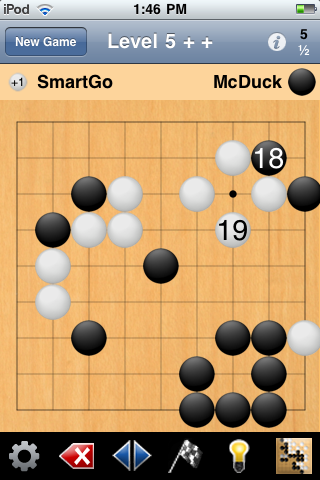 Chess masters are routinely defeat by computers, but this never happens with Go masters. There are 361 intersections on a Go board. Play can easily stretch for a couple hundred moves. (The longest game in history had over 400 moves.) Every move affects every subsequent move. Unlike Chess, Go has only a few rules governing stone placement. This results in a staggering number of potential board states, with each new move presenting ever more complex situations.
 Obviously, this makes Go a tough game to program, but that doesn’t keep people from trying. Go is heavily represented in the app store, mostly by inferior versions or simple mock-Go variants.
SmartGo, on the other hand, is an old and respected brand that has migrated through multiple platforms, and now arrives as an App in several different flavors. SmartGo 9x9 ($1) is exactly what it sounds like: Go on a 9x9 board for learners and kids. SmartGo ($3) offers a solid computer opponent and various boards ranging up to 19x19. It comes with a thorough tutorial and 100 problems, and will probably be the ideal point of entry for most gamers.
SmartGo Pro ($13) is the full package, complete with a library of 15,000 classic games accompanied by a powerful search tool, game recording and playback, 2,000 problems, multi-language support, and other features for serious users. A unique magnifying glass and crosshairs interface make it easy to place stones even on the full-size board. The entire package is very professional.
It’s remarkable that you can carry around this powerful a piece of software in your pocket. Avoid the other versions and spend a little extra money to get SmartGo. It’s worth it.
NOTE: SmartGo Kifu ($20) is a new version for the iPad. Although it is available, it is still considered a work in progress. Since I don't have an iPad, I haven't had a chance to check it out yet, but I hope to in the future.
Saturday, August 7, 2010
Weekend Puzzle
"Look!" says Miss Blue. "We all have on dresses that match our last name, but none of us is wearing a dress that matches her own name!"
"I want another drink," says the lady in black.
What color is each lady wearing?
[This is an old one, which was probably first devised by Martin Gardner.]
Friday, August 6, 2010
eCribbage: An Online Home for Cribbage Lovers
After you try eCribbage, you won’t want to bother with any other site. This is the real deal: slick, professional, and loaded to the gills with features.
 The programs and the site are the work of Damien Blond. This isn’t just any card-playing website. This is the work of someone who has focused on doing one game right. Even more impressive is Blond’s desire to create a real online community of card enthusiasts, where fans can find live opponents, communicate, and, compete.
 As of this writing, the site has almost 22,000 registered users, and it’s not at all unusual find a hundred people competing in several dozen games. Leaderboards, messaging, teams, and tournament tracks all come together to create a little corner of the internet that Cribbage fans can call home.
The game software itself is first-rate, with two levels of AI opponent in addition to the live players. Graphics are clean and functional, with a simple interface and plenty of information on each game. The software even rates your play by calculating a Cribbage rating, derived from the CXR system used in Chess.
The only quibble I have with eCribbage is the peculiar use of sound effects, which are jarring. Since I turn off the sound to play cards, this doesn’t bother me, but it’s one of the few awkward spots on an otherwise professional site.
eCribbage offers the traditional game (2, 3, and 4 hands), King’s Cribbage, CrossCrib, Crib With Jokers, Lowball Cribbage, Back Up 10 Cribbage, Crash Cribbage, and Cross 5 Cribbage, plus the opportunity to play with manual scoring, muggings rules, and team play.
Basic gameplay is free, but a $34 Pro subscription offers additional features, such as custom avatars, advanced stats, and the ability to form leagues. It also helps keep the site afloat, so if you find yourself putting in some time there, you might want to pitch a little something in the kitty.
Whether you’re looking for a quick game against a computer opponent, or trying to find a live player, eCribbage is the only place you need to go.
Nobs, Heels, and Muggins: Why Cribbage is King
Sometimes you learn a new game and discover just what you’ve been missing all these years. If I had an opportunity to sit down with a card player and teach him any game I could, that game would be Cribbage.
Until a couple of months ago, my sole point of reference for Cribbage was “that game that Maj. Winchester played on M*A*S*H.” Sure, I knew about the famous board-and-peg scoring mechanic, and even had a couple of boards lying around, but I never just sat down to learn the game.
Between the Cribbage King App and David Parlett’s Penguin Book of Card Games, I was able to teach myself fairly quickly. I began playing several hands on the App every day, and gradually got the hang of its unique elements.
Cribbage is part card game, part race game. The function of the board is to track points for each hand. The first person to make it to 121, wins. The game was invented in the early 17th Century by Sir John Suckling, who not only had a great name, but was also one the Cavalier poets (a group that included Ben Jonson and Robert Herrick).
The point system can be intimidating at first, since it seems to have a lot of fussy details. In fact, it’s governed by a few easy-to-remember rules. Each player is dealt 5 cards (or 6 or 7, depending upon which version you choose to play). They immediately discard 2 cards to the “crib,” which is a second hand that will be scored by the dealer. (The role of dealer alternates each turn, with low card beginning the deal.)
The play is simple: people take turns laying cards, one at a time, face up on the table. Each card has a standard point value, Aces low. Points are awarded based on a few simple criteria. Pairs, triples, and runs peg 1 point per card. If someone places a card that brings the face total to 15, they peg 2 points. If they are the last person able to play a card without going over 31, they peg a point. If they bring the total to 31, they peg 2 points. Card placement then begins again until both hands are exhausted.
When placement is done, players score their hands. They peg points for combinations adding up to 15, pairs, and runs. The dealer also gets to score the “crib” as an extra hand. Thus, when you control the crib, you discard good cards worth points. When the opponent controls the crib, you discard junk (or what you hope will be junk).
I’m leaving out some of the finer points, along with the colorful British terminology. There are points for “His Heels” and “His Nobs,” rules for swiping other people's points (called "muggins"), and other details that add color and depth. Check out the Pagat entry for the full rules.
Cribbage works on several levels, with interlocking strategies that are a delight to manipulate. As with any card game, you're subject to the luck of the draw, but you can bend that luck in ways other games don't allow. A bad draw doesn't have to correlate to a bad hand. The choice of which cards to unload to the crib (as dealer or non-dealer), what order to lay down cards, and which points to attempt all factor into the strategy.
There really is nothing quite like it in the realm of card play. Despite its layered scoring system (which allows cards to score points more than once) and its unique terminology, it’s a fairly easy game to learn and teach. It also plays like gangbusters. People familiar with the rules and scoring system can knock through a full scoring track in about 15 to 20 minutes.
 Don’t be put off if the rules seem a bit baroque. A little time spent with an App or web version of the game will get you up to speed quickly. You’ll soon start to see where points are made, and how to manage the crib to best thwart your opponent while rewarding yourself. Print out a simple cheat sheet of the scoring combos and keep it at hand as you learn. A good one can be found here.
Almost every discount store sells a cheap Cribbage board. Target and Walmart sell one by Cardinal that costs about $5, and stores the pegs in a cavity on the bottom. (It also comes with a deck of Cardinal cards, which are good for target practice.)
The eCribbage site is also an excellent way to play, and I plan to cover it in more depth.
It can be played by up to four people, but Cribbage is best as a two-handed game. Although it’s a quintessential English pub game, it doesn’t have a huge following in America.
Let’s try to remedy that.
Until a couple of months ago, my sole point of reference for Cribbage was “that game that Maj. Winchester played on M*A*S*H.” Sure, I knew about the famous board-and-peg scoring mechanic, and even had a couple of boards lying around, but I never just sat down to learn the game.
Between the Cribbage King App and David Parlett’s Penguin Book of Card Games, I was able to teach myself fairly quickly. I began playing several hands on the App every day, and gradually got the hang of its unique elements.
Cribbage is part card game, part race game. The function of the board is to track points for each hand. The first person to make it to 121, wins. The game was invented in the early 17th Century by Sir John Suckling, who not only had a great name, but was also one the Cavalier poets (a group that included Ben Jonson and Robert Herrick).
The point system can be intimidating at first, since it seems to have a lot of fussy details. In fact, it’s governed by a few easy-to-remember rules. Each player is dealt 5 cards (or 6 or 7, depending upon which version you choose to play). They immediately discard 2 cards to the “crib,” which is a second hand that will be scored by the dealer. (The role of dealer alternates each turn, with low card beginning the deal.)
The play is simple: people take turns laying cards, one at a time, face up on the table. Each card has a standard point value, Aces low. Points are awarded based on a few simple criteria. Pairs, triples, and runs peg 1 point per card. If someone places a card that brings the face total to 15, they peg 2 points. If they are the last person able to play a card without going over 31, they peg a point. If they bring the total to 31, they peg 2 points. Card placement then begins again until both hands are exhausted.
When placement is done, players score their hands. They peg points for combinations adding up to 15, pairs, and runs. The dealer also gets to score the “crib” as an extra hand. Thus, when you control the crib, you discard good cards worth points. When the opponent controls the crib, you discard junk (or what you hope will be junk).
I’m leaving out some of the finer points, along with the colorful British terminology. There are points for “His Heels” and “His Nobs,” rules for swiping other people's points (called "muggins"), and other details that add color and depth. Check out the Pagat entry for the full rules.
Cribbage works on several levels, with interlocking strategies that are a delight to manipulate. As with any card game, you're subject to the luck of the draw, but you can bend that luck in ways other games don't allow. A bad draw doesn't have to correlate to a bad hand. The choice of which cards to unload to the crib (as dealer or non-dealer), what order to lay down cards, and which points to attempt all factor into the strategy.
There really is nothing quite like it in the realm of card play. Despite its layered scoring system (which allows cards to score points more than once) and its unique terminology, it’s a fairly easy game to learn and teach. It also plays like gangbusters. People familiar with the rules and scoring system can knock through a full scoring track in about 15 to 20 minutes.

Almost every discount store sells a cheap Cribbage board. Target and Walmart sell one by Cardinal that costs about $5, and stores the pegs in a cavity on the bottom. (It also comes with a deck of Cardinal cards, which are good for target practice.)
The eCribbage site is also an excellent way to play, and I plan to cover it in more depth.
It can be played by up to four people, but Cribbage is best as a two-handed game. Although it’s a quintessential English pub game, it doesn’t have a huge following in America.
Let’s try to remedy that.
App O' the Mornin': Cribbage King

I’m going to post a longer item on Cribbage later today, so I wanted today’s App O’ the Mornin’ to focus on my favorite Cribbage App.
Lately, Cribbage King has been the App that gets the heaviest workout on my iPod Touch. I tried a couple of other Cribbage games, and just wasn’t satisfied. Cribbage Lite/Premium has an unappealing design and poor scoring system, Cribbage Deluxe is ugly, and the Cribbage included with Card Shark simply isn’t full-featured enough.
Cribbage King, however, offers a terrific little package, with the main game for free and the registered version for $1. It looks great, and has a very fluid and intuitive touch control scheme. It shows you when points are scored and then pegs them on the animated board. In between each hand, it shows precisely where each point comes from.
Features in the registered version include three different difficulty levels, with three players each; options for up to four hands; and different kinds of scoring. This last feature is quite neat, since it allows you to manually enter your scores. This might just seem like a needless bit of extra work, but it actually has a tactical role in Cribbage play. If you fail to score some of your points, your opponent can claim these points under the “Muggins” rule. Cribbage King incorporates this rule, and the AI will use it every chance it gets.
I do find it bizarre that more options and variants are not included. You have 6-card Cribbage, and that's it. I'd much rather play 5-card.
The Card Sharks compilation is a great App that should be on every card-lover’s smartphone, but there are some games that just require stand-alone versions. Cribbage is one of them, and Cribbage King is the stand-along version of choice.
Thursday, August 5, 2010
Games Magazine for October 2010

There's a feature about the 2010 U.S. Memory Championship, a classic puzzle from the late, great Martin Gardner, and the usual selection of reviews, features, news, and puzzles. I contributed a story about the mysterious success of Zynga and their awful games (Farmville, Mafia, etc), and added an extra page of electronic game reviews this month.
Buy it wherever better magazines are sold.
Gen Con Begins

Gen Con has even produced an App, Gen Con Mobile, with maps, event schedules, and Twitter/Facebook support.
Follow details about this year's show on their site, Twitter, or Facebook.
App O' the Mornin': Zombie Dice

Yesterday, I posted a little outburst about Munchkin games and their transcendent awfulness. Zombie Dice is what prompted that outburst.
Munchkin had long been a sore point, since it really is just about everything that could be wrong with a card game compressed into one over-priced, under-produced waste of shelf space.
But spending time with the Zombie Dice app is what finally made me lose hope that Steve Jackson Games was capable of making a good product.
The Zombie Dice app isn’t really meant to be it’s own game. (At least, I hope not.) Instead, it’s more like an interactive demo for the actual, tabletop dice game, complete with an in-game ad telling you where to buy your very own set.
This is where SJG has made their fatal error. The success of their titles depends upon people thinking they look good in the package and sound like they might be entertaining. They don’t depend upon actual time spent with their gameplay, which only reveals their shortcomings.
Zombie Dice is what Yahtzee would be like if Yahtzee was much dumber and trying desperately to cash in on the zombie fad. (Or the Cthulhu fad, since there’s also Cthulhu Dice.) Basically, you’re a zombie who’s rolling dice to try to determine if he gets to eat some brains. The dice are red, yellow, or green, and have pictures representing SHOTGUN, FEET, and BRAINS. If you roll brains, you get a snack and 1 point. If you roll feet, your victim runs away. If you roll shotgun, you get blasted. If you get three shotguns, your turn is over and you lose the brain points you’ve already accumulated.
The idea is that you have to decide how far to press your luck by choosing when to stop rolling. And … well, that’s pretty much it. If you’re smart enough to stop rolling when you have 2 shotguns, then you’ll probably never get blasted. That’s really not a lot to hang an entire game line on, is it?
And, no, I’m no leaving out some vital part of the gameplay. That’s really all there is to it.
I cannot tell you how glad I am that I downloaded this App. Based on my disappointing encounters with everything else from Steve Jackson Games, I was beginning to wonder if they were capable of making a good game. Now, I no longer wonder.
UPDATE: After I posted this, I received some good comments about Revolution by SJG, so there is hope!
Play in Public
It's pretty easy to get local bookstores and coffee shops to sponsor open game nights, which has two benefits: 1) more people can learn about games, thus creating 2) more people to play with. So, as the nice man at the bar always tells me, "Take it outside."
Check out the website or the Facebook page for more information.
Wednesday, August 4, 2010
Mammas, Don’t Let Your Babies Grow up to Play Munchkin

Every parent should have a few bare-minimum goals: keep your kids off drugs, make sure they get a good education, and don’t let them play Munchkin games. I’ve already failed at the last of these, so I’m paying extra special attention to the other two.
I have yet to play anything from Steve Jackson Games that I thought was any good. The titles that clog the shelves—Munchkin, Chez Whatever, and those crummy dice games—are simply bad design, period.
The worst of these, by far, is the Munchkin series. I’d rather be strapped down for a 24-hour session of Sorry than sit through another session of Munchkin Bites.
The premise is faintly amusing. In RPG (role-playing game) slang, a “munchkin” is a player who just cares about combat and loot. Munchkin turns that approach into a card game, in which you begin as a Level 1 character with a goal of getting to Level 10. Each turn, you “kick in the door” to generate encounters, and then fight any creatures you encounter. Any items you’ve collected add points to your base level, so that a Level 1 character could fight at Level 12. If you encounter a monster, you compare this number against its number, and either you win, lose, or run away.
That’s it. That’s all you do. Over and over again, game without end, Amen.
The Mysterious Success of Munchkin
As far as I can tell, Munchkin has one thing going for it that makes it fly off the shelves: the art of John Kovalic. The cards and Kovalic’s cartoons are genuinely funny, and always worth a laugh for game fans, particularly those who recognize the clichés and pop culture references being skewered.
Readers who like this kind of humor can save themselves the irritation of bad gameplay and just check out Dork Tower. It’s cheaper, better, and doesn’t involve absurd level mechanics.
Look, any criticism I level at Munchkin will be dismissed by fans as “not getting it.” I can hear lonely Munchkin fans saying, “The gameplay itself is supposed to be a satire of gameplay conventions!”
No. Just … no. Satire is satire, and gameplay is gameplay. Gameplay mechanics are not a satirical medium.
Strip away the humor and you have a truly awful game. The gameplay is nothing but grinding monotony: turn over door card, add up attack value, compare it to monster, and either a) win, b) run away, or c) fail to run away and die. Die and everyone splits your stuff and you have to start over again. It’s maddening.
Fans of the series appreciate this madcap approach to gameplay, perhaps seeing it as more of a social lubricant than as an example of fine gamecraft.
For $25, I'd rather just buy a couple of cases of social lubricant and a pack of playing cards.

It Keeps Going, And Going, And Going…
I assumed Munchkin would vanish long ago, or simply find itself relegated to a small niche of dedicated gamers. Instead, it actually seems to be growing like some hideous fungoid mass, spinning off new editions and taking over shelf space that could be used by better games.
When Barnes & Noble and Borders started expanding their game offerings, I was pleased. It’s great to have a major retailer get behind Euro-titles and adult boardgaming. These are an ideal place for adult games to reach a mainstream audience.
But when you look at the displays, you see a whole section of Munchkin games, each selling for $25. That $25 is the key, since many of the good games cost $40 to $50. Combined with appealing art and packaging, as well as fun themes, that price point helps sell Munchkin to people who might have otherwise bought something that would spark a love of good gaming.
Instead, they get home and find … a box of cards, a die, and a rule sheet. The game is unplayable without counters or character sheets, so why doesn’t SJG games provide these? You have to go to their website and print them yourself. Is it that big an expense to add some character sheets and a few chits? This isn’t an inexpensive title from James Ernest. This is a $25 purchase!
Consumers opening a new game only to find a $25 box of cards are not going to be consumers who think fondly of other new and untried games. This makes Munchkin a kind of anti-game, actually driving people away from the genre.
I know Steve Jackson’s name has a certain resonance among old-timey gamers, but Car Wars and GURPS were a long time ago. Lately, Steve Jackson Games seems mostly committed to churning out endless editions of inferior product.
UPDATE: After I posted this, I received some good comments about Revolution by SJG, so there is hope!
Sometimes words aren't needed

App O' The Mornin': Clue
Various Monopoly incarnations are essentially the same core gameplay with new proporties and actions cards. Clue, however, has provided some nice variations on the basic theme. Clue Mysteries, Clue Suspects, Clue: The Great Museum Caper, Clue DVD Game and even the much maligned Clue: Secrets and Spies all have their strong points. Heck, even some of the themed clues, such as Harry Potter and even Seinfeld (seriously) are not a total wash.
Never one to leave well enough alone, Electronic Arts has decided to reinvent Clue yet again for the the App market. They seem to have designed their Clue app to be as unappealing as possible to fans of the game. There is no traditional board layout, the classic visuals have been updated to make the characters and locations look more contemporary, and the entire pace and structure of the original game has been dropped.
In its place EA offers something very different, but with its own charms.
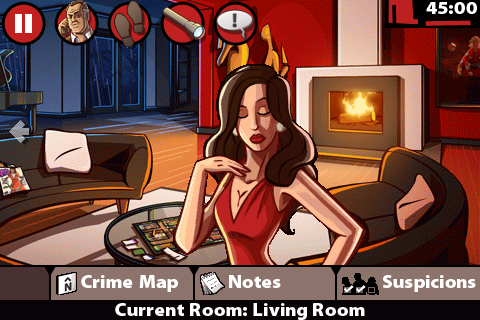
Rather than turning the classic whodunit game straight into an app, EA has instead hung a kind of interactive mystery on the bones of the original. Instead of moving around a board or competing against other detectives, you move from room to room asking questions from a menu of dialog options and searching for clues.
Never one to leave well enough alone, Electronic Arts has decided to reinvent Clue yet again for the the App market. They seem to have designed their Clue app to be as unappealing as possible to fans of the game. There is no traditional board layout, the classic visuals have been updated to make the characters and locations look more contemporary, and the entire pace and structure of the original game has been dropped.
In its place EA offers something very different, but with its own charms.
Rather than turning the classic whodunit game straight into an app, EA has instead hung a kind of interactive mystery on the bones of the original. Instead of moving around a board or competing against other detectives, you move from room to room asking questions from a menu of dialog options and searching for clues.
As an ace reporter on a deadline, you can perform only a certain number of actions before your time runs out, and you need to call your editor with the suspect, location, and weapon used to kill Mr. Boddy. You’re able to use a map of the game to place suspects and weapons where they were located when the crime occured, and then cross potential suspects off your list before you make your final accusation.
The touch controls are a bit fussy, with a little too much screen flipping and awkward input locations. There's also a timing element, which limits the number of moves you can make before you have to solve the mystery. This timing element seems to mimic the "clock" cards that are being added to some clue variants in order to make the game more suspenseful. Actually, they only make the game feel rushed and somewhat random.
Needless to say, the contemporary setting is nowhere near as appealing as the old English country house mystery captured so effectively by the original. Hasbro has so little clue about what people like in this game that they even created an updated edition, called Clue: Discover the Secret, that dispensed with the classic setting in favor of a cast of washed-up child stars, videogame designers, and football players. Note to Hasbro: People like cozy English mysteries. They don't like dated pop-culture pandering.
Those reservations aside, this is a still a fun little interactive mystery. There are ten cases in all, and each has random elements and a scoring system to encourage repeat play. This isn’t Clue, but it has its own appeal.
Those reservations aside, this is a still a fun little interactive mystery. There are ten cases in all, and each has random elements and a scoring system to encourage repeat play. This isn’t Clue, but it has its own appeal.
Tuesday, August 3, 2010
App O’ the Morning: Yahtzee Adventures

That’s odd, because I never play Yahtzee. In preparing for this review, I sat down with my Yahtzee Elvis: Shake, Rattle and Roll Edition and tried to work up some enthusiasm.
It’s poker! With Dice! And scoring! And chips for … actually, I have no idea what the point of the chips is, but they make a nice rattly sound in the plastic cup of the travel edition.
Annnnd ... I just couldn't continue. The specter of vast amounts of dice-rolling stretched out before me, and I quailed at the prospect. I put the pieces away and set the game on the shelf next to my copy of Monopoly Elvis Collector’s Edition, then went back to separating my drier lint by color, which seemed far more interesting.
But for some reason, I keep coming back to the app, which is called Yahtzee Adventures.
Don’t be fooled by the “Adventures” part, which is a just a hopeless attempt to make it sound like this isn’t a game about rolling dice over and over again. It fails for the simple reason that this is a game about rolling dice over and over again.
The Yahtzee Adventure puts you in the role (hah, get it? get it?! … ehhhh, never mind) of Grasshopper to some guy's Sensei, and frankly I could not care less. The idea is that you have to “battle” against a series of opponents across the world to unlock secret dice and become some kind of Yahtzee Bruce Lee in a dice-driven Game of Death. Every character is hideously annoying and someone desperately needs to poke Sensei in the eye with a chopstick. The whole regrettable thing can be finished in about an hour. Plus: you never get to use the special dice, which makes you wonder what the point was. Let us never speak of it again.
Moving on from the Adventure part, however, brings us to plain old Yahtzee, and that was really all they needed to do in the first place. You can burn through a game of Yahtzee in about ten minutes flat, either by click-rolling or shaking the iPhone to roll. Scoring and rolling are all done on a single screen, and it all looks good and controls smoothly.
I have no idea why, but I found this so much more entertaining that I ever found real Yahtzee. Maybe it was the speed, which appeals to my ADD, or maybe it was just the ability to do it while waiting at the DMV. It doesn’t take much thought or effort, but has the right combination of chance with a tiniest bit of skill to keep it interesting.
The game includes a few interesting variants to keep things fresh. The “Rainbow” game uses colored dice, with the ability to score an extra set based on rolling all of one color. The “Battle” game splits the two halves of the scorecard into “attack” and “heal.” Roll an “attack,” and you drain points from an enemy. Roll a “heal,” and you restore you own points. The goal is to get the enemy down to zero points.
The App has its share of little annoyances, such as asking me if I want sound every time I start it, and then completely ignoring the fact that I selected “no.”
Look, I don’t even like Yahtzee, and I liked this App, so that should be a fair indication that Apps function under somewhat different rules than their tabletop versions.
Monday, August 2, 2010
Definitions: Apps
Most readers probably don’t need to be told that “Apps” is short for “applications,” and is most closely associated with software running on Apple’s smartphones and similar portable devices.
Yes, people talk about “Apps” for Android and other mobile platforms, but as far as this site is concerned, if you can’t buy it on iTunes, it isn't an App: it’s an unfortunate byproduct of a poor consumer choice.
I am a hardcore PC loyalist, but I no longer fear the Fruit. I made the mistake of doubting the power of Apple in the early days of the iPod. I would not become a consumer of Apples. I would be different, and buy a portable MP3 player made by … Rio.
Within a year of that purchase, the unit was lying in pieces on my work table, as I tried to dissect its manifest failings and get it functional again. I finally gave up, bought the first of several iPods, and have been happy ever since.
Apple owns this market. Period. Everything else (Android, Windows Phone, etc) is the electronic equivalent of a triceratops glancing into the sky to see the comet streaking to earth. They are doomed: they just don’t realize it yet.
Apps As a New Genre
It took Apple to finally make mobile gaming into a legitimate genre. For years, my Editor-in-Chief at Games Magazine had urged me to cover mobile games, but I resisted. They were still in a formative period, and remained scaled down versions of full-size games. They hadn’t made a convincing claim to becoming a unique format, until Apple created the OS, platform, tools, and marketplace that would unleash the creative power of thousands of developers, thus creating something new.
To become its own genre, something must have a unique language, a core vocabulary that it shares with every other item in that genre. There are distinct qualities to PC, Wii, DS, and Xbox/PS games, primarily based upon control, ergonomics, and aesthetics. Apple mobile software can make a similar claim, due to its unique blend of portability, size, multi-touch controls, and a 3-axis accelerometer (enhanced by a gyroscopic sensor for the iPhone 4).
Developers are using these tools to create remarkable portable gaming experiences. Some of these games are familiar things that have been given a new means of interaction, such as Solitaire, Chess, Scrabble, or Catan. But some of them are fresh ideas entirely, such as Doodle Jump or Jelly Car.
Certain games are Wii games and can only ever effectively be Wii games. And certain games are Apps, and can only ever effectively be Apps.
This is the reason I finally started covering Apps for my magazines, and why for the first time Games Magazine is awarding an “App of the Year” in the annual Games 100 awards issue.
App O' the Mornin': Plants vs. Zombies

That’s bad news for the zombies, since your front yard is planted with the most undead-butt-kicking set of flora ever to take root in a suburban lawn.
The premise is simple: zombies are in the street, and they want to get into your house to eat your brains. Between them and you is a nice stretch of green lawn. On some levels it’s split in half by a water feature, and later in the game the zombies will try to get in through the roof.
To stop the zombies, you place defensive lines of plants. Both the types of plants and kinds of zombies multiply with each level. From a single “pea shooter,” you’ll eventually accumulate a dazzling array of ferocious flora: double and triple pea-shooters, frozen-pea-shooters, watermelon catapults, flaming logs, hopping squash, man-eating plants, gas-spewing fungus, and more.
The zombies aren’t remaining idle while you’re gathering this arsenal. They’re calling on reinforcements: zombies with pails on their heads or football uniforms (for armor), pole-vaulting zombies, zombie dolphins (for the water feature), Michael Jackson zombies with backup dancers, zombie zambonis, zombie bobsled teams, and more.
The puzzle is in figuring out the best combination and pattern of plants to stop the invaders before they get to you. A healthy selection of levels and myriad minigames keep the action going for a good long time.
Clever, challenging, and insanely addictive, Plants vs. Zombies has made a terrific leap from PC to App, losing none of its signature gameplay. You still have to place a variety of lethal plants to halt a zombie attack upon your peaceful suburban home, but this time you use simple touch commands instead of the mouse. It’s a remarkably effective port, with sharp visuals and no loss of scope or control from the radical shrinkage to iPhone size. Everything in the original is here, and portable!
Plants vs. Zombies is pure madness, in the best possible way. It’s funny, clever, and entertaining. Without any hint of shame, I can say that the original was the most fun I’d had playing a game in months, and the App version doesn’t lose a bit of the magic.
UPDATE: Welcome PvZ Facebook fans! This is a new blog which will cover all aspects of gaming, from beginner to advanced, electronic to conventional, high-tech to no-tech. Stick around, read some of the introductory posts, check out our ongoing App coverage, and follow us on Facebook or Twitter!
Subscribe to:
Posts (Atom)