Thursday, May 19, 2011

Ticket to Ride and Bohnanza Are Now Apps

The headline pretty well says it all.  Ticket to Ride is iPad only. Here's a 5 minute video walk through from Days of Wonder.


Bohnanza, a port of the classic bean-planting card game, is available in regular and HD flavors. I've spent some time with the Bohnanza app and it plays fairly well, albeit a bit slowly.

Both of these are classic Eurogames, now available in handy portal formats for a fraction of their original price. With Tikal released last month and Puerto Rico on the way, the Spring is shaping up to be a very good season for mobile Eurogames.

Review: Stacking (XBLA/PS3)

A game set at the turn of the century dealing with child abduction, labor strife, and poverty, all done in a whimsical silent-movie style and featuring a cast of matryoshka (nesting) dolls with diverse powers? Yeah, Tim Shafer and Double Fine Productions are back.

Stacking is a small, Xbox/PSN Arcade game developed simultaneously with Double Fine’s more high-profile Brutal Legend, and is altogether more entertaining and imaginative than its big-budget cousin.

Stacking concerns the adventures of Charlie Blackmore, the smallest member of a family of nesting dolls. When his siblings are kidnapped and forced into indentured servitude, Charlie is left behind due to his small size. This, however, becomes one of his greatest assets, because Charlie is able to “nest” in any doll that is one size larger than him.

Each kind of doll has a unique power. Some of these are useless, such as playing tag or going to the bathroom. But some are essential for solving puzzles, and therein lay the key to the gameplay. If you need to lure a doorman away from his door, you can use the female doll that screams (he’ll rush to her aid) or the female doll that “seduces” (he’ll fall in love and abandon his post for a few seconds). Many locations include multiple solutions, so you might find yourself clearing a room by (ahem) passing gas into a ventilator, or by infiltrating the room as a mechanic, or by sneaking past the guard.

The variety of dolls and powers along with the detailed environments mean the game is rich in content. You can simply go about collecting new dolls and trying out their powers. You can search out sets of matching dolls in order to learn their stories. Or you can just follow the adventure where it leads by talking to characters and using various doll abilities to solve puzzles.

This is an immensely clever and appealing game. There is a bit of potty humor (belching, flatulence, bathroom visits, etc), but nothing too offensive. The odd and disappointing part is the length. For a game that is jammed with detail and loaded with potential, the adventure itself plays out rather quickly. A sequel—The Lost Hobo King—is already out, but it’s even shorter. I guess there are worse things to say about a game than “I wish it went on longer.”

Site Update

Sorry for the light blogging lately, but a combination of work, vacation, volunteer obligations, the beginning of grad school, minimal gaming time, and the complete meltdown of Blogger conspired to keep me away from the game table and the blog.

Also: I'm lazy.

While I find some balance among work, school, home, and sanity, blogging may be light, but there will still be new content each week. I have a lot of items I've been wanting to review, and I hope to start getting some of those posted next week.

And just so reading this post wasn't a total waste, here's a sculpture made of Scrabble tiles.
The sculpture and the photo are by David Mach (the link is NSFW).

The Rivals For Catan: The Card Editor

I haven't had a chance to play The Rivals for Catan, but I just noticed that Mayfair has a custom card creator for the game. Here's how they describe it:
Here you have the possibility to create your very own playing card within minutes. The “Harald” card serves as a template. Just insert a picture, choose a name, and create a short text for your very own hero card. After that, all you have to do is save your work as a JPG or PDF file, print it, and glue it to the original “Harald” card.

Saturday, May 14, 2011

Repostings

Blogger kept saying they were going to restore the posts they wiped out, but that never happened. Instead, I've reconstructed them from the RSS feed. It's not that the content was so deathless and essential that I felt it needed to be preserved forever, but it's irritating to do something and have it deleted.

Games Magazine: Online Contest (Xiangqi/Chinese Chess)


Wayne Schmittberger, my boss at Games Magazine, designed a new online contest based on Chinese Chess (Xiangqi). I haven't tried it yet, but it looks fairly brutal.

The goal is to use the opening setup shown above, and then "determine the number of different positions that can occur after the first player’s (Red’s) second move in a game of xiangqi, if both of Red’s moves are made with cannons. That is, after Red moves a cannon, Black replies with any legal move by any piece, and Red moves a cannon again (either the same cannon as before or the other one), how many different positions can appear on the board?"

Check out the site for the full instructions and details on how to enter the contest. The prizes are a year's subscription to Games Magazine. Deadline is July 1st.

NOTE: This is a republication of a post lost by the Blogger software. Originally posted 5/12/2011.

Home Sheep Home: A Shaun the Sheep Game


Home Sheep Home is a remarkably popular free Java game featured on the Shaun the Sheep home page. It's a simple but immensely appealing puzzle game with a gentle watercolor/ink art style and clever challenges. The goal is to get Shaun, Shirley, and Timmy back to the barn by solving various obstacle-based puzzles. It's not particularly hard, but it's fun nonetheless.

Now, Home Sheep Home has made the leap to the App Store. It's the same as the flash game, but for $1 you can take it along with you on all your plasticine-animated adventures.

NOTE: This is a republication of a post lost by the Blogger software. Originally posted 5/12/2011.

Tetris Gets a Movie

Directed by Michael Bay, starring Johnny Depp as "Four-Block-L-Shaped-Piece," and with special effects by WETA Workshop!

Okay, so I made that up. But there is a Tetris movie, and it's called Ecstasy of Order: The Tetris Masters. In the tradition of The King of Kong, Darkon, The Dungeon Masters, and Word Wars, this is a documentary about a particular gamer subculture, and no doubt will feature the usual obsessives and Aspergians wrapping their entire lives around something most us only find passingly entertaining.


Ecstasy of Order: The Tetris Masters Full Trailer from Adam Cornelius on Vimeo.


NOTE: This is a republication of a post lost by the Blogger software. Originally posted 5/12/2011.

WIM Sona Pertlova Passes Away

Susan Polgar is reporting that Woman International Master Sona Perlova died last Sunday at the age of 23. She was diagnosed with cancer during the 2008 Chess Olympiad.

Viktor Novotny writes:
Sona decided to fight the disease, under the influence of strong medication she played the Dresden Olympiad and undertook the chemotherapy right after it. After a year of intensive medical care she seemed to be fit again and she made the best individual result of the Czech players on the European Team Championship achieving a WGM norm. But the cancer came back. In the September of 2010 she became paralyzed during the tournament in Rijeka and the prediction of the doctors didn’t give much hope.

Our prayers are with Sona and her family.

NOTE: This is a republication of a post lost by the Blogger software. Originally posted 5/12/2011.

Friday, May 13, 2011

Blogger Problems

Blogger had some sort of meltdown and wiped my last couple days worth of posts. They're making noise about restoring them, but so far, nothing. I'm not going to post much until they straighten this out. If my posts don't return by tomorrow, I'll try to reconstruct the lost items.

Wednesday, May 11, 2011

Scrabble Gets Dumber, Sort Of

Last year around this time, Mattel announced that Scrabble would now "allow" proper nouns in play. (Mattel owns the rights to Scrabble outside of the US, while Hasbro owns the US rights.) This was the outrageous outrage du-jour among the gaming community in general and Scrabble cognoscenti in particular.

Except that Mattel didn't do anything of the sort. They were merely creating a branded spin-off called Scrabble Trickster, and misleading the press just a bit in order to gin up controversy and thus get some free publicity.

It worked like a charm (searches for the phase "Scrabble proper nouns" yield thousands of links), so they decided to do it again.

The latest news is that stupid non-words like "grrl","innit", and "thang" are being added as "official" Scrabble words. Wellllll ... yes and no.

The Collins Official Scrabble Word Book, in a desperate attempt to get themselves permanently dropped as a resource for tournament play, is indeed publishing a new edition with 3,000 additional words, some of them quite stupid. "Innit" is a kind slang contraction, which would exclude it from play. "Grrl" is just an abbreviation that's not abbreviated. No word yet on whether "pwned" is included, but I wouldn't be a bit surprised.

The World Scrabble Championships uses the SOWPODS list as its official word source. SOWPODS is a combination of the US/Canadian Official Scrabble Players Dictionary (the OSPD) and the UK Chambers Official Scrabble Words (the OWL). In 2005, Mattel changed their preferred (non-US) dictionary to the Collins Official Scrabble Word Book, but as far as I can tell, SOWPODS remains on the OSPD/OWL standard. If I'm wrong about that, please correct me and I'll update this post.

The US, Canada, and Thailand still use The Official Tournament and Club Word List (TWL), a modfication of the OSPD for tournament play, so these changes affect US play not at all. One the other hand, WESPA, the World English Scrabble Players Association, appears to be getting ready to use the new Collins list for international play.

All this does is create maximum confusion for international play and further discredit the use of Collins as any kind of international standard. The US player associations were correct to maintain conservative standards for acceptable words, thus avoiding the desperate trend-chasing and regionalisms of the international Scrabble community.

None of this matters one jot, however, in standard play. If someone slams down "grrl" during a home game, you're quite free to shake your head in sad disappointment and refer to the OSPD or TWL. This is exactly why my ancestors fought the Revolutionary War: so I didn't have to suffer stupid British word standards during Scrabble play. Up the Colonies!

Sid Meier Wants to Friend You

CNN has a long story about Sid Meier's upcoming Civilization game for Facebook. The social gaming version of Civ, dubbed Civilization World (or CivWorld), has been rumored at least since 2009, and Meier posted a more detailed note about it last January. The game went into closed alpha-testing shortly thereafter, and remains in that state today. Sid had this to say about the game:
I’m having a really fun time hands-on designing and programming Civ World along with our terrific team at Firaxis. In the coming months, we'll be posting a series of gameplay updates here on the fan page detailing parts of the game. Today I’d like to talk a little bit about the organization of the game to tide you over until that time comes. 
Civ World games will have a well-defined beginning and end, each ending with a triumphant civilization and one person recognized as that game’s most prestigious player. Along the way, as you progress through the different eras of time, you'll have the chance to win era victories as well. We want players to have both a final goal to work towards, as well as short-term objectives to achieve as they play. The trophies you unlock with your triumphs will carry over from game to game, and you can show them off in your throne room.
A social game with a beginning and an end? As if. Social games need to go on and on and on forever, preferably while selling people imaginary coins and annoying as many friends as possible. This Sid Meier guy doesn't know a thing about how to design quality games, like FarmVille.

Epic Gaming Con

Epic Gaming Con is a new gaming convention being held this year in Las Vegas (June 16 – 19 at the Paris Hotel and Casino) and Philadelphia (September 29 – October 2 at the Pennsylvania Convention Center). This is a free-to-attend gathering of board and trading card gamers.

The con is being organized by Cryptozoic Entertainment, which is currently working on a board game based  based upon the Lookout comic from Penny Arcade. It looks like the Cryptids have been inspired by the Penny Arcade gang to create an analog equivalent to the PAX gaming show, which is currently the biggest electronic gaming con in the country.

Is there room for another Gen-Con/Origins-style show on the roster? As long as they reach parts of the country that rarely get board/card-gaming cons, I'd say yes. I never get to either Gen Con or Origins because they're too far away. Since is Philly is just down the road from me, I may actually get to go.

Tuesday, May 10, 2011

Chesterton On Games

I'm an avid Chestertonian, so I loved this shirt from Eternal Revolution, the makers of Uncle Chestnut's Table Gype. Make sure you look around their shop while you're there, and learn a bit about Distributism while you're at it.

UPDATE: Brett J. Gilbert shot me a Twitter message with a link to the entire essay from which this quote is taken. People, if you love language, if you love a man with a cheerful hunger for life, if you simply love good humor, then you need to read more G.K. Chesterton. He is the great author that your teachers kept you from all those years because of his dangerous ideas. You become a better person for having read him.

The Angry Birds Theme by Pomplamoose


And if you need to know more about Pomplamoose, go here.

Wednesday, May 4, 2011

Eyeball Benders--Vacation Edition ANSWERS

Wow. I knew I made these hard, but I thought some Orlando visitors would have recognized some of them. No luck: no one figured out any of the answers, so here's each original Eyeball Bender with the larger picture from which it comes.

1. Hogwarts Castle: Wizarding World of Harry Potter (Universal)


2. St. George & the Dragon: Germany Pavilion, Epcot


3. The Lorax: Universal Islands of Adventure


4. Daisey Duck: Disney World


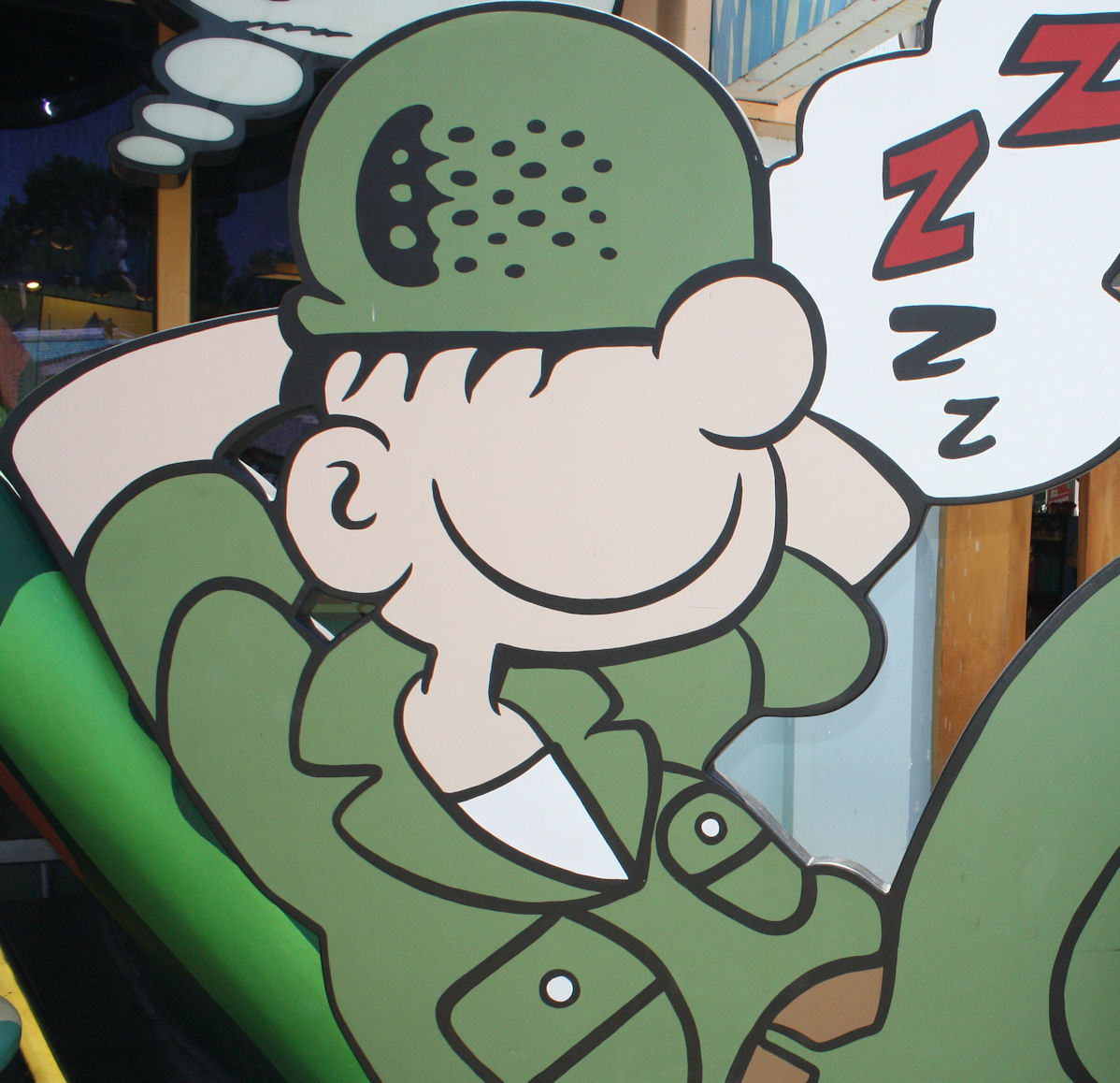
5. Beetle Bailey: Universal Islands of Adventure


6. Butterbeer Cart: Wizarding World of Harry Potter (Universal)


7. Magic Brooms: Disney Hollywood Studios


A Closer Look: French Tarot: Trumps 13 & 14

Many people are familiar with the standard Tarot suits (the "Major Arcana") used for "divination" purposes, but they're less aware that Tarot cards were created for playing trick-taking games and have a rich and diverse design history. These images are part of an ongoing series highlighting the art of a single deck used in France, which contains scenes of rural and domestic life in the 19th century.


Click to enlarge.

Tarot Trump No. 13 Detail
Click to enlarge
Tarot Trump No. 14 Detail

Z-Man Updates

The new Z-Man newsletter is online in PDF, and it has details on 3 upcoming games: the tile-laying game Mondo, an area-control game called Palenque, and the Discworld-inspired Guards! Guards! I've been really enjoying the Z-Man stuff I've seen lately, and I'm particularly eager to get my hands on Troyes. Check out the newsletter for more details.

Tuesday, May 3, 2011

Updates on The Road to Canterbury

Game designer Alf Seegert sent me a couple of links about the progress of his upcoming game, The Road to Canterbury (Gryphon Games), which I previewed last month.

First up is a long and interesting designer diary written by Alf in in which he explains the origin and evolution of his concept and the way he turned his love for the writing of Geoffrey Chaucer into a game.

The game also now has a Kickstarter Campaign, which is an intriguing new trend to fund and support projects during their development. If the game reaches the $10,000 threshold for support and pre-sales, then publication is guaranteed. As of this writing, they're already past the $7,000 mark with 42 days to go. A $45 "investment" gets you free copy of the game. (It functions like a pre-order.) Higher donations come with nifty bonuses. Check out the Kickstarter site for more details.

Alf and I have exchanged a few emails as we discussed his concerns that people with religious sensibilities might be offended by the game. (I'm a Catholic catechist and lecturer, and I begin work on my Masters in Theology this summer.) The game focuses on Chaucer's character of the Pardoner, a corrupt churchman who sold indulgences and preyed on people's sins. The game places each player in the role of the Pardoner, attempting to get people to commit sins and then profiting from them. These are deadly sins, however, so push too far, and a player could simply die.

Chaucer is one of my great passions, as is medieval Catholicism. The game is true to its period and sources, and if it seems to play lightly with the serious matter of sin and clerical corruption, it also shows the deadly effects of both. In a society that tends to dismiss the very notion of sin, that's a valuable thing. Chaucer himself remained a pious Catholic until his death, and at the end of his life made an "apology" disavowing and repenting for his more bawdy works. (Though this, too, may have been his idea of a joke. Sometimes it's hard to tell with Chaucer.) His satirical work was meant to be medicinal, much like In Praise of Folly by Erasmus. (Erasmus was shocked to learn that his biting satire on Church corruption was thoroughly enjoyed by its main target, Pope Leo X: the man who turned the selling of pardons into an art form.)

I'm looking forward to Road to Canterbury. I think it looks fun and I like the subject matter, but I also think it may be a useful teaching tool.

Monday, May 2, 2011

The Oregon Trail: A Live-Action Educational Game


Introduction
This post is an explanation of an outdoor game I created for a Cub Scout event. It could just as easily be adapted for any age or educational situation, or even just for fun. I'll explain the game in some detail, and then attach some PDFs with all the game cards and signs.

Background
Every year, my wife organizes and leads the annual Cub-o-ree for the Burlington County Council of the Boy Scouts of America. It takes place in the New Jersey Pine Barrens, and is a full day of activities followed by a campfire and an overnight. This is often a Cub Scout's first time camping, and many young Scouts get their first real taste of scouting from the experience.

It's also a ton of work to pull off. Each year, it's planned on a single theme, and run over two weekends so many scouts have an opportunity to attend. This weekend we had about 150 scouts, plus their parents. All of them had to be organized, fed, and directed throughout ten activity periods, plus campfires, skits, and all the other accouterments of scouting. It's a great time, and as I watch my wife pull it off year after year, I'm simply amazed. I couldn't do it for love or money.

I usually get recruited to run one of the "stations" (a 30 minute activity), and sometimes to create them. The stations are based around a single theme. Last year, it was "CSI" (Cub Scout Investigators), and my vegetable DNA extraction was a big hit.

The theme this year was "Pine Tree Pioneers," on a pioneering theme. In addition to making a PVC wagon-building activity, I created a live-action game based on The Oregon Trail. The activities are supposed to mix a bit of education with fun, hands-on interactions, and some physical exercise in order to keep the cubs moving and make them tired. (That last part doesn't work. They never get tired. Ever. By afternoon, their energy level remains positively horrifying.)

Hiking the Oregon Trail
Our scout camp has a trail leading from an outdoor chapel area, down to a lake. The whole trip is about half a mile, and it makes for a nice, shady, semi-scenic hike with a good finish.

I decided to make this trail a full-size game board by creating 6 stops spaced at one-minute intervals. The first stop (in our case, a gathering space with benches) has a sign identifying it as "Independence, Missouri" and "The Oregon Trail." I begin with some facts about pioneer life in general and the Oregon Trail in particular, and then explain that we are going to split into wagon trains and pretend to travel the distance from Independence to Oregon City (the final stop).

In between the start and finish are 4 stops, each marked by a sign identifying it as a real location on the trail: Topeka, Kanasas (the Papan Ferry area); Ft. Laramie, Wyoming; Soda Springs, Idaho; and Ft. Boisie, Idaho. In order to give them an idea of the distances traveled, each sign told the cubs how "far" they have walked the Oregon Trail since their last stop (say, 400 miles), how long it took (about 2 months), and how long it would take today (maybe 7 hours).

The Game
Before setting out, each player gets a bag filled with plastic food to represent their food supply on the westward journey. The goal is for a wagon train to get to the final stop with at least 1 piece of food remaining. The idea is to emphasize the crucial role of provisioning for the journey, and how certain events could affect their trip positively or negatively.

Finding the right amount of starting food was difficult. I began with 5 piece of plastic food per person, but it was too easy. I wound up slashing it back to 2 pieces per person for large wagon trains, and 3 for smaller wagon trains. I wanted them to feel a sense of danger, but not fail altogether. I also wanted them to rely on trading and sharing with other members of their wagon train in order to emphasize the way people depended upon each other.

In addition to their food supply, each player could also choose 1 other thing to bring along, represented by little wooden shapes. I explained these as functioning like "power-ups" in video games, and the kids understood that immediately. The 3 things were a guide, a spare wagon wheel, or a gun. A guide could help you if you were sick or a lost, a wheel could help with wagon and trail problems, and a gun could help with food. Smart groups quickly realized that they shouldn't all take the same power-up, and had to discuss which items to choose that would work best for the group.

At each of the four stops, each player had to choose a card from a bag. The cards represented random events, such as getting lost, food spoilage, attacks, sickness, trading posts, hunting trips, foraging, and so on. (See the document below for all the cards.) Each card directed them to pay some food or a power-up, or to collect some food. Thus, food became a measure of their relative success at the game. Depending on the cards pulled, some lost food, others gained.

Some of the actions were based on the classic computer game Oregon Trail, so there were things like "You got dysentery, pay 2 food or 1 guide!" or "A member of your party was kidnapped by an eagle!"

As they got further along, some people ran out of food, and needed to talk to other members of their party in order to trade for, or simply request, food in order to continue. I ran the activity for 8 hours with 10 groups and a total of 150 kids, and only twice did every member of a party simply refuse to help someone in need. I let it go, but explained at the end how much people relied upon one another, and how part of the Boy Scout Code is "to help other people at all times." I didn't make a big point of it, but I think I made it clear that the "losers" (if there were any) weren't the people who ran out of food, but those who failed to help them.

The game is easy to scale. The tricky part is starting off with the right amount of food. You don't want them to have too much at the end, but you also don't want them to die on the way. (Parents inevitably made Donner Party jokes when people ran out of food, which went right over the heads of the Cub scouts.)

The activity ran well, except for one group which had too many people (We had split this group up into smaller groups, but they ignored us. Did I tell you that the parents, not the kids, can be the hardest part of Cub scouting events?) The activity worked well with 12 people (3 wagon trains of 4 people each), fine with 15 (5 people in each train), and completely broke down with more than that.

I could probably find a way to scale it for more people in a group if I had more food and more helpers. In this case, however, I only had 100 pieces of food and my son to help. If you have 150 pieces and 3 or 4 helpers, you can scale this for larger individual groups. Naturally, this also varies depending upon age. First and second graders took a little while to get the concepts, while older kids grasped it right away.

Remember when distributing the cards among the 4 stations to create an even split among positive and negative events. You can add as many stations as you like.

Here are 3 PDFs with everything I created for the game. Feel free to use it or modify it as you see fit. I imagine it could work quite well in a grammar school environment, for girl scouts, or even for large picnics or family gatherings. It's best outside on a trail, but in large building it could probably be done in hallways.

The Oregon Trail Files
Signs
Rules
Action Cards